Hubble reveals 1.3 km radius in 3I/ATLAS and exposes problem in heavy elements budget
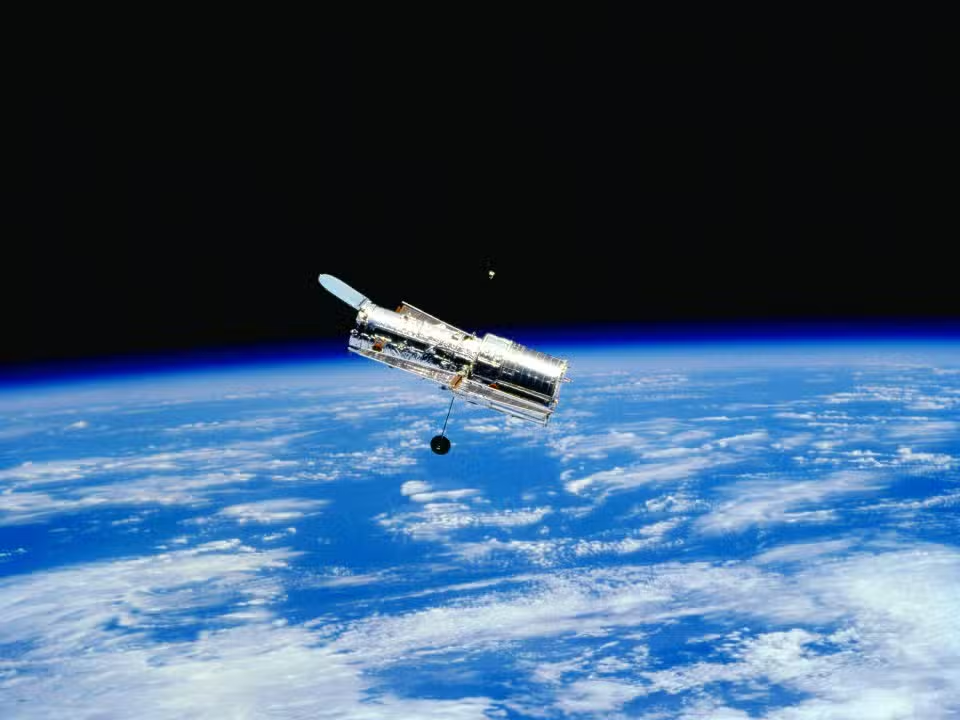
The interstellar object 3I/ATLAS, detected in July 2025 by the ATLAS system at Chile, continues to generate debate in the scientific community due to unusual features observed by telescopes such as Hubble and James Webb. Recent Dados indicate a nuclear radius of approximately 1.3 km with a margin of error of 0.2 km, assuming a typical density of 0.5 g/cm³ for cometary nuclei. Essa measurement results in an estimated nuclear mass of about 4.6 × 10¹⁵ grams. The interstellar numerical density of the population similar to the object reaches values close to 7 × 10^{-3} au^{-3}, leading to a local mass density of the order of 10^{-26} g/cm³.
Isotopic measurements carried out by instruments from James Webb and Very Large Telescope reveal anomalous abundances, such as a D/H ratio of 0.95 ± 0.06%, significantly higher than in comets from Sistema Solar. Razões ¹²C/¹³C variam entre 141-191 para CO₂ e 123-172 para CO, valores que excedem padrões típicos observados em proto-discos planetários próximos. Esses data suggest a chemical origin dating back 10 to 12 billion years, potentially associated with low metallicity stars.
Hubble measurements and inferences about the nucleus
The Hubble telescope provided images that allowed the effective radius of the nucleus to be estimated at 1.3 ± 0.2 km. Essa dimension, combined with assumed density, generates substantial mass for an interstellar object. The parental population inferred from numerical density implies continuous production of objects with a composition rich in heavy elements.
Observations indicate that the coma and jets contribute to the total detected reflectivity. The observed structure includes collimated jets that extend over considerable distances, influenced by interaction with the solar wind.
Voltage with heavy element reservoir
Low metallicity stars have a reduced metallic fraction, around 2 × 10^{-3} times the solar value. Considerando that only about 10% of local stars fall into this category and the galactic stellar density closes to 0.04 M⊙ pc^{-3}, the density of heavy elements reaches approximately 5.4 × 10^{-28} g/cm³.
This value turns out to be lower by more than an order of magnitude than the mass density necessary to sustain the observed interstellar population of type 3I/ATLAS. Discos of debris around these stars typically contains ten times less mass than the host star, worsening the discrepancy.
Factors that widen the discrepancy
Models of galactic chemical evolution indicate that the production of heavy elements in ancient populations occurs over extended time scales. However, the mass spectrum in planetary disks requires ejection of material in quantities much higher than expected to reconcile the numbers.
Factors such as ejection efficiency and mass distribution in interstellar objects need to be adjusted by at least three orders of magnitude to make the data compatible. Essa inconsistency suggests that direct association with low-metallicity stars may not be sustainable.



Alternative hypotheses considered
The origin in debris disks of more metallic stars or different production mechanisms are evaluated to explain the observed abundance. Superestimação of the nuclear radius or the numerical density of the population also appears as a possibility to resolve the tension.
Isotopic data reinforces the antiquity of the material, but requires revision in the available reservoir calculations. Observações continuous use of ground-based and space-based telescopes seeks to refine these parameters.
Recent additional observations
New analyzes indicate a composition rich in methanol and other volatiles in the object’s coma. The non-gravitational acceleration detected during perihelion, in October 2025, results from the ejection of material, consistent with cometary behavior, but with an intensity that requires a massive nucleus.
The object reached its closest point to Terra in December 2025, allowing detailed observations. Buscas by artificial emissions, carried out by projects such as Breakthrough Listen, did not detect radio signals located on the object.
Isotopic composition and implications
The high isotopic ratios of carbon and nitrogen point to processing in low-metallicity environments over billions of years. Enriquecimento in deuterium reinforces the distinction in relation to local comets from Sistema Solar.
These findings combined with the mass balance create challenges for current models of the formation and ejection of interstellar objects. Additional Estudos aim to clarify whether adjustments to densities or alternative origins resolve the discrepancy.
The 3I/ATLAS object continues its trajectory away from Sistema Solar, approaching Júpiter in March 2026 before definitively moving away.
Veja Tambem em News (EN)

Research reveals that parents are unaware of how their children use artificial intelligence

Samsung releases new system update with new features for Galaxy Watch 4 users

Digital retail reduces the value of the Galaxy S25 5G smartphone with bank bonuses and device exchange

Amazon’s wireless CarPlay adapter has a 50% discount and high approval ratings from drivers

Zach Cregger’s new Resident Evil ignores games and focuses on an unprecedented story with new characters

Rumor suggests that Nintendo is preparing a special edition of the Switch 2 with a remake of Ocarina of Time

Apple accelerates production of the iPhone 17e and develops new Air model with dual camera system

Epic Games platform releases twelve high-budget games at no permanent cost for PC users

PlayStation 5 Pro price drop accelerates digital retail sales and eliminates global stocks

New Galaxy Watch 9 firmware appears on server and confirms progress in software development

Apple’s commemorative project tests cell phone with 1.1 millimeter edge and curved screen for 2027