
In-depth analysis of comet 3I/ATLAS indicates an age close to the formation of the universe

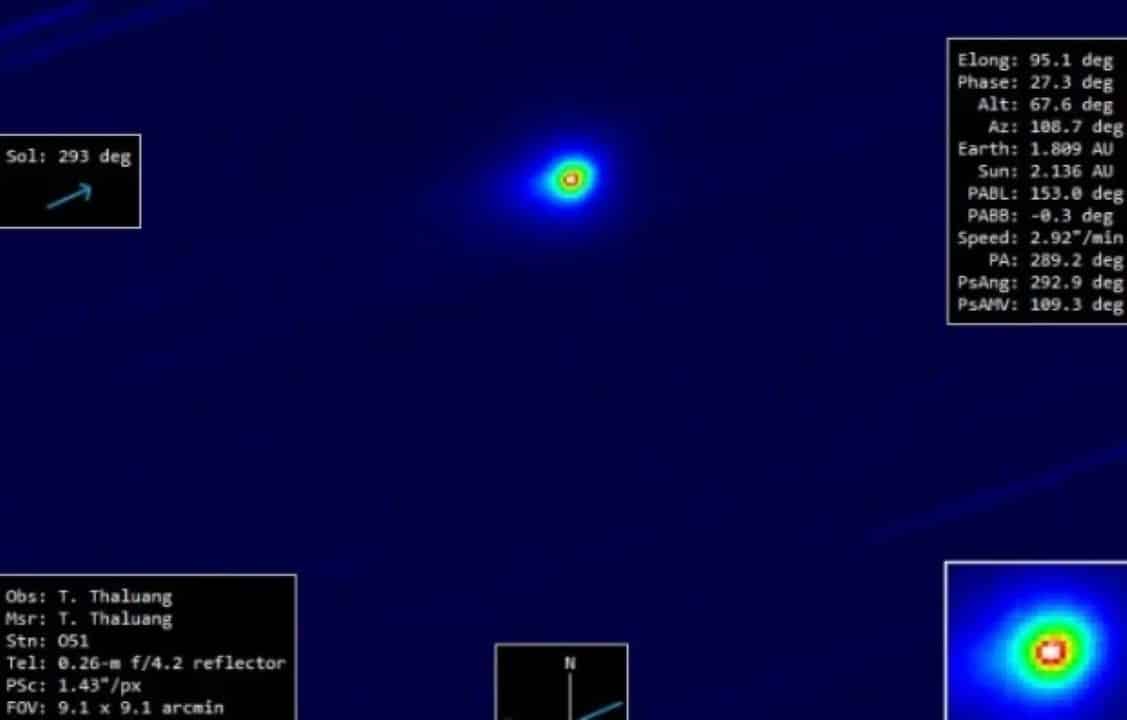
A cosmic visitor who recently crossed Sistema Solar is being studied intensely by astronomers around the world, proving to be a true relic of galactic formation. Novas Scientific analyzes suggest that the interstellar comet 3I/ATLAS may be between 10 and 12 billion years old, an estimate that would position it as one of the oldest objects ever observed in the vicinity of Terra. Este remote period would place it in an era when Via Láctea was still in its early stages of development, shortly after the birth of Universo, which occurred approximately 13.8 billion years ago.
To put this discovery into context, our planet, Terra, is estimated to be around 4.5 billion years old, and Sistema Solar was formed approximately 4.6 billion years ago. Assim, if projections are correct, comet 3I/ATLAS would be more than twice Earth’s age, offering an unprecedented glimpse into conditions prevailing in the early universe.
Detailed information about this remarkable age was revealed in a comprehensive study published March 6 on the preprint server Research Square. Este server is a crucial platform that hosts scientific research before it goes through the rigorous peer review process in academic journals, allowing the scientific community to quickly access new discoveries.
A mysterious interstellar visitor
Comet 3I/ATLAS was initially identified in 2025, a milestone for astronomy that occurred when researchers observed an object crossing Sistema Solar with an extraordinarily high speed and a trajectory that differed markedly from the pattern of local comets. Esses two factors, the speed and the unusual route, were decisive for scientists to conclude that the celestial body could not have originated in the vicinity of Sol, signaling its origin from a more distant region.
This type of celestial body, which travels from outside our star system, is categorized as an interstellar object. Sua observation is extremely rare; To date, only a few objects of this classification have been detected and monitored as they pass through our galactic neighborhood. The passage of 3I/ATLAS, therefore, represents a unique opportunity to study the composition and formation of celestial bodies in other systems.
Investigation of cosmic composition
Soon after its discovery, comet 3I/ATLAS generated a wave of speculation and discussion, especially on social media, where theories that it could be an alien spacecraft gained some space. However, the scientific community and astronomers quickly dismissed this hypothesis, considering it highly unlikely and not based on hard evidence. Para them, all the evidence collected so far pointed clearly and unequivocally to the nature of a comet that originated in another distant star system.
Subsequent observations, carried out with Telescópio Espacial Hubble precision, provided additional data that solidified this interpretation. Hubble was able to estimate the diameter of comet 3I/ATLAS, placing it between 440 meters and 5.6 kilometers, a considerable size for an object of this nature. Ele entered Sistema Solar at an impressive speed of approximately 221 thousand kilometers per hour, performed a transient orbit around Sol, and then continued its journey into the vast and unexplored interstellar space, gradually disappearing from our closest observation capabilities.
The relevance of Telescópio Espacial James Webb
The crucial information that allowed us to uncover the surprising age of comet 3I/ATLAS was obtained through detailed observations made by the advanced Telescópio Espacial James Webb. Este powerful space observatory focused on the comet on December 22, 2025, a few days after the object made its closest approach to Terra, passing at a distance of about 270 million kilometers from our planet. James Webb’s infrared capability was critical in capturing the faint chemical signals emitted by the comet.
To unravel the origin and past of the comet, scientists focused their analyzes on the gases that were released by it. Esse phenomenon occurs when a comet approaches a star; the ice that makes it up begins to heat up and evaporate, a process that releases a vast amount of material into space, forming its characteristic tail. It is in this gaseous material that the chemical clues about its formation are found.
Within this released gas are isotopes, which are slightly different variations of the same chemical element, having a different number of neutrons. Estes isotopes act as a kind of “chemical fingerprint,” providing scientists with valuable information that helps determine both the location and specific conditions under which a celestial object formed, revealing details about its original environment.
Evidence of primordial age
In the specific case of comet 3I/ATLAS, the results of the isotope analysis were truly surprising and revealing. Investigations have shown that the water present in the comet has a significantly higher concentration of deuterium, a heavier form of hydrogen, compared to the water found in comets that formed within the confines of our own Sistema Solar. Esta notable difference already indicated a distinct origin and a peculiar training environment.
Furthermore, the proportion of carbon isotopes detected in 3I/ATLAS was also different from those commonly observed in objects that developed in the vicinity of Sol. Essas anomalous isotopic characteristics for both hydrogen and carbon provide strong evidence that the comet likely originated in an extremely cold environment. Temperatures at this formation site were estimated to be around 30 kelvins, which corresponds to approximately -243 °C, unthinkable conditions for the formation of objects in the current Sistema Solar.
Cradle in a protoplanetary disk
Researchers speculate that 3I/ATLAS may have formed in a protoplanetary disk, which consists of a vast cloud of gas and dust orbiting a young star. It is in these discs that the processes of agglomeration and growth begin that, over millions of years, give rise to planets, comets and other celestial bodies. The presence of such extreme cold conditions suggests that this formation environment dates to a much earlier period.
This type of environment, characterized by such low temperatures and specific chemical compositions, may have been a common scenario in the first stellar systems that formed in Via Láctea, at a time that long precedes the formation of our own Sistema Solar. If the 3I/ATLAS age estimate is correct, this comet becomes a precious archive, preserving crucial clues and information about what these ancient environments were like and the conditions of the universe in its early days.
The presence of certain complex molecules detected on the comet also raises a fascinating hypothesis: complex chemical processes, which are potentially linked to the fundamental ingredients of life, could already be actively occurring in these star systems very early in the galaxy’s history. The Esta revelation, highlighted by publications such as Live Science, suggests that the building blocks of life may have been spread across the universe on much older timescales than previously thought.
The race to trace the origin
Even with all the valuable clues that have been collected, figuring out precisely which star system comet 3I/ATLAS originated from will likely remain an impossible task for scientists. Over the billions of years of its existence, wandering through the immense interstellar space, the comet’s trajectory must have changed countless times. Diversas gravitational forces, exerted by stars, dense gas clouds and a multitude of other celestial objects, would have influenced and modified its original course.
This intricate tapestry of gravitational interactions over time makes it extremely difficult, if not unfeasible, to reconstruct the exact path the comet took on its cosmic journey. The complexity of its path until the moment it crossed our Sistema Solar is a testament to the vastness and dynamics of the universe, leaving astronomers with a fascinating enigma about the primordial homeland of this cosmic relic. Comet 3I/ATLAS continues to be an object of intense study, promising further revelations about star and planetary formation in distant eras.



