
Interstellar comet 3I/ATLAS stands out for high release of methanol detected by the ALMA radio telescope

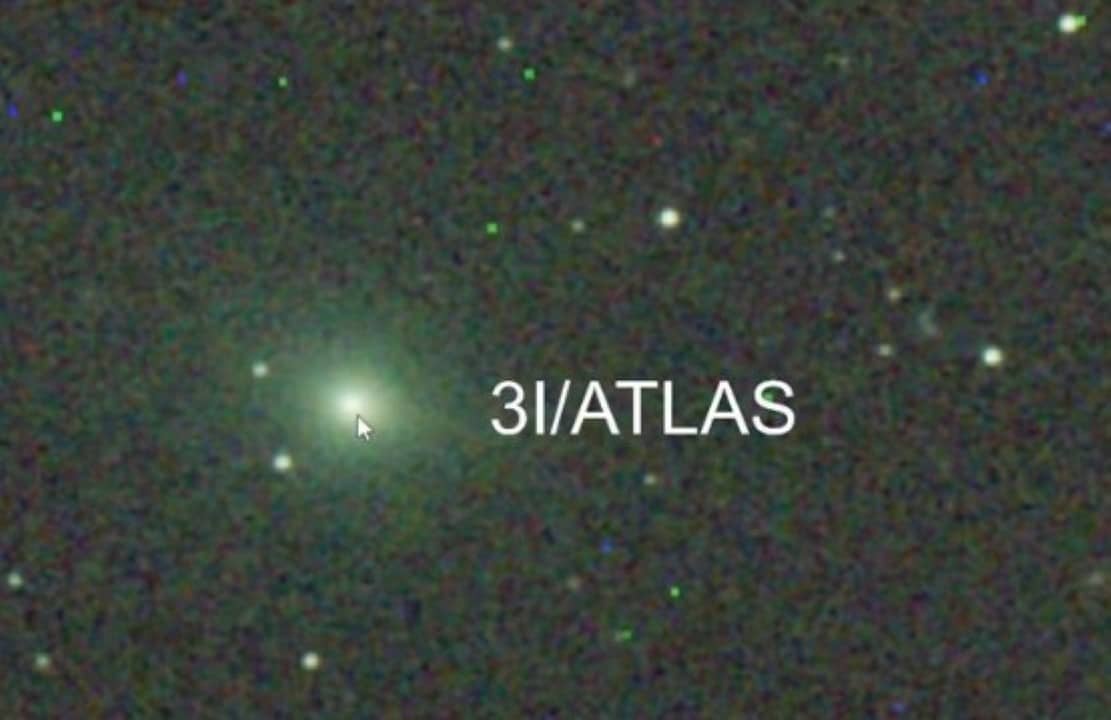
Astronomers detected high amounts of methanol in the interstellar comet 3I/ATLAS through observations carried out with the ALMA radio telescope, at Chile. The team led by Nathan Roth, from American University, analyzed the object’s coma during its approach to Sol between August and October 2025. The results indicate that methanol predominates in proportions much higher than those observed in comets of Essa discovery was published in the journal The Astrophysical Journal Letters and highlights significant chemical differences compared to objects native to our planetary system.
3I/ATLAS was identified in July 2025 as the third confirmed interstellar object, after 1I/’Oumuamua and 2I/Borisov. Telescópios as well as Hubble, Subaru, and James Webb also contributed to his initial study. The measurements focused on methanol (CH₃OH) and hydrogen cyanide (HCN), common molecules in comets. ALMA’s high resolution made it possible to map the origin of gaseous emissions in the coma.
Exceptional chemical proportions
Observations recorded methanol/HCN ratios of approximately 124 on September 12 and 79 on September 15, 2025. In Sistema Solar comets, the average is around 26 times. The value found places 3I/ATLAS among the richest in methanol ever recorded, surpassed only by C/2016 R2 (Pan-STARRS).
This composition suggests that the object was formed under environmental conditions different from those of our system. Observações previews of James Webb indicated a carbon dioxide-rich coma when the comet was furthest from Sol. The abundant presence of methanol reinforces the idea of different origins or unique chemical evolution.
Differentiated gas release mechanisms
ALMA revealed distinct patterns of molecular ejection. Hydrogen cyanide is released mainly from the nucleus, similar to what occurs in solar comets. Já methanol arises both from the nucleus and from ice particles in the coma.
These particles heat up as the sun approaches and act like mini-comets, releasing additional methanol. Trata is the first detailed observation of this process in an interstellar object. The instrument’s high spatial resolution captured these differences accurately.
Origin in another star system
The chemical composition offers clues about the formation in extrasolar planetary systems. Nathan Roth compared the observations to a fingerprint of another star system. Excess methanol indicates formation environments with greater abundance of this organic molecule.
Studies of interstellar objects make it possible to compare planetary formation processes beyond Sistema Solar. 3I/ATLAS, by bringing material from another star, expands the understanding of chemical diversity in distant regions of the galaxy.
Observational details and context
Measurements took place at heliocentric distances between 2.6 and 1.7 astronomical units. Methanol production increased progressively as it approached Sol. The object is already moving away from Sistema Solar after its perihelion passage.
- Methanol/HCN ratio varied between 70 and 120 on the main dates.
- Methanol released from ice-cold grains in the coma like mini-fountains.
- Predominantly core hydrogen cyanide.
- Composition suggests formation in a zone rich in organic compounds.
Implications for future studies
The detection reinforces the value of telescopes like ALMA for fine molecular analysis. Observações complementary instruments continue to reveal aspects of the object. 3I/ATLAS contributes to mapping chemical variations between stellar systems.



