
Moon phases in March 2026: check the detailed lunar calendar with dates and times
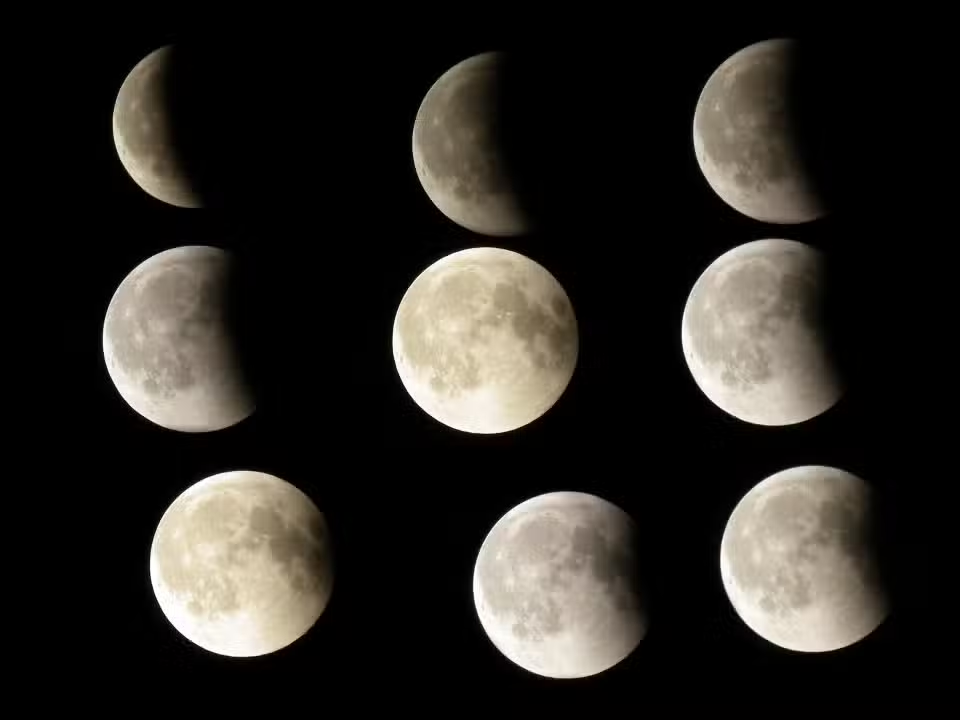
The month of March 2026 promises a continuous celestial spectacle for observers across the Brasil, with the lunar calendar featuring four distinct phase changes. Este astronomical period begins with the prominent Lua Cheia and passes through all its stages until completing the cycle at the end of the month. The movement of the natural satellite of Terra always generates great interest, whether due to its nocturnal beauty or its proven influence on natural phenomena.
Observing lunar phases is an ancestral practice, used to guide various activities, from agriculture to maritime navigation. Compreender the cycle allows you not only to enjoy the sky, but also to better understand the events that occur on our planet due to gravitational interaction. Para March 2026, the dates and times have already been defined, providing a clear roadmap for those who wish to follow each stage.
This detailed calendar is an essential tool for amateur astronomers, fishermen, farmers, and anyone curious about the mysteries of the cosmos. The information is crucial for planning activities that benefit from or are impacted by the different lighting and positions of the moon in relation to Terra and Sol, ensuring that no one misses the most important moments of the monthly lunar cycle.
March Lunar Calendar Details
The lunar calendar for March 2026 begins at the beginning of the month, setting the tone for the following weeks with a phase of high visibility. The first change occurs quickly, following a pattern that unfolds over the days, culminating in the renewal of the lunar cycle. It is a dynamic period for our natural satellite.
Check the exact dates and times of the moon phases in March 2026, based on the time of Brasília, so that the observation schedule or activities influenced by the tides can be done accurately:
- 03/03 at 08:39 am:Lua Cheia
- 03/11 at 6:41 am:Lua Quarto Minguante
- 03/18 at 10:26 pm:Lua Nova
- 03/25 at 4:19 pm:Lua Quarto Crescente
Understanding the lunar cycle and its stages
The lunar cycle, also known as the lunar month or synodic month, is the complete period in which Lua goes through its four main phases, taking, on average, around 29.5 days to complete. Este cycle begins with Lua Nova, when the satellite is aligned between Terra and Sol, advancing to of transformations that have fascinated humanity for millennia. Cada transition is an important milestone in the orbit of Lua around Terra, directly influencing our visual perception of the celestial body and natural phenomena.
New Moon Invisibility and Tides
During the Lua Nova phase, the lunar disk becomes practically invisible to the naked eye for terrestrial observers. Isso occurs because Lua is positioned between Terra and Sol, and the side facing our planet does not receive direct sunlight. Embora Although it is not possible to see it in the night sky, its presence is felt through other phenomena.
At this stage of alignment between Sol, Lua and Terra, the combined gravitational force of the two celestial bodies reaches its peak. Essa intense gravitational attraction is responsible for so-called spring tides, which result in higher high tides and lower low tides than usual. Essa gravitational influence is a clear example of the physical connection between Lua and the oceans of Terra.
The Lua Nova period, despite its visual discreetness, marks the beginning of a new cycle and has a significant impact on coastal ecosystems. Understanding how this phase affects tides is fundamental for maritime activities and for marine life that adapts to these variations.
Gradual growth: from thin slice to fullness
As Lua moves away from its position of Lua Nova, a thin slice of light begins to appear in the night sky, marking the beginning of the Crescente phase. As the days go by, this illuminated portion progressively increases, gradually taking on a more prominent shape and becoming more visible. Este continuous growth is what gives this phase its name, as the celestial body moves towards its total illumination.
In the Quarto Crescente phase, the Lua and the Sol are at right angles to the Terra. Essa specific configuration results in a decrease in the combined gravitational force on the oceans, leading to milder tides known as neap tides. High tides are less high and low tides are less pronounced during this period, contrasting with the spring tides observed in Lua Nova and Lua Cheia.



The full illumination of the full moon and its effects
The Lua Cheia phase is, without a doubt, the most stunning and easily recognizable phase of the lunar cycle. Nesse period, Lua is directly opposite to Sol in relation to Terra, causing its entire face facing us to be fully illuminated by sunlight. The result is a complete, bright lunar disk that dominates the night sky, providing spectacular natural lighting.
This direct alignment between Terra, Lua and Sol causes the combined gravitational pull on the oceans to be amplified again. Assim like Lua Nova, Lua Cheia also causes spring tides, characterized by high tides of greater amplitude and low tides of lower level. Essa tidal intensification influences various human and natural activities around the globe.
The decline and return to the beginning of the waning cycle
After the splendor of Lua Cheia, the natural satellite begins its process of diminution, entering the Minguante phase. Este period is the inverse of Crescente, where the visible illuminated portion of Lua begins to shrink day by day. Lua Minguante gradually loses its full shape, becoming an increasingly thin slice of the sky.
As Lua continues its orbit, it progressively positions itself back between Terra and Sol, signaling its return to the initial stage of Lua Nova. Esse movement back into alignment is an essential part of completing the lunar cycle, setting the stage for a new beginning.
The visibility of Lua decreases steadily during the Minguante phase, until its illuminated part becomes almost imperceptible. Este stage is a reminder of the cyclical and transitory nature of the celestial phenomena we observe.
Just as in the Quarto Crescente phase, during the Quarto Minguante period, the Lua and the Sol form a right angle with the Terra. Essa configuration results in neap tides, which are less intense. Tidal fluctuations are more moderate, offering a transition period between the more extreme tides.
Influence of lunar phases on Earth tides
The relationship between the lunar cycle and the movement of the tides is a scientifically proven phenomenon, a direct result of the gravitational influence that the natural satellite exerts on Terra. The gravitational attraction of Lua, combined with that of Sol, is the main factor that causes the formation of elevations and depressions in the oceans, creating the ebb and flow of tides.
Observing the moon: tips for enjoying the cycle
For those who want to observe the phases of Lua in March 2026, some tips can enrich the experience. Lua Cheia is the easiest to identify and provides the brightest spectacle, ideal for those starting night observation. Já the phases of Quarto Crescente and
Lua Nova, although invisible, is the perfect time to observe other celestial objects, as the absence of lunar light minimizes natural light pollution. A good pair of binoculars or a basic telescope can reveal even more details of lunar landscapes, adding an extra dimension to the appreciation of this constant companion of Terra. Programar observation based on the lunar calendar ensures that no important moments are missed.
Veja Tambem em News (EN)

Research reveals that parents are unaware of how their children use artificial intelligence

Samsung releases new system update with new features for Galaxy Watch 4 users

Digital retail reduces the value of the Galaxy S25 5G smartphone with bank bonuses and device exchange

Amazon’s wireless CarPlay adapter has a 50% discount and high approval ratings from drivers

Zach Cregger’s new Resident Evil ignores games and focuses on an unprecedented story with new characters

Rumor suggests that Nintendo is preparing a special edition of the Switch 2 with a remake of Ocarina of Time

Apple accelerates production of the iPhone 17e and develops new Air model with dual camera system

Epic Games platform releases twelve high-budget games at no permanent cost for PC users

PlayStation 5 Pro price drop accelerates digital retail sales and eliminates global stocks

New Galaxy Watch 9 firmware appears on server and confirms progress in software development

Apple’s commemorative project tests cell phone with 1.1 millimeter edge and curved screen for 2027
