Namibia boosts rail transport with green hydrogen hybrid freight locomotive
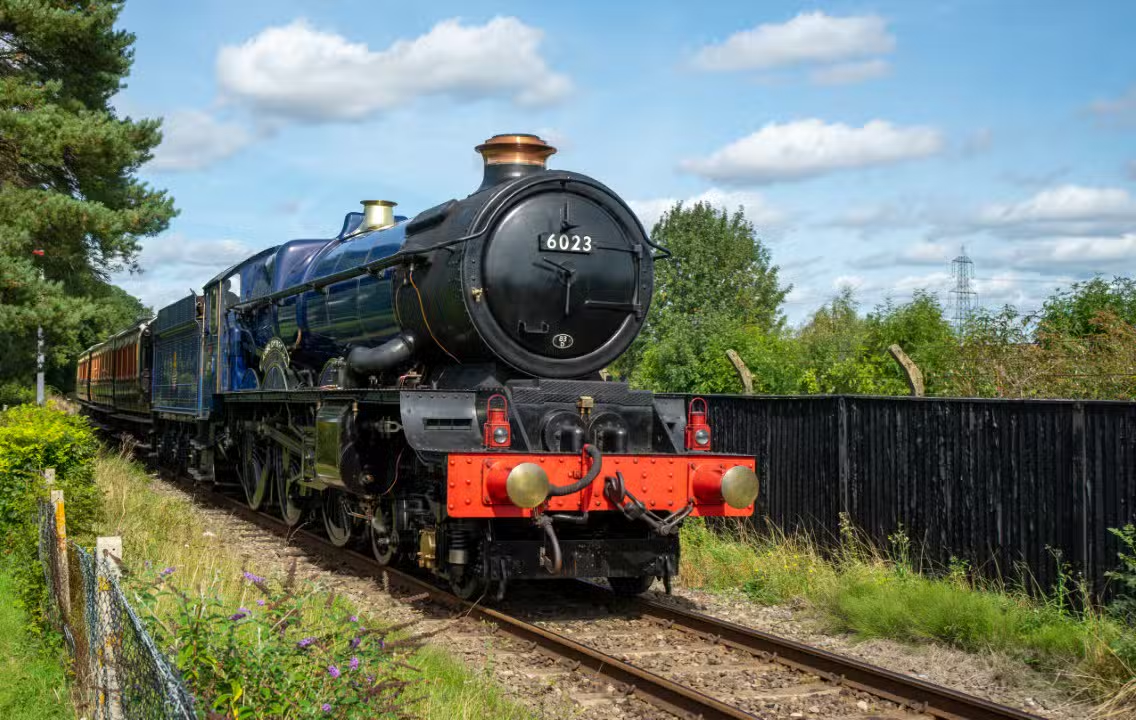
Namíbia makes significant progress in its sustainability and innovation strategy in the cargo transportation sector. The country is committed to developing and implementing an environmentally friendly, hydrogen-powered locomotive that promises to transform national railway logistics. Este pioneering project demonstrates a firm commitment to clean and efficient energy solutions in a context of growing demand for sustainable alternatives.
The initiative aims not only to modernize existing infrastructure, but also to establish a replicable model for the energy transition in heavy transport. The new locomotive, currently in the assembly process at the Traxtion facilities, at África of Sul, represents an important milestone for the region. The project is expected to boost the local economy and strengthen transport corridors in an environmentally responsible manner.
Strategic partnerships are the fundamental pillar of this ambitious undertaking. Três major companies — TransNamib Holdings Limited, Africa Global Logistics (AGL) and CMB.TECH Namibia — have joined forces to make this visionary project a reality. The collaboration of these entities ensures the necessary expertise in engineering, logistics and hydrogen technology, guaranteeing the viability and success of the initiative.
Reinforcement of railway infrastructure
TransNamib, railway operator of Namíbia, plays a crucial role in managing the national network and freight transport services. The company has been actively seeking opportunities to modernize its fleet, including converting existing locomotives to innovative dual-fuel systems such as hydrogen. The large number of decommissioned locomotives in the country offers fertile ground for retrofitting with this advanced technology.
This modernization strategy will not only reduce carbon emissions, but also offer a cost-effective and future-proof alternative for the sector. The use of green hydrogen aligns with global decarbonization objectives and reinforces the energy autonomy of Namíbia. The ability to convert existing locomotives minimizes the need for investment in new fleets, optimizing resources and accelerating the adoption of new technology efficiently.
Logistics operation with green hydrogen
Africa Global Logistics (AGL) is a logistics provider established in Namíbia, fundamental to the country’s freight, transport and logistics sectors. The company manages vital operations such as the multi-purpose bulk terminal in Walvis Bay, and has a vast integrated logistics network that spans more than 50 countries in África, connecting ports, corridors and multimodal supply chains with consolidated expertise.
The partners will begin Namíbia’s first heavy-duty transport service using autonomously produced green hydrogen. Durante the initial testing phase, 50 round trips are planned between the port of Walvis Bay and the container terminal near Windhoek. Esta phase will allow a detailed assessment of the performance and viability of the operation before a possible expansion, consolidating a green logistics corridor in the country.
The green hydrogen required for the project will be generated off-grid at the CMB.TECH Namibia plant, located in Walvis Bay. Este arrangement perfectly illustrates the integration of green hydrogen production into a pre-existing logistics corridor, demonstrating a sustainable and self-sufficient model. The local production strategy guarantees a more robust energy supply chain that is less dependent on imported fossil fuels.
Dual-fuel engines: innovation and adaptability
The locomotive is equipped with an advanced BeHydro dual-fuel hydrogen combustion engine. Esta joint venture between CMB.TECH and Anglo Belgian Corporation specializes in the commercialization of hydrogen engines for various applications, including the maritime, railway and power generation sectors. BeHydro engines are designed for both dual-fuel configurations and 100% hydrogen operation, and are particularly suitable for traction on non-electrified railway lines, where full electrification may be unfeasible.
The locomotive’s 2,250 hp engine can operate flexibly on both conventional diesel and green hydrogen, offering crucial versatility for operations. The hydrogen is stored in a special tender positioned behind the locomotive, which contains two 6-meter storage units, each capable of holding up to 360 kg of compressed hydrogen. Essa significant capacity allows for long periods of operation without the need for frequent refueling, a vital aspect for transporting cargo on extensive and challenging routes.
Maintaining operational reliability
The modularity of the storage system is one of the strengths of the project, as the tender can be refueled directly with the CMB.TECH mobile unit or its containers can be completely replaced in a few minutes, minimizing operational downtime. Essa agility is essential to maintain the efficiency of transporting heavy loads. Ensuring that the locomotive remains fully functional is crucial: in the event of an unexpected failure in the hydrogen system, it automatically switches to conventional diesel fuel. Essa functionality ensures maximum reliability and gives operators the security needed to integrate hydrogen into their operations without interrupting service continuity, a decisive factor for large-scale adoption.



The challenging scenario of the Walvis Bay-Windhoek route
The freight rail corridor connecting Walvis Bay to Windhoek was carefully selected as the ideal setting to test the potential of hydrogen in heavy rail transport. Esta specific route provides a rigorous testing environment for the technology.
The route extends for 414 kilometers, crossing varied landscapes, from the Atlantic coast to the highlands of the interior of the Namíbia. Sua extension and geographic characteristics are crucial for validating the system in real conditions.
The elevation profile of the route is particularly challenging, with the locomotive rising from just 6 meters above sea level in Walvis Bay to reaching 1,601 meters in the vicinity of Windhoek. Essa variation imposes a significant test on tensile capacity.
This scenario provides a rigorous, real-world test of traction performance, fuel replacement efficiency, and overall system robustness under continuous load. The data collected will be invaluable in improving the technology.
Contributions to regional sustainability
Converting a working locomotive, rather than building one from scratch, serves as a powerful demonstration of how hydrogen can be integrated into freight transport without the need for new cars or drastic changes to existing rail infrastructure. Essa pragmatic approach offers an efficient model to evaluate the applicability of hydrogen in long-distance rail transport, proving that the transition to cleaner energy can be done gradually and intelligently.
Chave Benefits of Projeto:
Reflections on the global energy transition
This project not only highlights Namíbia’s capacity for innovation, but also sets an important precedent for África and the world, demonstrating that the transition to a low-carbon future is fully viable. The experience and data collected along the way will be invaluable in refining and scaling hydrogen technology in the heavy transport sector, informing future decisions and investments on a global scale.
The advancement in the use of hydrogen as an energy source for rail transport in Namíbia demonstrates a promising path towards the decarbonization of critical sectors. The partnership between TransNamib, AGL and CMB.TECH Namibia not only optimizes the use of resources, but also consolidates a vision of the future where the economy and ecology go hand in hand. The success of this venture could inspire a wave of similar innovations across the African continent, driving the adoption of cleaner and more efficient energy solutions on a large scale.
Veja Tambem em News (EN)

Research reveals that parents are unaware of how their children use artificial intelligence

Samsung releases new system update with new features for Galaxy Watch 4 users

Digital retail reduces the value of the Galaxy S25 5G smartphone with bank bonuses and device exchange
Amazon’s wireless CarPlay adapter has a 50% discount and high approval ratings from drivers

Zach Cregger’s new Resident Evil ignores games and focuses on an unprecedented story with new characters

Rumor suggests that Nintendo is preparing a special edition of the Switch 2 with a remake of Ocarina of Time

Apple accelerates production of the iPhone 17e and develops new Air model with dual camera system

Epic Games platform releases twelve high-budget games at no permanent cost for PC users

PlayStation 5 Pro price drop accelerates digital retail sales and eliminates global stocks

New Galaxy Watch 9 firmware appears on server and confirms progress in software development

Apple’s commemorative project tests cell phone with 1.1 millimeter edge and curved screen for 2027