
NASA: Newly identified bus asteroid approaches Earth on safe path after detection

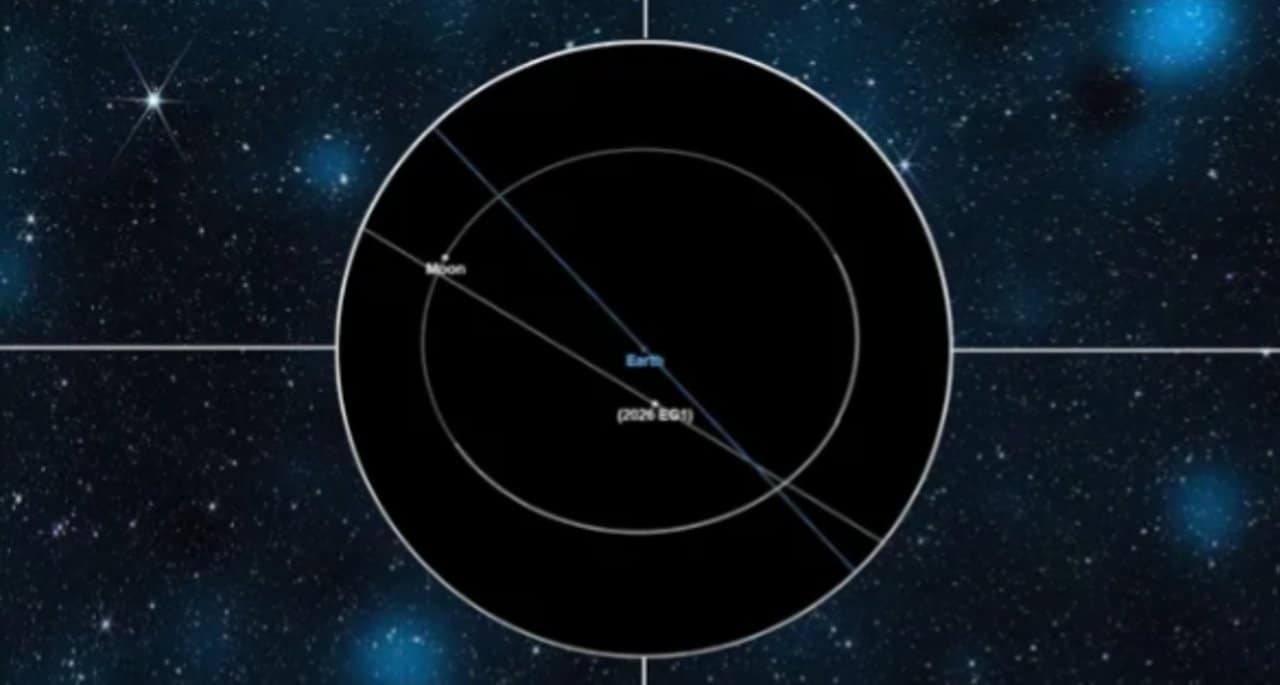
A recently discovered celestial body with dimensions comparable to a bus made a remarkable passage in the vicinity of Terra in mid-March, a few days after its identification by scientists. The event did not pose an imminent risk to our planet or to Lua, as monitored by astronomers from different parts of the globe. Continuous surveillance of the object’s trajectory reaffirms the importance of global efforts to map and understand movements in space close to Terra, ensuring the security and accuracy of information disseminated to the global community about these celestial bodies that cross our solar system. Agile detection and accurate tracking are the fruits of continuous investment in technology and international collaboration.
As the asteroid continued on its journey, the scientific community remained vigilant, using advanced technologies to track its every movement and confirm the absence of any threat. Este type of monitoring is essential for understanding the cosmic environment and protecting our planet against potential impacts, even the most unlikely ones.
Such events, although not rare, highlight the importance of detection and monitoring programs for objects close to Terra. Esses programs seek to categorize and map thousands of asteroids, assessing potential risks and enriching knowledge about the dynamics of our planetary system, an effort that intensifies every year.
The journey of 2026 EG1 and its discovery
Discovered on March 8, the asteroid, named 2026 EG1, quickly became the focus of attention for researchers. Sua identification in such a short time before approach demonstrates the growing capacity of astronomical observation networks to detect and catalog objects moving in orbits close to Terra, a testimony to technological advancement in the area. Speedy detection is crucial for understanding its characteristics, assessing any potential risk and communicating effectively with the public.
The orbit of 2026 EG1 is classified as elliptical, taking approximately 655 days to complete one revolution around Sol. Durante its route, the asteroid ventures from a region very close to Earth’s orbit to well beyond the trajectory of Marte, demonstrating the complexity of its path in the solar system and the vast extension of its orbital cycle, which takes it to different zones of gravitational influence.
Approach and speed details
The asteroid’s closest approach to Terra occurred at 11:27 pm EDT on March 12 (03:27 GMT on March 13), in a passage under the southern hemisphere, specifically Antártida. Neste critical moment, the celestial body was at a distance of approximately 317,791 kilometers from our planet, a measurement that puts it closer than Lua itself. Este data highlights the relevance of the event, although without presenting danger.
With an estimated diameter of between 10 and 22 meters, 2026 EG1 moved at an impressive speed of 34,621 kilometers per hour relative to Terra. Esta speed made it quickly pass us, after an already distant approach to Lua. The object’s dizzying speed highlights the intense dynamics of the space environment and the difficulty of tracking these bodies without the appropriate technology.
Despite the relative proximity, the asteroid’s trajectory was carefully calculated and monitored, confirming that there was no risk of collision with Terra or its natural satellite. Space agencies such as NASA maintain continuous monitoring systems to track these events and ensure that accurate and reassuring information is disseminated to the global public, preventing speculation and unnecessary panic.
Space threats and the surveillance network
Currently, more than 41,000 near-Terra asteroids (NEAs) are tracked by NASA and its international partners, a number that is continually increasing as new discoveries are made. Este colossal record reflects the complexity of the space around our planet and the continuous need to observe and catalog every object that may eventually cross our orbit, forming a dynamic catalog of potential threats and objects of study.
A constante evolução tecnológica tem contribuído significativamente para essa vigilância, permitindo que os cientistas detectem objetos cada vez menores e mais distantes. O Observatório Vera Rubin, por exemplo, já identificou 2.000 corpos celestes até então desconhecidos com seu conjunto de dados inicial, demonstrando a crescente capacidade de detecção de novas ameaças ou objetos de interesse científico que podem oferecer insights valiosos sobre a formação do sistema solar.
Despite the vast number of objects monitored and new daily discoveries, NASA’s Centro to Estudos to Objetos Próximos to Terra (CNEOS) offers reassuring predictions. The space agency estimates, based on complex models and detailed observations, that no large asteroid impact, capable of causing serious damage, will occur on our planet in the next 100 years, providing a considerable safety margin for humanity.
This ongoing assessment, however, does not mean complacency. Research and development of new planetary defense strategies are ongoing priorities for the global scientific community. The objective is to ensure that humanity is prepared for future scenarios, even the most unlikely, by investing in science and technology to mitigate any potential risks that may arise in the distant future.
Planetary defense strategies
Faced with the possibility, even if remote and predicted for a very distant future, of an asteroid impact, NASA and its international partners are dedicated to developing several ways to protect Terra. Essas strategies range from running complex simulations to improve communication and responsiveness on a global level, to executing innovative asteroid redirection missions. The main objective is to ensure that, if necessary, there are effective protocols and technologies to divert an object on a collision course before it poses a threat.
A notable example of these efforts is the successful DART mission (Double Asteroid Redirection Test), which demonstrated, in September 2022, the ability to alter the trajectory of an asteroid through kinetic impact. Although DART’s target asteroid, Dimorphos, did not pose a threat to Terra, the mission validated a crucial concept for planetary defense, proving that it is technically feasible to intervene in the path of celestial bodies and offering a concrete plan for protecting the planet.
The future of astronomical surveillance
The observation and study of asteroids and other celestial bodies continues to be a vibrant and essential field of research for understanding the universe. With the advancement of telescope technologies, including new generation ground- and space-based ones, and data analysis systems driven by artificial intelligence, the ability to detect, catalog and predict the trajectories of objects close to Terra will only increase exponentially. Essa constant evolution not only strengthens planetary defense capabilities, allowing for greater response time, but also offers valuable insights into the formation and evolution of our solar system, from its beginnings to its current complexity. Cada new discovery, like asteroid 2026 EG1, contributes to a deeper understanding of the cosmos and our place in it, driving curiosity and scientific innovation for the next generations of space explorers and astronomers.
Importance of international collaboration
Asteroid detection and monitoring are efforts that transcend national borders, requiring robust and ongoing international collaboration between space agencies and research institutions. Observatórios from around the world share data and knowledge in real time, creating a global surveillance network that is far more effective than the sum of its individual parts. Essa The union of resources and expertise allows for more comprehensive tracking of potential threats and the rapid dissemination of crucial information to the scientific community and the public, ensuring a coordinated response.
Cooperation on ambitious projects such as Observatório Vera Rubin, which will map billions of celestial objects, and Rede Internacional of Alerta of Asteroides (IAWN) exemplifies this collaborative approach. By combining efforts, scientists and engineers from different countries can maximize the ability to identify and assess celestial objects, ensuring a coordinated and informed response to any eventuality, strengthening the planet’s security.
Tracking other celestial bodies
Historically, several other celestial bodies have caught the attention of the scientific community and the public, providing moments of great interest and learning about our solar system and beyond.
These examples underscore the ongoing importance of observing and understanding the cosmic environment around us, turning every close pass into a valuable opportunity for research and scientific advancement.



