
Nintendo releases Xenoblade refund after criticism over refresh rate on Switch 2
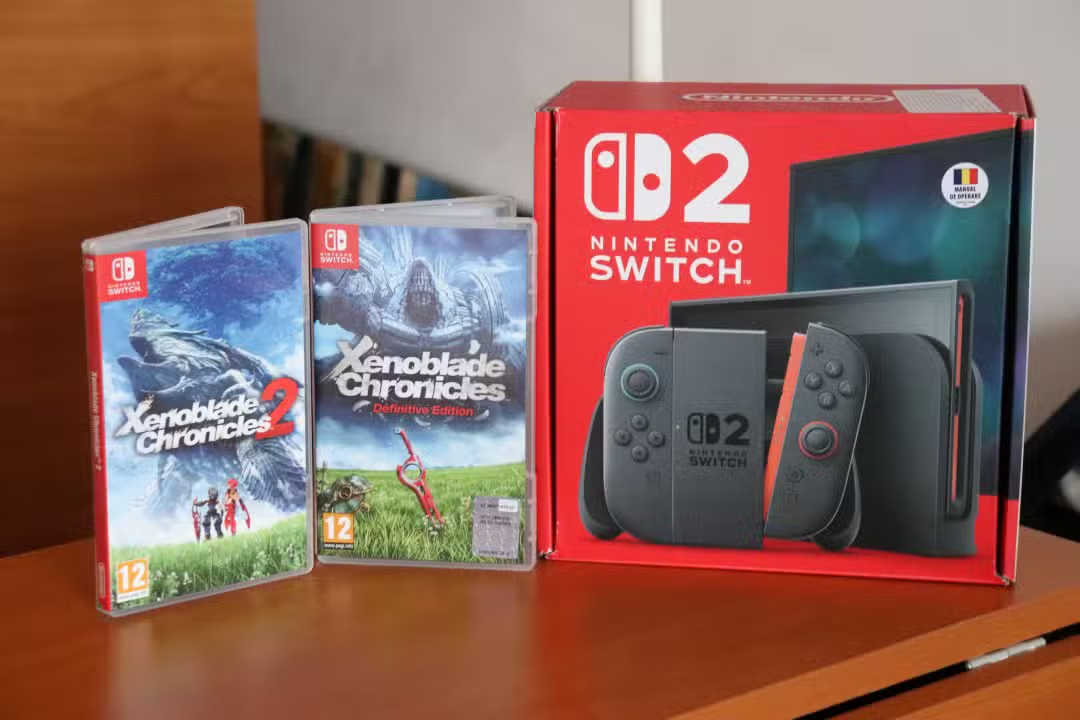
The Japanese electronics manufacturer has initiated a financial refund process for buyers of specific digital titles, in response to public dissatisfaction with the new monetization policy for its upcoming hardware. The measure comes after confirmation that users will need to pay an additional amount to access graphical improvements in games they already have in their virtual libraries.
The center of the controversy involves the software transition system for the company’s new generation of consoles. Consumidores who purchased definitive versions of role-playing games recently discovered that performance upgrades for the new equipment will not be free, contrary to a practice that has become common in the entertainment technology sector.

To curb the volume of complaints and avoid direct financial disputes with credit card companies, the customer service department has been authorized to process immediate chargebacks. The internal guideline aims to mitigate damage to the brand’s image weeks before the official details of the new digital sales system.
Details of the new software commercial policy
The corporate strategy for the new console establishes that adapting games from the previous generation will require the payment of a fee that varies between five and ten dollars. Este amount will cover the engineering work required to unlock higher resolutions and improved frame rates in older titles.
The technical documents point out that the updates will allow games to run in 4K resolution with a fluidity of sixty frames per second. However, the requirement to pay for this optimization patch generated an immediate response from owners of large digital libraries, who expected a transition without additional costs.
The policy differs from the approach adopted by other corporations in the sector, which often offer generation updates automatically and without charge to maintain user engagement. The decision to charge for enhanced backwards compatibility reflects an attempt to maintain direct profitability on the catalog of past hits.
In addition to upgrade fees, the company plans to sell direct conversions of classic games with adjusted prices. Títulos originating from the thirty-two-bit era may reach the market with prices close to forty dollars, while smaller games will have a base price set at nineteen dollars and ninety-nine cents.
Technical issues and initial hardware performance
During the initial quality testing phases, developers encountered significant technical obstacles when applying enhancement patches to older games. Relatórios engineering team indicated that the performance mode exhibited chronic instability, resulting in abrupt resolution drops and failures to load complex textures during times of high processing demand. Esses issues forced the programming team to revise the adaptation code, delaying the certification schedule for several launch titles.
The architecture of the new equipment requires a profound restructuring of the way data is managed by the system’s memory. Software engineers are working to optimize communication between the graphics processing unit and internal storage, seeking to eliminate bottlenecks that cause visual degradation. Resolving these issues is treated as a top priority, as the justification for charging the upgrade fee is based entirely on delivering a superior, defect-free technical experience.
The specific case of the RPG franchise
The return of values was initially concentrated on buyers of the Xenoblade franchise, due to the timing of the acquisitions. Muitos users purchased full editions of the game recently, assuming the title would be next-gen ready at no extra cost, based on previous release history.



The discovery that the enhancement patch would require a new financial outlay sparked a wave of cancellation requests. Consumers argued that the lack of transparency at the time of the original purchase invalidated the online store’s standard terms of service.
The technical support team was instructed to ignore the strict no-refund policy for digital products in this particular case. Operators were given access to a quick approval system to process returns directly to the customer’s original payment method.
Market strategy and digital licensing
Digital license management has become a central point in the transition between hardware generations. The company seeks to establish a model where ownership of the base software does not automatically guarantee access to technically superior versions developed for new processors.
This separation between the original license and the technical enhancement creates a new, ongoing revenue stream. The corporation relies on the high perceived value of its intellectual properties to convince the public to repeatedly pay for incremental improvements to the same product.
Support and financial return guidelines
The procedure adopted by the customer service department establishes a strict protocol for dealing with the public relations crisis. Quando a user gets in touch requesting the reversal of a digital title affected by the new fee policy, the operator checks the date of the financial transition and the period of use of the software. Diferente of the normal flow, where refund is summarily denied after file download, the new guideline allows for complete reversal of the transaction. The amount is refunded in full, and the usage license is revoked from the servers, removing the game from the user’s console the next time they connect to the internet. Esta administrative maneuver has the main objective of avoiding the chargeback phenomenon, a situation in which the customer calls the credit card company to cancel the purchase due to commercial disagreement. A high rate of chargebacks can result in severe fines for the online store and harm the company’s risk rating with international financial institutions, which is why voluntary returns were preferred by the financial board.
Positioning in the technology sector
The public’s reaction to this pricing policy will serve as a barometer for future commercial decisions in the electronic entertainment market. Acceptance or rejection of the optimization patch billing model will dictate how other corporations approach the preservation and modernization of digital libraries in future hardware cycles.
Crisis management and communication
The absence of a prior official statement on the pricing structure for updates contributed to the escalation of dissatisfaction. The discovery of the fees occurred through information leaks from partner developers, which prevented the corporation from controlling the initial narrative about the benefits of the new system.
The communications department is now working on creating informative materials that attempt to justify the additional cost. The strategy involves demonstrating in detail the technical effort and human resources allocated to redo visual elements, seeking to convince the consumer that the fee represents a remastering service, and not a simple unlocking of hardware functions.
Veja Tambem em News (EN)

Research reveals that parents are unaware of how their children use artificial intelligence

Samsung releases new system update with new features for Galaxy Watch 4 users

Digital retail reduces the value of the Galaxy S25 5G smartphone with bank bonuses and device exchange

Amazon’s wireless CarPlay adapter has a 50% discount and high approval ratings from drivers

Zach Cregger’s new Resident Evil ignores games and focuses on an unprecedented story with new characters

Rumor suggests that Nintendo is preparing a special edition of the Switch 2 with a remake of Ocarina of Time

Apple accelerates production of the iPhone 17e and develops new Air model with dual camera system

Epic Games platform releases twelve high-budget games at no permanent cost for PC users

PlayStation 5 Pro price drop accelerates digital retail sales and eliminates global stocks

New Galaxy Watch 9 firmware appears on server and confirms progress in software development

Apple’s commemorative project tests cell phone with 1.1 millimeter edge and curved screen for 2027
