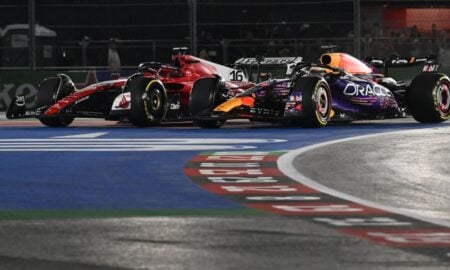
Sergio Pérez receives special authorization from the FIA to compete in the Chinese GP sprint race


Federação Internacional of Automobilismo officially confirmed the participation of Sergio Pérez in the sprint race of Grande Prêmio of The Mexican driver from the Cadillac team faced serious mechanical problems that prevented him from recording a time in the qualifying session, creating uncertainty about his presence on the starting grid. Authorization was granted based on the satisfactory times recorded by the competitor during the only free training session held on Friday morning, as established by the category’s current sporting regulations.
The scenario for the experienced Guadalajara driver became critical right at the beginning of the track activities in Chinese territory, where time logistics are limited by the sprint weekend format. Sem managed to complete the basic cycle of fast laps when defining the grid, the technical team had to formally appeal to the race officials to avoid the exclusion of car number 11 from the short race. The favorable decision is based on FIA Artigo B2.2.3b of Regulamento, which allows the inclusion of drivers who have demonstrated competitiveness in previous sessions of the same event.
- The release occurred after a detailed analysis of Pérez’s performance in the single free training session.
- The FIA regulations provide for exceptions for technical failures proven by the teams.
- Sergio Pérez will start from last position due to the lack of timed qualifying.
- The Cadillac team works against time to stabilize the engine’s power system.
Persistence of mechanical failures compromises Cadillac performance
The problem identified in Sergio Pérez’s car refers to the fuel system, a failure that seems to haunt the structure of Cadillac since the beginning of the current season. Durante free practice in Xangai, the Mexican managed to complete just 13 laps, which represents one of the smallest volumes of data collected among all competitors on the grid. Essa mileage limitation directly impacts the car’s setup for the sprint race and for the main Grande Prêmio, leaving the driver at a strategic disadvantage.
The North American team publicly admitted that the defect in the fuel pump could not be repaired in the interval between sessions, which forced the vehicle to be recalled before the start of Q1. Este type of technical mishap is particularly damaging on circuits like that of Xangai, where the asphalt and weather conditions require a precise configuration of fuel pressure and flow. The repetition of the error raises internal questions about the quality control of the components supplied for this Asian stage.
History of technical problems generates frustration in the Mexican box
Sergio Pérez did not hide his dissatisfaction with the recurring situation that has limited his opportunities to score consistently in the championship. In official statements after confirming the failure, the pilot emphasized that the fuel pump issue is an old problem that the factory has not yet managed to completely eradicate. The athlete’s frustration is visible, especially considering that Xangai is a track where he has historically displayed solid race pace and recovery ability.
Communication between the driver and the engineering team in Xangai has been focused on finding a palliative solution that would allow at least the completion of the 19 laps of the sprint race without further blackouts. The Mexican highlighted that, although the team is working exhaustively, the recurrence of the defect during Friday morning drastically reduced confidence in the equipment for wheel-to-wheel disputes. The focus now revolves around reliability, as any retirement in the sprint could also compromise the starting position for Sunday’s race.
Complexity of the fuel system in high-demand circuits
The Xangai route imposes thermal and pressure challenges that test the limits of the power systems of modern Fórmula 1 power units. The system needs to guarantee a constant flow even under intense lateral forces, something that the Mexican’s car was unable to sustain during the initial attempts at a fast lap.
Technical experts point out that persistent failures in this sector may indicate a design error in the integration of the tank with the power unit, or a software failure in pressure management. Para Saturday’s race, the team should opt for a more conservative configuration, prioritizing the completion of the race rather than the aggressive search for positions. The main objective is to collect as much data as possible to adjust the mapping towards the main classification that defines Sunday’s grid.
Analysis of comparative performance in free training of Xangai
Despite the few laps recorded, Sergio Pérez’s best mark in free practice was 1min39s200, a time that served as evidence for the FIA stewards to validate his technical ability. Essa mark, although it left the Mexican in the last position of the table, was considered safe within the 107% margin required in normal classification situations. The gap to the session leader,
Comparison with other drivers at the back of the grid, such as Arvid Lindblad from Racing Bulls, shows that Pérez was not the only one to suffer from the lack of track time on the first day in Xangai. However, Cadillac faces greater pressure as it is a team looking to establish itself in the midfield and cannot afford to lose entire sessions due to basic component problems. Analysis of telemetry data from the 13 laps completed will be the team’s sole basis for deciding the level of aerodynamic load for the remainder of the event.
Logistical and technical challenges for sprint recovery
Starting from last position in the sprint race forces Sergio Pérez to adopt a controlled attack stance, avoiding incidents that could cause structural damage to the chassis. Parc fermé regulations limit the changes that Cadillac can make to the car after qualifying begins, meaning the team needs specific technical authorization to change parts of the fuel system. Essa technical bureaucracy adds an extra layer of difficulty for mechanics, who must work under close supervision by FIA delegates.
For fans and the category itself, the presence of Pérez on the grid is essential to maintain the level of competitiveness expected from a stage in the China, which recently returned to the official calendar. The Mexican driver is known for his skill in tire management, a trait that could be crucial if the Cadillac manages to resolve the fuel pump instability before the start. The race strategy must focus on overtaking in DRS zones to minimize the damage caused by absence from official qualifying training.
Expectations for the end of the weekend in Xangai
The journey from Sergio Pérez to China now depends entirely on the responsiveness of the Cadillac factory and track team to isolate the root cause of the successive failures. The sprint race will serve as a test of fire in real competition conditions, where fuel flow is required to the maximum in vacuum situations and speed rebounds. Caso car number 11 can complete the race without any complications, the driver’s confidence can be restored for the main Grande Prêmio qualifying session.
The weekend in Xangai continues to be a test of resilience for the Mexican, as he seeks to reaffirm his prominent position on the global motorsport scene. The FIA’s decision to authorize their participation was met with relief by the Cadillac staff, but the responsibility for delivering a reliable car now falls squarely on the shoulders of the engineers. How the next few hours unfold will determine whether the frustration expressed by Pérez will turn into a story of overcoming or whether the fuel system will continue to be the team’s biggest adversary at this stage.