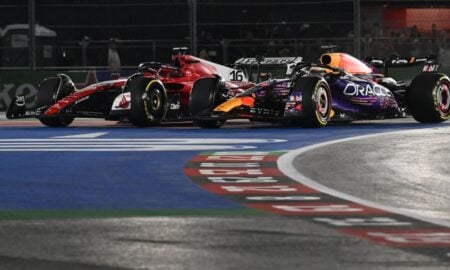
Driver Gabriel Bortoleto loses control of Audi in Q2 and starts sixteenth in the Chinese GP


Brazilian driver Gabriel Bortoleto faced difficulties during the qualifying session for Grande Prêmio of China of Fórmula 1, held in Circuito Internacional of The representative of the Audi team lost control of his single-seater during the Q2 phase, which compromised his fast lap and resulted in sixteenth position on the starting grid for Sunday’s main race.
The failure occurred in the decisive moments of the second stage of qualification, when the competitor was trying to extract the limit of the equipment to escape the elimination zone. The aggressive driving culminated in him leaving the track at high speed, forcing the premature end of his participation in the official activity.
The weekend scenario on Chinese soil presents specific challenges for the German team. Entre the main points observed by the engineering team are:
– Excessive Instabilidade at the rear of the vehicle during low-speed curves.
– Dificuldade optimal heating of soft tire compounds.
– Necessidade of precise aerodynamic adjustments for the long straights of the Asian track.
Unable to return to the official route after stopping in the gravel escape area, the athlete took responsibility for what happened. The transparent and self-critical stance was recorded in the team’s pits shortly after the end of the session, directing the immediate focus towards recovery in the race.
Details of the incident on the Xangai runway
During the interviews after qualifying, Gabriel Bortoleto explained the dynamics of loss of control in the final corner of the circuit. The Brazilian reported that the car behaved unpredictable when entering the high-speed section, making it impossible to correct the steering wheel in time to avoid going off the track.
The driver highlighted that the attempt to seek additional thousandths of a second was the only viable alternative to try for a place in Q3. The awareness that the equipment’s natural rhythm would not be sufficient to advance conservatively motivated the more risky approach in the final moments of the stopwatch.
The race management activated the yellow flags in the sector immediately after the car left Audi, alerting the other drivers about the danger in the escape area. The rescue of the single-seater took place without any major complications by the track inspectors, allowing the session to continue normally for the competitors who were still looking to improve their marks on the timesheets before the end.
Technical difficulties with the R26 model
The behavior of the R26 model has been the subject of in-depth analysis by the engineers at Audi since the first free practice sessions at China. The lack of grip on the rear axle compromises the driver’s confidence in the strongest braking zones, requiring constant corrections that result in the loss of precious time on each lap. The technical team works with different suspension configurations and differential mapping to try to mitigate this inherent characteristic of the current project, which has proven to be particularly sensitive to temperature variations in Chinese asphalt.
The evolution of the track throughout the weekend also did not favor the setup chosen by the Brazilian’s garage. Enquanto other teams in the intermediate field managed to optimize the operating window of the Pirelli tires, Audi encountered barriers to maintaining the thermal consistency of the compounds. Essa disparidade técnica forçou o piloto a adotar uma tocada além do limite de segurança do carro, evidenciando a necessidade de atualizações aerodinâmicas nas próximas etapas do calendário mundial de automobilismo.
Performance contrast against Melbourne
The result in Xangai directly contrasts with the performance presented by the team in Grande Prêmio of Austrália, the previous stage of the championship. On the Albert Park circuit, in Melbourne, the combination demonstrated solidity and allowed the Brazilian to cross the finish line in ninth place.
The score obtained in Oceania generated positive expectations for the continuation of the Asian season. However, the smooth track characteristics and long radius curves on the China exposed mechanical deficiencies that were not evident on the Australian urban layout.
Telemetry data collected in the two stages shows a clear difference in cornering speed. The competitive advantage that the Audi had over its direct rivals in the middle of the field seems to have dissipated in the specific conditions of the Chinese circuit.
Correlation work between the simulator at the factory and real track data has become the absolute priority for technicians. Compreender The reasons for this fluctuation in performance are vital for planning the next races in the European phase.
Team strategy for the main race
Starting from sixteenth position, Audi will need to adopt an extremely aggressive and non-standard racing strategy to try to put Gabriel Bortoleto in the scoring zone. The high tire degradation on the abrasive asphalt of Xangai suggests that the race will have multiple mandatory pit stops, leaving room for tactical variations that could benefit those starting at the back of the pack.
The possibility of extending the first stint with hard compound tires is one of the options evaluated at the pit wall. The objective is to take advantage of any safety car entries and guarantee newer rubber for precise attacks in the final laps of the Asian race.
Impact of the result in the sprint race
Before defining the starting grid for Sunday, the Circuito Internacional of Xangai hosted the sprint race, where the Brazilian representative finished in thirteenth place. Partindo from fourteenth place, he managed to overtake cleanly and maintain a constant pace throughout the short race. Although the result did not yield points for the drivers’ championship, the mileage accumulated at race pace provided crucial information about tire wear and the car’s behavior with a full tank of fuel. Essa database will be essential to define the wing angles and compound pressure for the main test, serving as a practical laboratory amidst the difficulties faced in the official classification.
Grid renewal and pressure for results
The weekend at China also highlighted the strength of the new generation of Fórmula 1 drivers, evidenced by the historic pole position achieved by Andrea Kimi Antonelli. The extremely competitive environment places newcomers under constant evaluation by team management throughout the calendar.
Inserted in this context of renewal, Gabriel Bortoleto sees mistakes as a natural part of the process of adapting to the highest category of motorsport. The management of Audi reiterated its support for the pilot, valuing the transparency and capacity for self-criticism demonstrated after the incident in Q2.
Final preparation of mechanics in the paddock
In the German team’s pits, mechanics carried out a thorough inspection of the floor, wings and suspension of the R26 single-seater to rule out any hidden structural damage caused by the impact on the gravel. With the mechanical and aerodynamic integrity of the vehicle fully confirmed by reliability engineers, full focus turns to grid alignment and the perfect execution of the start procedures, seeking a clean, efficient recovery race free of new incidents.