
Data from the James Webb telescope reveals that interstellar comet 3I/ATLAS is 12 billion years old

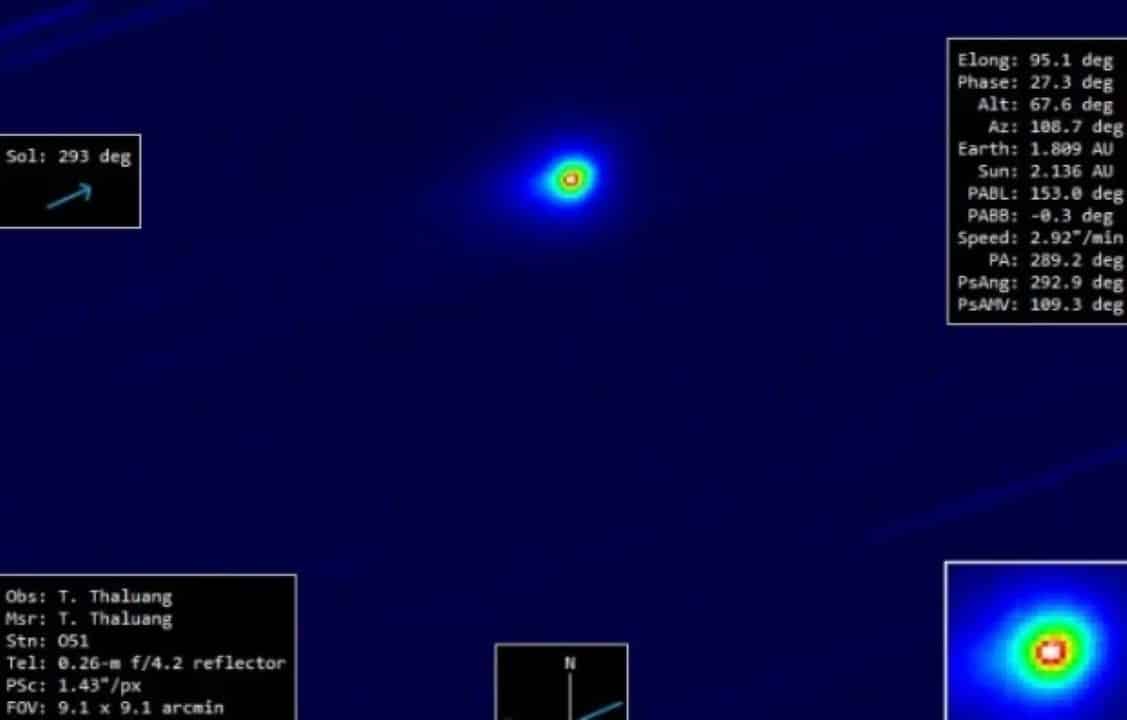
The international astronomical community identified that the interstellar celestial body called 3I/ATLAS is estimated to be between 10 and 12 billion years old. Recent analyses, based on data captured by high-precision space observatories, indicate that this object formed in the early stages of Via Láctea’s development. The calculated origin period places the comet in an era very close to the emergence of the universe itself, an event that scientists estimate to have occurred approximately 13.8 billion years ago.
To establish a comparison parameter, the planet Terra and Sistema Solar are estimated to be around 4.5 and 4.6 billion years old, respectively. The data obtained indicates that the visiting object is more than twice the age of our planetary system. Essa temporal characteristic transforms the celestial body into one of the oldest structures ever detected in the vicinity of Earth’s orbit, providing unprecedented study material on the physical and chemical conditions of the primordial cosmos.
The technical details and measurements underlying this discovery were documented in a scientific article available on the preprint server Research Square. The platform functions as a preliminary repository for academic research, allowing astronomers and physicists from various global institutions to access raw data and applied methodologies before official publication in peer-reviewed journals.
Identification of the object’s advanced age was only possible due to its temporary passage through our planetary system. The celestial body traveled through deep space for billions of years before crossing the Sol region of gravitational influence, at which point ground-based and space-based observation instruments were able to record its spectral signature and material composition in detail unprecedented in the history of space exploration.
Trajectory and identification of the celestial body
The object was initially detected by astronomical monitoring systems due to its extraordinarily high speed and approach route. The trajectory recorded by the telescopes differed markedly from the orbital pattern followed by comets originating from Nuvem of Oort or Cinturão of Kuiper, regions that house the icy bodies of our system.
The combination of these dynamic factors allowed researchers to classify 3I/ATLAS as an interstellar object, that is, a structure formed outside the area of influence of Sol. The detection of bodies with this origin is a statistically rare event in observational astronomy, making each pass a fundamental opportunity to collect data on matter existing in other parts of the galaxy.
Initial observations and physical measurements
Soon after the confirmation of its interstellar orbit, the celestial body became the target of unfounded speculation about its nature, including theories without scientific basis that suggested an artificial origin. Astronomers and space agencies quickly presented photometric and spectroscopic data that proved the cometary nature of the object, discarding any hypothesis that deviated from astrophysical rigor.
The Telescópio Espacial Hubble was directed to track the object’s displacement and make precise measurements of its physical structure. The images captured by the orbital equipment allowed scientists to calculate that the diameter of the comet’s nucleus measures between 440 meters and 5.6 kilometers, dimensions considered substantial for a celestial body that travels between star systems.
During its closest passage to the central star of our system, the object reached a translational speed of approximately 221 thousand kilometers per hour. Após bypassed Sol in a natural gravitational assistance maneuver, the celestial body resumed its trajectory towards deep space, gradually moving away from the visual range of terrestrial optical instruments.
Chemical analysis using infrared
The definitive data on the composition of the object was collected using Telescópio Espacial James Webb, operated by the North American space agency. The observatory aimed its infrared sensors at the target at the end of December, a period in which the celestial body was at a distance of 270 million kilometers from Terra, guaranteeing an ideal observation window.
The equipment’s spectroscopy technology was used to analyze the cloud of gas and dust that surrounds the comet’s nucleus, a structure known as a coma. Esse envelope gasoso se forma quando a radiação térmica da estrela aquece a superfície gelada do objeto, provocando a sublimação imediata dos materiais voláteis que permaneceram congelados durante a viagem pelo vácuo espacial.
The space observatory’s sensors focused on identifying specific isotopes present in gaseous emissions. Isotopes are variants of the same chemical element that have different atomic masses due to the variation in the number of neutrons in their nuclei, functioning as precise markers of the environmental conditions at the time the matter was condensed.
Reading these chemical signatures allows astrophysicists to perform a kind of cosmic archeology. By comparing the proportion of elements found in the ejected gas with theoretical models of star formation, researchers are able to determine the temperature, density and radiation of the environment where the celestial body solidified billions of years ago.
Isotopic signatures and extreme temperatures
The results obtained from the spectral reading revealed significant anomalies in the composition of the water ejected by the cometary nucleus. The analysis demonstrated a concentration of deuterium, a heavy isotope of hydrogen, considerably higher than levels documented in celestial bodies formed in the early solar nebula. Essa primary chemical discrepancy provided the first concrete evidence that the material that makes up the object was processed in a galactic environment with physicochemical characteristics radically different from those that gave rise to the planets neighboring Terra.
In conjunction with the hydrogen anomaly, the researchers identified atypical proportions in the carbon isotopes present in the simple organic molecules released by the comet. Computational modeling based on these chemical data indicated that the agglomeration of ice and dust occurred in a sector of space subjected to temperatures of approximately 30 kelvins, equivalent to minus 243 degrees Celsius. Esse level of extreme cooling is incompatible with the formation zones of our system, reinforcing the thesis that the object was born in a much older and colder molecular cloud.
Formation in early protoplanetary disks
The interpretation consolidated by astrophysicists suggests that the celestial body originated within a primordial protoplanetary disk, a vast structure of gas and cosmic dust that orbits newly formed stars and serves as a nursery for planetary systems. The detection of such severe temperatures and such specific isotopic chemistry indicates that this formation environment existed in one of the first generations of Via Láctea stars, long before the gravitational collapse that generated Sol. The intact preservation of these molecules in the comet’s frozen interior transforms the object into a time capsule, offering modern science the opportunity to analyze the raw matter that circulated throughout the galaxy in its early days. The identification of complex molecular compounds in the ejecta also raises fundamental questions about the distribution of life-precursor elements throughout the cosmos. The presence of these substances in a body more than 10 billion years old demonstrates that the chemical reactions necessary for the formation of organic building blocks were already actively occurring in the young universe, indicating that the basic ingredients for the development of biological systems may have been disseminated throughout the galaxy for much longer than previous theoretical models proposed.
Challenges in tracking exact origin
Despite the volume of chemical and physical data collected by space observatories, determining the exact star system that ejected the celestial body remains beyond current technological and mathematical capabilities. Durante its billion-year journey through the interstellar medium, the object has suffered the gravitational influence of countless stars, black holes and giant molecular clouds, interactions that have irreversibly altered its original route and made it impossible to reverse calculate its complete trajectory through the galaxy.



