
Extreme solar heat hits interstellar comet 3I/ATLAS and causes unprecedented explosion of chemical compounds

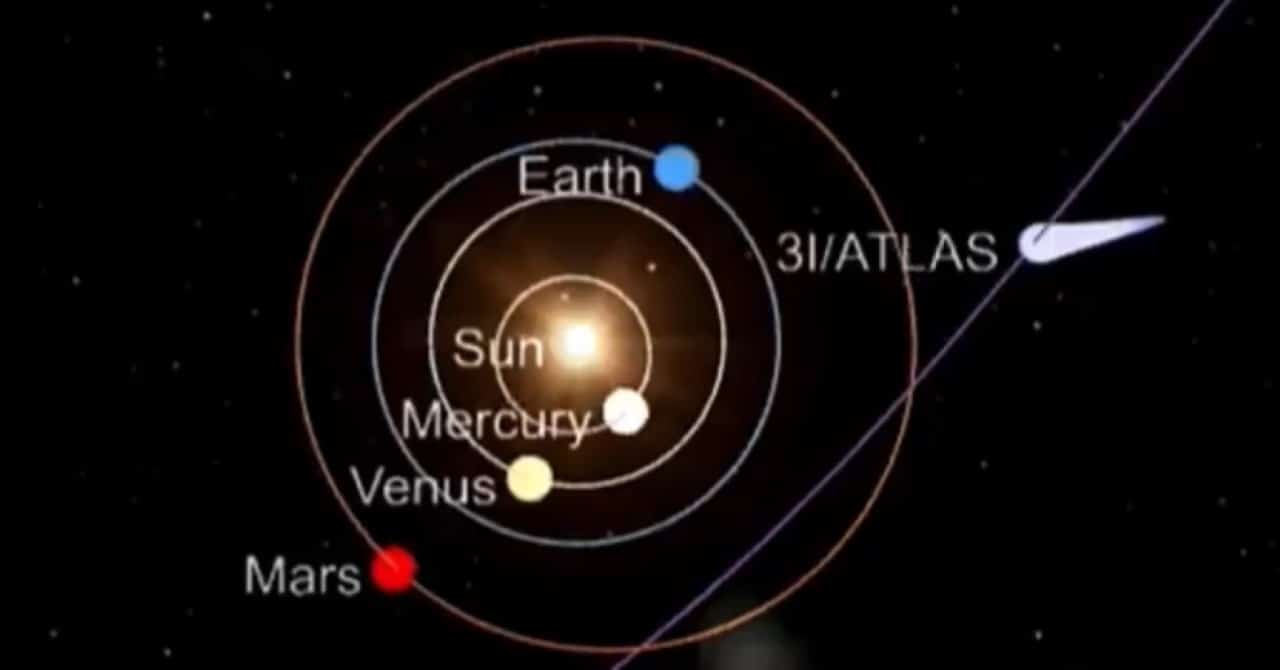
Continuous monitoring of deep space has revealed a drastic physical and chemical transformation in the third interstellar object ever confirmed by astronomers in our cosmic neighborhood. The SPHEREx space mission, responsible for mapping the sky in infrared light, detected substantial changes in the celestial body called 3I/ATLAS shortly after its closest approach to Sol, an event that occurred at the end of October last year. The data captured by the high-precision instruments indicated that the intense thermal radiation penetrated the most superficial layers of the rocky and icy object. Esse extreme warming has reached deep reservoirs of volatile materials that have remained frozen for millennia in the interstellar vacuum. Starting in November, scientists recorded an abrupt and continuous release of cosmic dust and various gases. The phenomenon marked the end of the distant visitor’s state of dormancy, beginning a phase of vigorous and highly energetic sublimation. Detailed analysis of emissions pointed to an exponential growth in the amount of water vapor expelled into space. Records show that the volume of water released has increased about twenty times compared to initial measurements taken in August. The flow of carbon monoxide also followed this upward curve, highlighting a chemical complexity hitherto hidden in the comet’s nucleus.
Additional images captured by Telescópio Óptico Nórdico in mid-November documented clearly visible physical changes in the structure of the object’s coma. Enquanto the gaseous emissions maintained a symmetrical distribution around the nucleus, the dust cloud assumed a very peculiar asymmetrical shape. Essa morphology, similar to a pear, indicates the direct and relentless influence of solar radiation pressure on the newly released particles.

The ATLAS warning system was responsible for detecting the object for the first time in July 2025. The team of experts immediately classified the body as originating from outside our planetary system due to its extreme speed and unusual trajectory. Viajando at more than 57 kilometers per second, the comet follows a route that guarantees its unique passage through our space region.
Discovery and initial tracking
The absence of any gravitational link with Sol has allowed astronomers from several observatories around the world to prepare highly focused observation campaigns at perihelion. The gradual approach to the inner Sistema Solar generated a progressive thermal wave over the irregular surface of the interstellar comet.
This constant heating acted as the necessary trigger to activate physical processes that remained completely stagnant during the long, dark journey through the interstellar medium. The observed phenomenon served as an unprecedented natural laboratory for understanding the thermal resistance of objects formed in other distant star systems.
Details of the chemical composition
Spectrometers coupled to powerful ground- and space-based observation instruments have identified a rich variety of compounds being violently ejected into outer space. Além of the expected water and carbon monoxide, the spectral signature revealed the marked presence of complex organic molecules.
These fundamental elements were released instantly as the thick barrier of surface ice was breached by our star’s relentless heat. Cyanide detection occurred in strong emissions shortly after perihelion, indicating extremely high volatility of the internal material.
Methanol has also been found in proportions that defy previous astronomical models about the formation of celestial bodies in excessively cold environments. The formaldehyde ended up being released together with other heavy gases, suggesting strong thermal processing directly in the comet’s nucleus.
Organic and structural elements
The presence of methane and ethane acts as a direct indicator of the sublimation of internal layers that have remained preserved since the time of the object’s original formation. The fine-grained detection of these elements provides crucial clues about the primordial conditions of the unknown star system where 3I/ATLAS originated billions of years ago.
The complex mix of ices and organic materials suggests that universal chemical processes are at work in the formation of smaller bodies throughout the galaxy. Isso occurs regardless of the type of host star or the distance from the galactic center, unifying theories of planet formation.
The researchers cataloged the main compounds and their thermal reactions as follows:
– Cianeto: high volatility after solar approach.
– Metanol: atypical proportions for cold environments.
– Formaldeído: evidence of internal thermal processing.
– Metano and Etano: markers of ancient structural preservation.
This rigorous cataloging allows scientists to draw a direct parallel between the chemistry of the interstellar medium and the building blocks that gave rise to our own system. The data continues to be processed by supercomputers to further refine the error margins of spectrographic measurements.
Transformation of dust morphology
The radical change in the morphology of the dust cloud reflects the dynamic and constant interaction between the material ejected from the nucleus and the hostile solar environment. The specific orientation of the dust tail, which faces Sol in its narrowest part, clearly demonstrates how particles of different sizes and masses react to the pressure of sunlight. Análises Reflectance details show that the newly exposed material is quite dark and has a low albedo, meaning it reflects little light. Essa visual feature is typical of space surfaces rich in amorphous carbon and minerals such as olivine, commonly found in primitive meteorites. Continuous observation of this structure makes it possible to map the density of the ejected material with millimeter precision.
The scattering of bluish light observed in the smaller particles indicates that the comet has definitively lost its original protective coating, exposing a geologically diverse and complex interior. Essa kind of large-scale thermal flaking allowed scientists to observe, for the first time in the history of astronomy for this specific object, the transition from an ice-dominated domain to an environment dominated by rocky dust. Tal process has permanently altered the visual appearance and thermal signature of the celestial body as it passes through our neighborhood. The dynamics of fluids and gases in a vacuum create unique patterns that help calibrate observing instruments for future detections of similar bodies. The phenomenon reinforces the importance of keeping large telescopes pointed at hyperbolic routes.
Comparisons with interstellar visitors
The physical and chemical behavior of 3I/ATLAS offers an extremely interesting scientific contrast to its interstellar predecessors already documented by the astronomical community. The first confirmed visitor, known as 1I/’Oumuamua, passed through Sistema Solar with minimal cometary activity, which has generated intense academic debate about its true rocky or metallic nature. On the other hand, the second object, called 2I/Borisov, behaved exactly like a typical comet in our system from the moment of its initial discovery. The new visitor, however, presented a late and almost explosive activation, surprising the monitoring teams who were expecting a more restrained reaction. The exact chemical ratios of carbon dioxide, carbon monoxide, and water, clearly observed in early 2026, surprisingly aligned with the local comet patterns of Nuvem and Oort. Essa unexpected chemical similarity raises profound new questions about the homogeneity of planetary formation processes across the entire range of Via Láctea. The finding strongly suggests that the fundamental building blocks of life and planetary systems may be much more common and standardized than imagined in previous decades. Astrophysicists now work under the hypothesis that galactic chemical seeding follows strict thermodynamic rules, regardless of the region of origin of the primary molecular cloud.
Exit route from the planetary system
After the sublimation spectacle near Sol, the celestial body maintains its hyperbolic trajectory unchanged towards the ends of outer space. The escape velocity exceeding 57 kilometers per second ensures that solar gravity will not be able to capture the object into a closed elliptical orbit. Earth-based observatories will continue to track the weakening of its brightness until it disappears completely into the darkness of the deep interstellar medium.
Relevance to modern astrophysics
The passage of 3I/ATLAS consolidates a new era in the astronomical observation of exogenous bodies, providing robust empirical data for the validation of cosmological theories. The ability to analyze the composition of an intact piece of another star system without the need to send space probes represents an immeasurable methodological advance.
The accumulation of information on the isotope ratio and molecular structure of the ejected gases will serve as the basis for hundreds of future studies. The international scientific community already organizes research consortia dedicated exclusively to deciphering the vast volume of telemetry data generated during the months of the comet’s greatest activity.



