
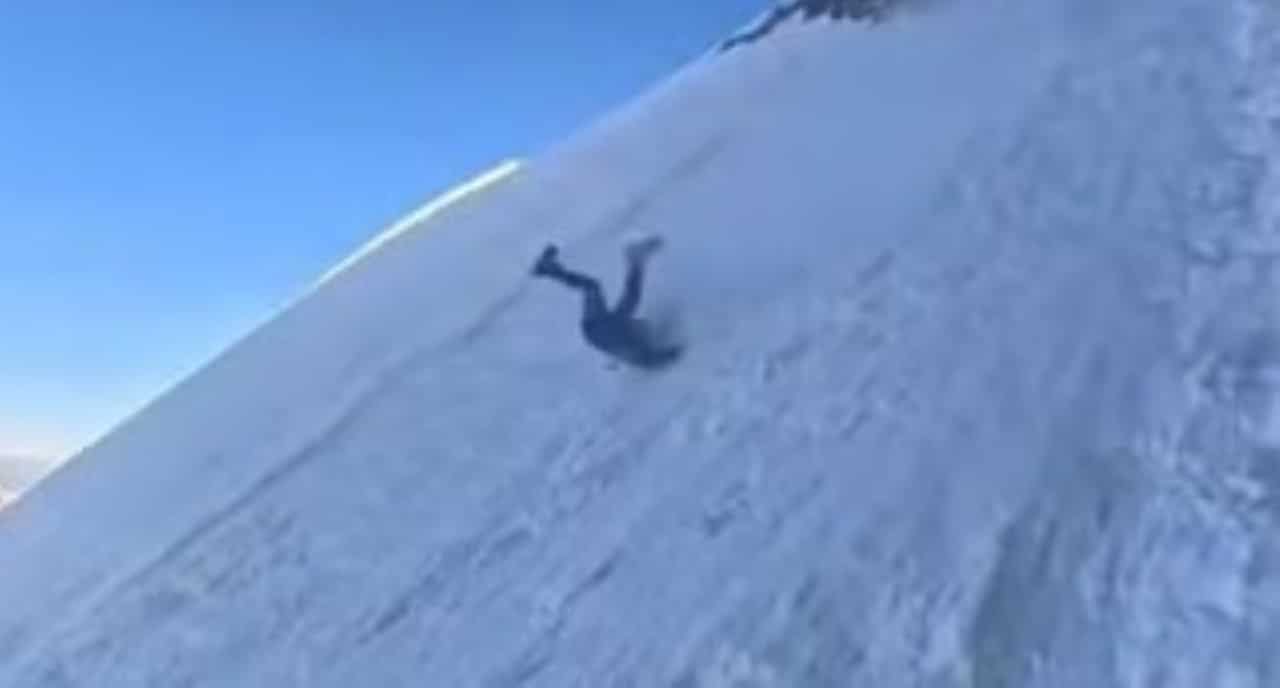
A winter sports practitioner recorded the exact moment he lost control while descending the Montes Tatra massif, a geological complex located on the European border. The incident occurred on the side of Rysy mountain, a rock formation known for its steep elevation and terrain often covered in thick ice for much of the year. The first-person recording documents the individual’s progression until the moment of loss of stability.
The images capture the failure in the positioning of the man’s feet on the frozen surface. Sem the boots are properly anchored on the steep terrain, the body begins a rapid and completely involuntary movement towards the base of the snowy valley. The lack of immediate friction with the ground transformed a simple imbalance into a high-speed descent down the mountain face.
During the forced descent, the speed increases considerably with each meter traveled, resulting in several rotations of the body on the compacted snow. The event caught the attention of alpine safety experts and mountain guides due to the specific dynamics of the fall and the absence of severe injuries to the practitioner, raising technical debates about progression procedures in high-risk areas.
On the same topic: Avalanche impact in Panticosa: three people lose their lives and a woman is injured
Dynamics of the accident on the frozen slope
The trigger for the slide was a false step on an unstable sheet of snow, located on a steep stretch. The immediate loss of traction prevented any attempt at primary stabilization with the climbing boots, nullifying the effectiveness of the metal spikes attached to the individual’s shoes.
In the first seconds of the journey, the practitioner tried to use his manual support equipment to brake the descent. However, the force of gravity, added to the extreme slope of the terrain and the hardness of the ice, made it difficult to correctly execute the self-arrest maneuver, a standard procedure taught in mountaineering courses.
The ice ax, an essential tool for braking on glacial surfaces, slipped out of the man’s hands at the beginning of the fall. Sem this mobile anchoring feature, the friction of the body and clothes with the ice was insufficient to reduce speed or change the straight trajectory towards the bottom of the valley.
The images document the erratic journey through the mountain, highlighting the difficulty of regaining directional control after the loss of main equipment. The inclination of the Rysy enhances the continuous acceleration of any object or person that loses firm contact with the ground, requiring reactions in fractions of a second.
Geographic characteristics of the Montes Tatra
The mountain The Montes Tatra massif is classified geologically as an alpine mountain range, featuring sharp rock formations, narrow corridors and deep valleys carved by ancient glaciers. The rugged topography creates specific microclimates that favor the accumulation of black ice and compacted snow, elements that drastically reduce the coefficient of friction on ascent and descent routes, making navigation complex even for experienced mountaineers.
The access route to the summit requires navigation through highly exposed sections, where the verticality of the terrain does not forgive progression errors or equipment failures. Durante the winter and early spring months, the traditional route is covered by successive layers of nival precipitation, hiding cracks, holes and loose rocks. The combination of high altitude, slope winds and diurnal temperature variation transforms the mountain’s surface into a slippery and unpredictable track, requiring visitors to use uninterrupted use of metal traction systems attached to their shoes and constant attention to the morphology of the terrain.
More on this story: Ski expedition ends in tragedy with nine dead after avalanche hits group in Sierra Nevada
The critical failure of the restraint equipment
Technical analysis of the visual record reveals that the inability to stop the slide was directly linked to the loss of the ice ax in the initial moments of the imbalance. The ice ax acts as a climber’s main line of defense in the event of a slip, allowing the self-arrest technique to be performed, which consists of embedding the metal blade into the snow while the body is pressed against the slope to generate drag and come to a complete stop. The moment the individual lost the grip on the tool, he became dependent exclusively on the friction of his clothes against the smooth surface, which is ineffective on steep slopes. Especialistas in rescue in remote areas point out that retaining the ice ax often requires the use of safety straps tied to the wrist or harness, a technical practice that prevents the equipment from separating during violent jolts. The absence of this redundant connection transformed a common stumble into an uncontrolled descent dictated solely by the topography of the terrain, highlighting the almost zero margin for error in mountaineering operations at altitudes above two thousand meters in altitude.
Activation of emergency protocols
High mountain regions in Europa Central have monitoring systems and ready response teams for incidents of trauma or loss of mobility. On the Polish side, operations are coordinated by highly trained volunteer groups, such as TOPR, specialized in extraction in vertical terrain and adverse weather conditions.
Learn more: Search for worker from Saxony ends with body found on mountain in Allgäu Alps
The mobilization of rotary-wing aircraft and ground search teams depends on the exact location of the victim and the visibility conditions in the massif. In many cases of falls into ravines, extraction via winch attached to the helicopter is the only viable alternative to safely remove victims from narrow corridors.
The teams’ response time is a critical factor for survival, as immobility in the snow quickly accelerates the process of systemic hypothermia. Communication via radio or satellite tracking devices speeds up sending exact coordinates to cross-border rescue centers.
Physical assessment after total stop
Despite the kinetic violence involved in the multiple rotations and the long distance traveled downhill, the primary physical assessment indicated the absence of bone fractures, serious lacerations or head trauma. The practitioner reported only mild muscle bruises and a superficial injury to one of his fingers, eliminating the need for highly complex medical interventions or urgent aeromedical evacuation.
Learn more: After being stabbed by a stick on a mountain, hiker walks for help in the USA
Technical guidelines for on-ice progression
Risk mitigation in alpine environments is based on the strict adoption of standardized progression procedures and the use of appropriate technical clothing. Redundancy of safety systems is the basic premise for operations on snowy slopes with a high degree of inclination.
Winter sports regulatory entities establish minimum equipment requirements for incursion into peaks with the morphological characteristics of Rysy. The mandatory checklist includes personal protective items and mechanical anchoring tools.
- Use of steel crampons with sharp front spikes for efficient penetration into hard ice.
- Continuous use of a helmet with international certification for multiple impacts and falling rocks.
- Use of dynamic ropes and harnesses in sections with an inclination of more than forty degrees.
- Carrying two-way communication devices immune to cell phone signal shadow areas.
- Layered structured clothing for body moisture management and freezing wind blocking.
Meteorological variables in the high mountains
Meteorological records from the day of the event indicated a high pressure system acting over the Cárpatos mountain range, resulting in clear skies, calm winds and no precipitation. The apparent atmospheric stability, however, can generate a false perception of security among those visiting the massif, masking the dangers inherent to the terrain.
Direct solar radiation on snow alters the cohesion of ice crystals throughout the day, creating a slippery surface layer on a rigid, frozen base. Essa thermodynamic transformation of the surface requires constant adaptation of the walking technique and increased attention to the distribution of body weight with each step taken on the mountain.