

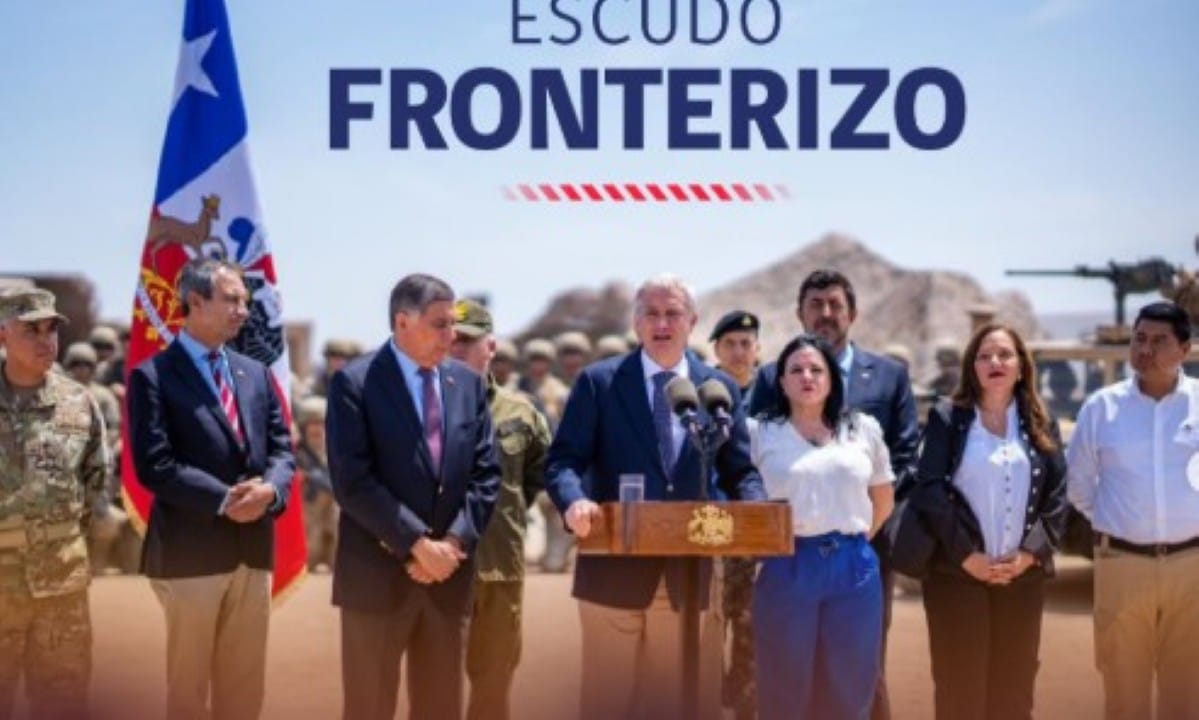
The Chilean government has begun the construction of a complex security structure on the northern border with Peru. The initiative aims to strengthen migration control and combat the illegal entry of people into the national territory, fulfilling one of the current president’s main campaign promises.
President José Antonio Kast was personally in Arica, in the north of the country, to inspect the progress of the works this Monday, March 16th. The visit highlighted the priority that the new government gives to the issue of border security and the containment of unregulated migratory flows.
The measure is part of a comprehensive plan that seeks to establish a robust surveillance and containment system. The expectation is that this physical and technological barrier will serve as an effective deterrent to the unauthorized crossings that have challenged Chilean authorities in recent years.
Border Security Project Details
The Chilean government’s plan includes implementing firm actions, such as completely closing unauthorized border crossings to illegal immigration. Além Furthermore, the proposal foresees the application of strict penalties for those who try to circumvent the new security scheme.
The strategy involves building a physical and technological containment system designed to be impenetrable. Este system incorporates security walls and fences that reach five meters in height.
These structures will be equipped with advanced motion sensors and will have constant surveillance using drones. The installation prioritizes areas adjacent to official crossings and also clandestine routes that have been identified and are now being blocked.
Context of the migration crisis in the region
The construction of the border barrier comes at a time of intense discussion about immigration in América Latina, especially Venezuelan immigration. Chile, in particular, has become one of the main destinations for migrants looking for better living conditions.
Recent data indicates that there are a significant number of irregular migrants living in Chile. Estimativas government officials point to approximately 337 thousand people in this condition, the majority of them of Venezuelan nationality, who entered the country through unofficial channels.
Pressure on public services and infrastructure in border cities has been a constant challenge. The increase in irregular immigration has generated heated debates about national sovereignty, public security and the capacity for social integration of newcomers, motivating the adoption of more restrictive policies.
Advanced technology on the front line
The security project on the Chilean-Peruvian border incorporates a series of cutting-edge technological resources to ensure effective surveillance. The objective is to create an intelligent barrier that can detect and respond to any attempted illegal crossing, operating uninterruptedly and autonomously whenever possible.
In addition to walls and fences, the structure will include the excavation of three-meter-deep trenches in regions known for their intense migratory flow. Essas trenches have the specific purpose of preventing vehicle access and blocking the passage of migrant caravans, adding an extra layer of physical impediment. Além In addition, the monitoring system will be reinforced by strategically placed surveillance towers, which will provide a broad view of the area. Radares thermal sensors will be used to detect heat in low visibility conditions, while autonomous drones, equipped with facial recognition technology, will patrol the airspace. Câmeras infrared and thermal will operate 24 hours a day, seven days a week, ensuring continuous observation of the border regardless of weather conditions or time of day.
Regional reactions and implications
The Chilean initiative to erect a physical barrier on the border with Peru generated discussions both internally and at a regional level. Embora the government of José Antonio Kast defended the measure as essential to sovereignty and national security, human rights groups and international organizations expressed concern.
Critics argue that building walls could worsen the humanitarian situation of migrants, forcing them onto even more dangerous and inhumane routes. Peru, in turn, closely monitors the development of the project, given the historical complexity of border relations and the potential impact on binational communities.
Challenges in execution and future perspectives
The materialization of a project of such magnitude presents considerable challenges, from the topography of the region to the management of the resources necessary for its completion. The border between Chile and Peru is characterized by a varied terrain, which includes deserts and mountainous areas, which requires engineering solutions adapted to each segment of the barrier.
The implementation of technological infrastructure, which ranges from the installation of sensors to the operation of drones and facial recognition systems, requires significant investments and specialized labor. The ongoing maintenance of these systems will also represent a relevant operational cost for the Chilean government budget in the long term.
In addition to the technical and financial aspects, the operation of the fortified border raises questions about the training of security forces and compliance with protocols that respect human rights. The government needs to balance the need for control with compliance with international laws protecting refugees and migrants, avoiding abuses and ensuring transparency in actions.
The impact of the construction of the wall on the region’s migratory dynamics is another point of analysis. Embora the objective is to contain illegal immigration, it is possible that migratory flows will be redirected towards other borders or that new clandestine routes will emerge, requiring constant adaptation of security policies.
Lessons from other border experiences
Chile’s decision to invest in a more robust border is not an isolated case on the global stage. Diversos countries around the world have adopted similar measures, including the construction of physical barriers and the use of advanced technology, in response to migration and security challenges.
The experiences of other nations show that, although walls and surveillance systems can make illegal crossings difficult, they are rarely able to eliminate them completely. The complexity of the migration phenomenon often requires a multifaceted approach that combines security with social, economic and diplomatic policies.



