
NASA details plans for future flight tests of the X-59, silent supersonic plane
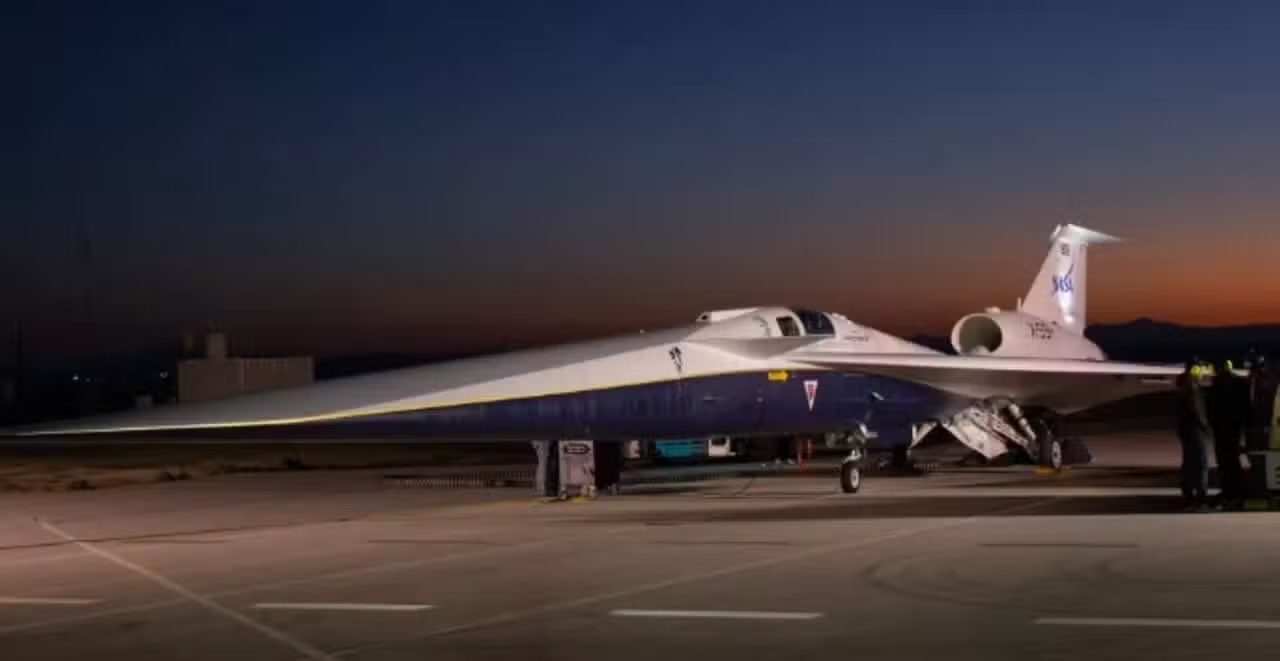
The US space agency, NASA, has announced a crucial press conference call on Thursday, March 19, at 5:30 pm ET, aimed at detailing the next steps and test flights of its silent supersonic experimental aircraft, the X-59. The event is scheduled to take place shortly after the completion of the prototype’s second flight, a significant milestone for the innovative project seeking to revolutionize air travel. Este development follows a series of engine run tests conducted the previous Thursday, March 12, 2026, at NASA’s Centro of Pesquisa of Voo Armstrong at Califórnia.
The X-59 aircraft, known for its unique design with a long, thin nose that extends for almost a third of its length, along with elegant wings and an engine mounted on the top of the fuselage, has as its main mission to enable commercial supersonic flight over land. Atualmente, Strict regulations prohibit supersonic flight over populated areas due to the “sonic boom” – a noisy shock wave produced when an aircraft breaks the sound barrier. The X-59, the centerpiece of NASA’s Quest mission, was designed to mitigate this sound, turning it into a much softer “thump” or “murmur.”
With the promise of drastically reducing travel times on a global scale, the technology developed by the X-59 could redefine the future of commercial aviation. The NASA teleconference therefore represents a key moment for the scientific community, the aerospace industry and the general public, offering insights into the advances and challenges that still need to be overcome before silent supersonic flight becomes an everyday reality. The results of these tests are essential to prove the viability of the concept and pave the way for the certification of faster and more efficient aircraft.
Teleconference details and initial flights
The conference call will feature prominent figures from NASA and Lockheed Martin Skunk Works, the contractor responsible for building the X-59. Entre confirmed speakers are Amit Kshatriya, associate administrator at NASA, and Cathy Bahm, project manager for Demonstrador of Voo of The presence of X-59 test pilots, Jim “Clue” Less and Nils Larson, is a highlight as they will be on hand to share their experiences and challenges in flying this unique experimental aircraft.
The second flight of the X-59, which precedes the press conference, will include taxiing operations from NASA hangar Armstrong, takeoff and landing at Base Aérea of Edwards. The aircraft is scheduled to fly for approximately one hour. During this period, the X-59 will reach a cruising speed of 370 km/h at an altitude of 3,658 meters, before accelerating to 418 km/h at 6,096 meters. Esses parameters are carefully monitored to ensure safety and the collection of accurate data on the aircraft’s performance in different flight regimes.
The Quest mission and the expansion of the flight envelope
The initial flights of the X-59 mark the beginning of a critical phase known as “flight envelope expansion.” Durante this stage, NASA will progressively take the X-59 to higher speeds and altitudes. Este gradual process is essential to evaluate the aircraft’s safety and its performance in increasingly demanding operating conditions. Collecting detailed data is vital to understanding how the aircraft behaves and reacts to different flight parameters.
After the envelope expansion phase, subsequent flights will be dedicated to evaluating the X-59’s unique acoustic profile. The objective is to confirm that the aircraft does not, in fact, generate the traditional sonic boom, but rather a significantly lower and less disturbing sound. Esta acoustic validation is at the heart of NASA’s Quest mission, whose purpose is to provide crucial data to regulatory bodies, enabling the review of supersonic flight bans over populated areas.
Technological innovation and the future of travel
The development of the X-59 is a testament to NASA’s continued effort to advance aerospace technology. The aircraft incorporates innovative technologies that enable sonic boom suppression, a barrier that has prevented the development of viable commercial supersonic aircraft for decades. Diferente from Concorde, which flew above the speed of sound, but was restricted to routes over oceans due to noise, the X-59 seeks a solution that allows flexible routes over any type of terrain.



The implications of the success of the X-59 project are vast. The ability to fly supersonic over land without causing noise disturbances could open a new chapter in aviation, connecting cities and continents with drastically reduced travel times. Isso would not only optimize business travel, but it could also transform the way people travel for leisure. The search for an aircraft that flies faster and more sustainably remains a priority for the industry, and the X-59 is at the forefront of this innovation.
The Quest program is not limited to just building and testing the X-59. Ele encompasses comprehensive research into the interactions of sound with the atmosphere and soil, as well as the study of human perceptions of noise. The goal is to create a robust set of data and information that can influence future Organização regulations from Aviação Civil Internacional (ICAO) and other civil aviation agencies around the world. Validating this data is crucial so that the next generation of supersonic commercial aircraft can operate freely on global routes.
Pilot collaboration and experience
Collaboration between NASA and Lockheed Martin Skunk Works is critical to advancing the X-59 project. Skunk Works, known for its history of developing experimental aircraft, brought its engineering and manufacturing expertise to bring the X-59’s innovative design to life. Essa public-private partnership is a model for future aerospace endeavors, combining NASA’s fundamental research with industry’s engineering capabilities.
The test pilots, Jim “Clue” Less and Nils Larson, are essential components to the success of the program. Sua experience flying cutting-edge aircraft and his ability to provide detailed feedback on the X-59’s performance are invaluable to engineers. The challenge of flying an experimental aircraft that redefines the norms of supersonic flight requires a unique combination of skill, courage and precision, and your perspectives are crucial to refining aircraft design and operations.
Community impact and regulation
Public acceptance will be a determining factor in the commercial success of silent supersonic flight. Therefore, NASA’s Quest mission includes a research component on the perception of sound by terrestrial communities. If the X-59 can prove that its sonic “thump” is in fact acceptable to people on the ground, it could change perspectives on the regulation of supersonic flying. Noise reduction is not just an engineering feat, but also a step towards the harmonious coexistence of aviation technology with communities.
NASA’s conference call, with its live broadcast on YouTube and recording available, ensures that information about the X-59 and the Quest mission is widely accessible. Esta Transparency is vital to educating the public and regulators about the potential and challenges of silent supersonic flight. The success of the X-59 could open the door to an era of faster, more efficient and environmentally conscious air travel, redefining the boundaries of commercial aviation globally.
Veja Tambem em News (EN)

Research reveals that parents are unaware of how their children use artificial intelligence

Samsung releases new system update with new features for Galaxy Watch 4 users

Digital retail reduces the value of the Galaxy S25 5G smartphone with bank bonuses and device exchange

Amazon’s wireless CarPlay adapter has a 50% discount and high approval ratings from drivers

Zach Cregger’s new Resident Evil ignores games and focuses on an unprecedented story with new characters

Rumor suggests that Nintendo is preparing a special edition of the Switch 2 with a remake of Ocarina of Time

Apple accelerates production of the iPhone 17e and develops new Air model with dual camera system

Epic Games platform releases twelve high-budget games at no permanent cost for PC users

PlayStation 5 Pro price drop accelerates digital retail sales and eliminates global stocks

New Galaxy Watch 9 firmware appears on server and confirms progress in software development

Apple’s commemorative project tests cell phone with 1.1 millimeter edge and curved screen for 2027
