
New Munich research reveals colossal mass of 3I/ATLAS: billions of tons, 100,000 times `Oumuamua

An innovative analysis, the result of a study conducted by scientists from Universidade of Munique, presents the most detailed assessment to date of the mass of the intriguing interstellar object 3I/ATLAS. The results indicate a massive proportion that defies expectations and raises profound questions about the nature of these cosmic visitors.
This new article, signed by Valentin Thoss, Andi Burkert and
The research revealed that the mass of 3I/ATLAS reaches the order of one billion metric tons. Este volume é, no mínimo, cem mil vezes superior à massa estimada do primeiro objeto interestelar conhecido, o 1I/`Oumuamua, que teve sua massa final calculada em aproximadamente 10⁷ quilogramas, assumindo uma origem natural.
Mass assessment through the rocket effect
Understanding the mass of 3I/ATLAS was based on a fundamental principle of physics: the rocket equation. Este model connects the mass of the object, its non-gravitational acceleration, and the rate of mass loss of the ejected material, multiplied by the ejection velocity. By quantifying the observed acceleration and rate of mass loss, and modeling the speed of the expelled gases, scientists were able to infer the mass of the celestial body.
To perform this precise measurement, it was necessary to consider an outflow asymmetry parameter, ζ, estimated at approximately 0.5. Este factor is crucial in determining how material is expelled and what impact this has on the object’s propulsion, directly influencing the calculation of its mass and physical characteristics.
The meticulous study used all available observational data, including the evolution of gas and dust production, as well as changes in the brightness of 3I/ATLAS. Essas information was essential to reconstruct the object’s behavior as it approached Sol, an event that triggered significant outgassing and detectable non-gravitational acceleration, providing clues about its composition and structure.
Sublimation models and estimated dimensions
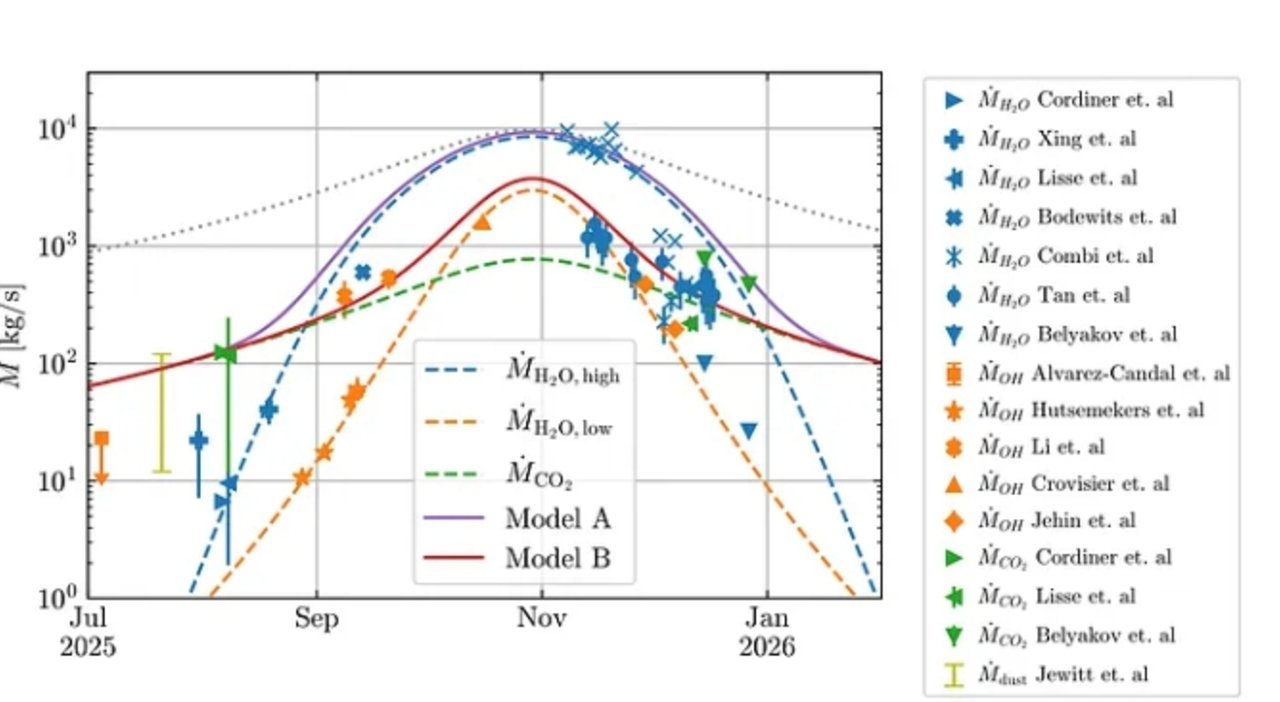
The research team combined different models for the rate of mass loss, focusing on the sublimation of water (H₂O) and carbon dioxide (CO₂). Estes models were fundamental in deriving the non-gravitational force and, consequently, estimating the mass and size of 3I/ATLAS. A conservative restriction on core size, based on the active surface required for sublimation, was also applied to refine the estimates.
When mass loss is predominantly driven by CO₂ sublimation, calculations suggest a core diameter of 0.84 kilometers, assuming a density of 0.5 grams per cubic centimeter and a ζ parameter of 0.5. Este scenario is statistically more favorable, especially when only data from large telescopes and interplanetary spacecraft are used.
Strong sublimation of water, reaching up to 10 metric tons per second, was ruled out, as the surface area required to sustain such a rate would be incompatible with the observed rocket effect. A more moderate water production model, in turn, indicated a core diameter of 1.48 kilometers. In the Neste case, a lower density or a higher outgassing speed could harmonize the size estimate with the lower limits of the Telescópio Espacial Hubble data, which pointed to 2.6 (± 0.4) kilometers.
Discrepancies and the active fraction of the nucleus
The analysis adopted three distinct parameterizations to address uncertainties: one focused exclusively on CO₂ sublimation, and two that incorporated the contribution of water sublimation, adjusted to the highest (model A) and lowest (model B) production rates. The subtle statistical preference for the CO₂ model became evident with higher precision data.
The calculated mass of 3I/ATLAS varied significantly between models. Para a purely CO₂ model, the derived mass was (M / ζ) = 0.3 × 10¹² kilograms. Já with the inclusion of water sublimation, the values increased to (M/ζ ) = 1.7 × 10¹² kilograms (lower limit, model B) and (M/ζ) = 6.4 × 10¹² kilograms (upper limit, model A).
Considering a density of 0.5 grams per cubic centimeter and ζ = 0.5, the estimated diameter of 3I/ATLAS is 0.84 kilometers for the CO₂ model and between 1.48 and 2.3 kilometers for the water sublimation models. However, an additional restriction was imposed on the size, taking into account the minimum surface area required to sustain the observed sublimation.
Challenges in data reconciliation
Under the most conservative assumptions, the model with high levels of water production (Modelo A) showed a strong discrepancy, requiring a diameter greater than 3 kilometers for the core. Este value is incompatible with the maximum estimate of 2.3 kilometers derived from non-gravitational acceleration, leading to its exclusion. Model B, with lower water production, showed a moderate discrepancy that could be mitigated by a lower density or higher ejection velocity.
These results suggest that the sublimation of water on the surface of 3I/ATLAS probably does not exceed that of carbon dioxide. Para the model that only considers CO₂ sublimation, the core size estimates are compatible with non-gravitational projections. Contudo, there would be a need for an underestimation of around an order of magnitude in CO₂ production rates to reconcile these estimates with the data from Hubble, which indicated a diameter of 2.6 (± 0.4) kilometers.
If water sublimation actually contributes to the propulsive effect, the nucleus would be larger. A lower-than-usual cometary density, combined with high gas velocities and outflow collimation, could increase the estimated diameter to as much as 2.2 kilometers, resolving the divergence between the Hubble estimate and the required surface active fraction.
Implications for the origin of interstellar objects
Regardless of the uncertainties inherent to the different models, one conclusion emerges clearly: 3I/ATLAS is, unquestionably, at least one hundred thousand times more massive than 1I/`Oumuamua. Esta mass disparity, of five orders of magnitude, has profound implications for our understanding of interstellar objects.
Considering the statistics of asteroids and comet nuclei of various sizes in Sistema Solar, we would be expected to have detected at least one hundred thousand objects with the mass of 1I/`Oumuamua before finding a single interstellar object of the magnitude of 3I/ATLAS. The unexpected observation of an object as massive as 3I/ATLAS defies probabilities based on mass distributions of known celestial bodies.
This remarkable detection discrepancy raises the fundamental question: do one or both of these enigmatic interstellar objects not have a natural origin? The hypothesis, although still in the field of speculation, points to the possibility that 3I/ATLAS or `Oumuamua, or perhaps both, could represent something beyond conventional astronomical formation, driving new lines of investigation in astrophysics and the search for extraterrestrial life.



