
Space station intensifies research and prepares new orbital walk after recent cargo resupply
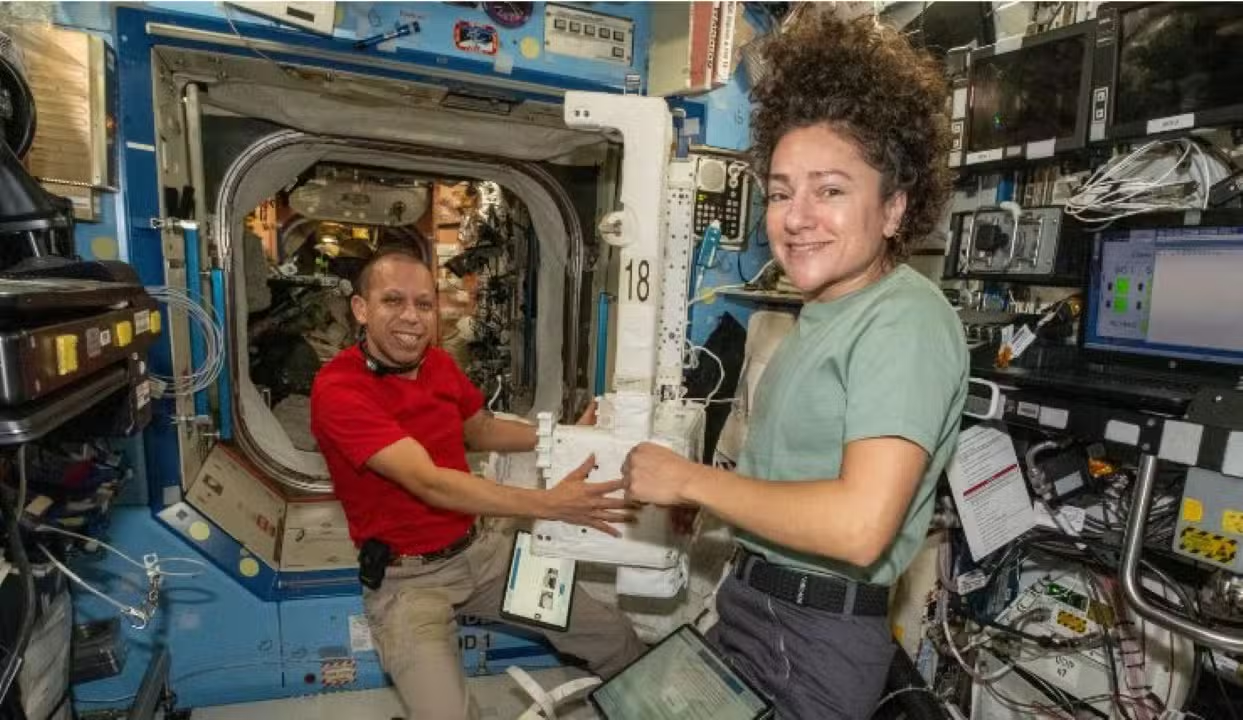
The Estação Espacial Internacional (ISS) has been the stage for a series of crucial activities for the maintenance and expansion of science in microgravity. Equipes of astronauts from various space agencies are focused on a busy schedule, which includes everything from preparing for challenging extravehicular treks to conducting biological experiments and logistically managing cargo ships.
Expedição 74, responsible for current operations, dedicated its days to inspecting and configuring essential equipment, ensuring the safety and effectiveness of future missions. Este collaborative effort is fundamental to the advancement of human research in space and the sustainability of life and work aboard the orbiting laboratory.
From routine maintenance of vital systems to optimizing scientific infrastructure, every action on the ISS reflects the complexity and precision required to operate in such a hostile environment. The accelerated pace demonstrates the global commitment to space exploration and understanding the impacts of microgravity on the human body and various physical phenomena.
Intense preparations for extravehicular activities
The safety and success of spacewalks are top priorities, requiring meticulous preparations on the part of crew members. NASA flight engineers Chris Williams and Jessica Meir performed detailed inspection and configuration of a spacesuit jetpack inside the Destiny laboratory module of Estação Espacial Internacional. Estes devices are a vital safety mechanism, allowing astronauts to return to the station if they become detached from their work station during an extravehicular activity (EVA).
Preparation for a spacewalk scheduled for Wednesday, March 18, was one of the focal points of the week. Williams and Meir dedicated themselves to communicating with mission controllers on the ground, discussing procedures and reviewing necessary tools and tasks. The objective of the EVA is to install a modification kit and run cables on the left side of the orbital station, an essential step for the future installation of the next set of solar panels, which will arrive aboard a SpaceX Dragon spacecraft.
Crucial Space Refueling Logistics
The movement of cargo ships is a vital component to maintaining ISS operations, ensuring that the orbital outpost has the necessary supplies and equipment. On Thursday, March 12, the Cygnus cargo spacecraft
Days earlier, on Friday, March 6, the HTV-X1 cargo spacecraft, from JAXA (Exploração Aeroespacial Agency of Japão), was also released by Canadarm2. Diferente from Essas cargo missions are critical not only for transporting supplies, but also for safely disposing of waste and, in some cases, conducting additional research.
Coordinating these logistical operations involves teams on the ground and on board the station, ensuring that launch and docking windows are accurate and that the spacecraft are maneuvered safely. The success of these resupply and disposal missions is a testament to the ability of space agencies to maintain a continuous and productive human presence in space. The constant flow of equipment and samples is the basis for microgravity science to flourish, offering valuable insights into life on Terra and future exploration.
Advances in scientific research in microgravity
Estação Espacial Internacional serves as a unique laboratory for microgravity research, and equipment maintenance is ongoing and essential for scientific progress. Dentro of the Kibo orbital laboratory module, NASA flight engineers Chris Williams and Jack Hathaway dedicated part of the week to maintaining various research equipment. Esse work guarantees the continuity of scientific operations and the validity of data collected in such a unique environment.



Williams replaced a large centrifuge with a smaller one inside the Saibo rack of the Kibo, preparing the infrastructure for future and more complex biological experiments. Esta adaptation is crucial to optimize available space and resources, allowing for a wider range of studies.
At the same time, Hathaway replaced an obsolete high-definition video camera with a more modern version inside Kibo’s airlock. Esta new camera will be installed outside the station, where it will capture images of Terra and monitor the arrival and departure of spacecraft, providing important visual data for research and mission control.
NASA Flight Engineer Jessica Meir and ESA Flight Engineer Sophie Adenot (Agency Espacial Europeia) have begun important work on the Columbus laboratory module. Elas set up the PhysioTool health monitoring experiment. Este project involved attaching portable sensors to the astronaut’s body, measuring crucial parameters such as heart, lung and brain activity. The results of this study promise to provide comprehensive biomedical data on the effects of living and working in microgravity, contributing significantly to the understanding of human physiology in space.
Health monitoring and biomedical experiments
Understanding the impacts of microgravity on the human body is a fundamental pillar of research on the ISS, with multiple experiments focused on astronauts’ health. The PhysioTool program, configured by Meir and Adenot, represents a breakthrough in real-time biomedical data collection, using wearable sensors to monitor a wide range of vital functions. Estes data not only contributes to the safety of current crew members, but also informs the development of countermeasures for future long-duration missions.
On another research front, Roscosmos cosmonauts, Sergey Kud-Sverchkov and Sergei Mikaev, completed a week-long cardiac study. The objective was to observe how the absence of gravity affects the circulatory system of crew members. Para this, sensors were connected to their foreheads, fingers and toes, transmitting blood flow data via Bluetooth adapter to a portable computer for detailed analysis, deepening knowledge about cardiovascular adaptation in a space environment.
Russian maintenance and waste management in orbit
Russian operations at Estação Espacial Internacional play an equally important role in the maintenance and functionality of the station, with Roscosmos cosmonauts engaged in a number of critical tasks. Flight engineer Andrey Fedyaev dedicated his shift to replacing components of the orbital hydraulic system and checking its operation within the Zarya module, ensuring the integrity of the life support systems. Fedyaev then transferred fluids between tanks and removed air bubbles as part of servicing the Elektron service module’s Zvezda oxygen generator, a task essential to producing breathable air at the station. Além of his technical assignments, the station veteran also documented life on board, filming his crewmates as they performed scientific, maintenance and exercise activities, providing a valuable record of daily routines on the orbital outpost. Mikaev, in turn, prepared the trash-filled cargo spacecraft Progress 92 for its next departure by disconnecting the docking components and closing the hatch, a critical step in ISS waste management.
Orbital maneuvers for station stability
Maintaining Estação Espacial Internacional’s altitude and orbit is a continuous operation and is fundamental to its safety and longevity. Recentemente, the station underwent a significant orbital readjustment maneuver, which guaranteed its ideal position. The Progress 93 cargo spacecraft, docked to the back door of the Zvezda service module, fired its engines for 10 minutes and 30 seconds at 11:58 a.m. EDT on March 12. Este readjustment increased the space station’s altitude by 800 meters at apogee and 1.4 kilometers at perigee, establishing it in a stable 428 x 414 kilometer orbit.
Veja Tambem em News (EN)

Research reveals that parents are unaware of how their children use artificial intelligence

Samsung releases new system update with new features for Galaxy Watch 4 users

Digital retail reduces the value of the Galaxy S25 5G smartphone with bank bonuses and device exchange

Amazon’s wireless CarPlay adapter has a 50% discount and high approval ratings from drivers

Zach Cregger’s new Resident Evil ignores games and focuses on an unprecedented story with new characters

Rumor suggests that Nintendo is preparing a special edition of the Switch 2 with a remake of Ocarina of Time

Apple accelerates production of the iPhone 17e and develops new Air model with dual camera system

Epic Games platform releases twelve high-budget games at no permanent cost for PC users

PlayStation 5 Pro price drop accelerates digital retail sales and eliminates global stocks

New Galaxy Watch 9 firmware appears on server and confirms progress in software development

Apple’s commemorative project tests cell phone with 1.1 millimeter edge and curved screen for 2027
