
Blizzard and slippery roads cause multiple collisions and block I-75 in Ohio
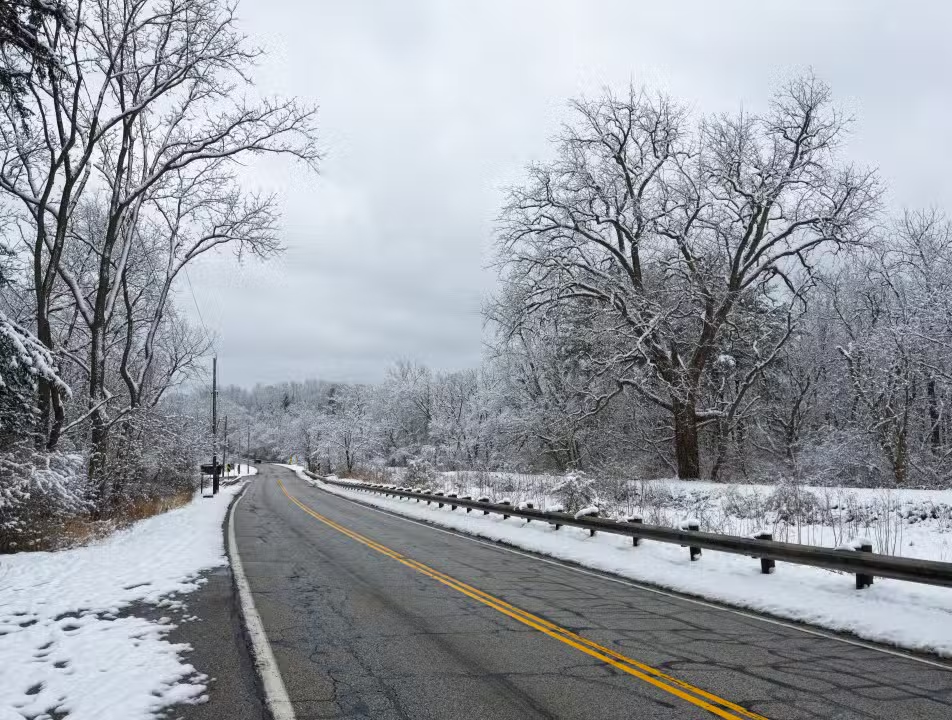
The adverse weather that hit the region of Vale of Miami, in the state of Ohio, resulted in a sequence of traffic accidents on the main local expressways. Equipes rescue services, paramedics and the highway police were mobilized to respond to several simultaneous incidents, which required the blocking of lanes to remove vehicles and clean the asphalt. The combination of continuous precipitation and a sharp drop in temperatures created a dangerous layer over the roadways, drastically altering nighttime traffic dynamics.
The weather conditions reduced drivers’ visibility and reduced the friction between tires and the ground, increasing the risk of skidding at high speeds. Autoridades traffic authorities issued alerts asking the population to avoid leaving their homes unless strictly necessary, aiming to reduce the volume of cars on the streets and facilitate the movement of emergency vehicles. The local traffic department highlighted the main guidelines for drivers who were already on the road during the start of the storm:
– Immediate Redução cruising speed in all ranges.
– Aumento of the following distance in relation to the vehicle in front.
– Utilização correct low beam headlights and fog lights for better visual identification.
The most severe incidents were concentrated on interstate highways, where the flow of commercial and passenger vehicles tends to be intense. The rapid deterioration of the weather took many drivers by surprise, resulting in sudden braking that culminated in rear-end collisions and lane departures on several stretches of the road network.
Rescue operations on the interstate highway
One of the largest accidents occurred on the I-75 highway, near exit 53, shortly before eight o’clock. A heavy load vehicle lost directional control, and the truck’s cabin ended up facing the opposite direction to its own body, blocking the normal flow of the road and creating an insurmountable physical barrier for other drivers.
Despite the severity of the accident kinematics and the size of the vehicle involved, emergency teams confirmed that there were no fatalities or serious injuries at this specific point. The complexity of the incident required the presence of heavy winches and specialized machinery to carefully remove the truck’s articulated structure, a process that demands time and technical precision.
Medical care and road closures
In a further section of the same highway, in the region known as Stanley Avenue, the northbound contraflow lane had to be completely closed. A collision involving multiple passenger vehicles created a logistical bottleneck for first responders, who had to access the scene by walking along the shoulder due to immediate congestion.
Two advanced medical support units were dispatched to the scene immediately after the pileup was reported. Paramedics screened all occupants of the vehicles involved, providing first aid and assessing the need for transport to hospitals in the region before authorizing any movement of the wreckage.
Sweeping and cleaning operations lasted several hours, maintaining severe traffic restrictions in the affected area. Motorists traveling through this sector faced significant delays as road maintenance crews applied absorbent materials to remove oil and debris scattered across the asphalt.
Occurrences recorded in the monitoring system
In addition to the problems documented on I-75, the I-70 highway also had hot spots for retention and accidents. At the junction with State Route 49, a new collision forced the closure of additional lanes, requiring the highway police to isolate a large perimeter to ensure the safety of rescue operations.



Sealing the area was a standard safety measure to protect both the victims and rescuers working to extract the damaged vehicles. The lack of natural lighting and wet asphalt substantially increased the danger of secondary collisions, one of the biggest causes of fatalities among emergency professionals on highways.
The state’s official traffic monitoring system, known as OHGO, documented more than a dozen separate occurrences on Vale of Miami alone during the early evening hours. Accident and slowdown alerts updated the interactive maps every minute, reflecting the chaos created by bad weather.
This rapid succession of accidents demonstrated how dangerous conditions quickly spread across a vast network of local roads and long-distance routes. The response capacity of public services was tested, requiring a dynamic relocation of available vehicles to cover the entire affected territorial extension.
Meteorological factors and road safety
The formation of black ice, a thin layer of transparent ice that perfectly camouflages itself with the dark color of the asphalt, is one of the most treacherous phenomena faced by drivers on nights of precipitation and intense cold. Quando the tires lose direct contact with the porous road surface, the vehicle enters a state of uncontrollable sliding, nullifying the effectiveness of the braking and traction control systems. Visibility limited by fog and light rain makes the situation worse, as it drastically reduces the driver’s reaction time when seeing an obstacle, a previous accident or a car stopped ahead on the road.
Traffic engineering experts reiterate that the speed limits set on road signs are calculated exclusively for ideal weather conditions, dry roads and good lighting. Sob adverse weather, the safe traffic speed drops sharply, requiring immediate adaptation of driving behavior. The fundamental technical recommendation is that the distance between cars, which is normally calculated in two seconds, be increased to up to six seconds, allowing adequate and safe braking space in case the vehicle in front brakes sharply or suddenly loses directional control.
Impacts on urban mobility and logistics
The shutdown of vital highway arteries such as I-75 and I-70 generates a profound ripple effect that affects not only passenger drivers, but the entire freight transport logistics chain that depends on these structural routes for regional and interstate supply. The prolonged closures resulted in kilometer-long queues in both directions of the highways, forcing drivers to turn off their engines to save fuel while they patiently waited for the lanes to open. Transit authorities needed to coordinate efforts in real time with local city halls to divert excess flow to smaller arterial roads, which also quickly reached their maximum saturation capacity, creating congestion nodes within urban perimeters. The clearing work involved removing spilled automotive fluids, such as engine oil and coolant, which make asphalt even more slippery and dangerous if not completely neutralized with absorbent chemical materials before traffic reopens. The complexity of these nighttime operations under severe weather requires strict safety protocols and heavy artificial lighting to prevent rescue agents and tow truck operators themselves from becoming victims of new incidents on site.
Preventive guidelines from authorities
Visible patrolling was intensified at all points considered critical by traffic engineering. The vehicles were strategically positioned with light signals activated to force drivers approaching risk areas to reduce their speed, reinforcing the vital need to adopt an extreme defensive driving posture.
Route planning and use of technology
The use of real-time navigation applications has become an indispensable tool for those who had to travel during the storm. Official platforms and variable message boards provide instant updates on closed sections, suggesting safer detours and alternative routes to avoid pockets of congestion.
Highway maintenance crews continue to monitor short-term weather forecasts to anticipate the spread of salt and de-icing agents on roadways. The main objective of the service fleets is to restore normal traffic as quickly as possible and guarantee the physical integrity of all users of the region’s road system.
Veja Tambem em News (EN)

Research reveals that parents are unaware of how their children use artificial intelligence

Samsung releases new system update with new features for Galaxy Watch 4 users

Digital retail reduces the value of the Galaxy S25 5G smartphone with bank bonuses and device exchange

Amazon’s wireless CarPlay adapter has a 50% discount and high approval ratings from drivers

Zach Cregger’s new Resident Evil ignores games and focuses on an unprecedented story with new characters

Rumor suggests that Nintendo is preparing a special edition of the Switch 2 with a remake of Ocarina of Time

Apple accelerates production of the iPhone 17e and develops new Air model with dual camera system

Epic Games platform releases twelve high-budget games at no permanent cost for PC users

PlayStation 5 Pro price drop accelerates digital retail sales and eliminates global stocks

New Galaxy Watch 9 firmware appears on server and confirms progress in software development

Apple’s commemorative project tests cell phone with 1.1 millimeter edge and curved screen for 2027
