

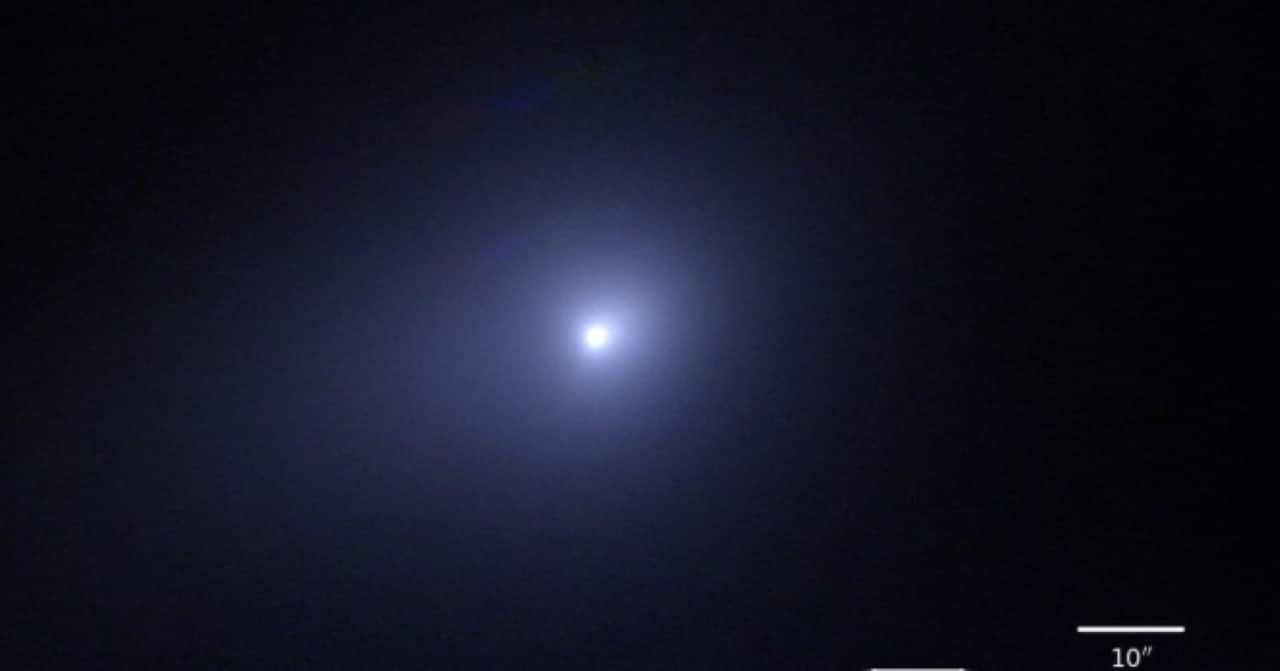
The team of astronomers identified an unusual amount of methanol in the composition of the newly discovered celestial body, marking a significant advance in the understanding of distant planetary systems. The object, which travels through outer space at high speed, has chemical characteristics that diverge drastically from the patterns observed in celestial bodies that orbit our main star. The detection occurred using high-precision instruments located at América of Sul, capable of capturing millimeter and submillimeter waves emitted by gases in the space vacuum.
The detailed identification of the chemical components present in the structure of the celestial body provides unprecedented clues about the processes of planetary formation in remote regions of the galaxy. The data captured indicates that the cloud of gas and dust that surrounds the object’s core has a unique molecular signature, suggesting a source environment with very specific temperatures and concentrations of elements. The complete study on the chemical composition of the cosmic visitor was submitted to scientific publications specializing in astrophysics for peer review.
The passage of celestial bodies from outside our space neighborhood offers a rare opportunity to collect direct data about the matter that makes up other stars and their respective systems. Spectroscopic analysis allows experts to determine the exact proportion of different molecules that sublime when the object approaches heat sources. The abundant presence of complex organic compounds raises new questions about the distribution of fundamental ingredients across the universe and the primordial chemistry of other worlds.
The research involved the coordination of several international teams to ensure continuous tracking of the object during its window of visibility from ground-based observatories. Constant monitoring of radio emissions made it possible to construct a detailed chemical profile before the celestial body moved too far away, ensuring the integrity of the data collected for future analysis.
History of registered cosmic visitors
The celestial body named 3I/ATLAS represents the third interstellar object confirmed to cross our spatial neighborhood since the beginning of modern astronomical records. The official nomenclature indicates its external origin and the project responsible for its initial detection, which occurred in July. Rapid passage through the system requires immediate responses from ground-based and space-based observation facilities to capture as much information as possible.
Previously, the scientific community documented the passage of object 1I/’Oumuamua, which presented an elongated shape and unexpected dynamic behavior during its exit trajectory. Dois years later, comet 2I/Borisov provided the first opportunity to analyze the coma of an extrasolar object with high-resolution equipment. The addition of 3I/ATLAS to this shortlist expands the database available for comparative studies on the formation of stellar systems.
The hyperbolic trajectory traced by the object confirms that it is not gravitationally bound to our star and will return to deep space after passing through perihelion. The speed of displacement and the angle of entry into the Earth’s orbital plane are definitive indicators of its external origin. Tracking its route helps map the general direction from which the celestial body was ejected thousands or millions of years ago.
Detailed chemical analysis by radio astronomy
The use of the Atacama Large Millimeter/submillimeter Array, located in the Chilean desert, was essential for capturing the molecular signatures emitted by the approaching comet. The antenna complex works synchronously to achieve unprecedented spatial resolution and sensitivity in observing cold gases in deep space. Durante the months of August to October, the antennas were aimed at the precise coordinates of 3I/ATLAS, capturing the photons emitted by the rotating molecules in the comet’s coma. The ability to operate at specific frequencies allowed the isolation of methanol emission lines among several other compounds present in the expanding gas cloud.
The team responsible for the investigation focused on the proportion between methanol and hydrogen cyanide, two molecules often used as chemical thermometers in observational astronomy. Sublimation of these compounds occurs at different rates depending on the distance from the heat source and the internal structure of the cometary nucleus. Hydrogen cyanide serves as a reliable reference base due to its constant presence in most comets observed to date by space agencies. The discrepancy found in measurements of the new object required a review of theoretical models that explain the formation of ices in protoplanetary disks around young stars.
Comparison of data with local celestial bodies
Quantitative measurements revealed an abundance ratio of methanol to hydrogen cyanide much higher than the average established for objects in our own system. Observações carried out on September 12th recorded a proportion of approximately 124 times more methanol compared to the reference gas.
Three days later, a new round of data capture indicated a ratio of 79 times, demonstrating variations in the gas release activity of the rocky and icy core. Essas fluctuations are common on active celestial bodies that rotate on their axis, but absolute values remained exceptionally high throughout the observation period.
To establish a comparison parameter, comets formed in Nuvem of Oort or in Cinturão of Kuiper have an average ratio of just 26 times for the same compounds. The substantial difference points to formation conditions radically different from those that gave rise to local planets and asteroids.
To date, only comet C/2016 R2, discovered by the Pan-STARRS project, has presented higher levels, with a rate of 280 times the proportion analyzed. 3I/ATLAS now takes second place in the general ranking of celestial bodies with the highest relative concentration of this specific organic compound ever documented by science.
Additional spatial observations
Before the measurements carried out by terrestrial antennas, the object had already been the target of instruments positioned outside the planet’s atmosphere to avoid weather interference. The space telescope responsible for capturing infrared radiation detected a massive amount of carbon dioxide being expelled by the comet’s nucleus towards the vacuum. Combining space data with ground-based radio observations provides a three-dimensional picture of the object’s chemistry and thermal behavior. The simultaneous presence of high levels of carbon dioxide and methanol suggests that the celestial body formed in an extremely cold region of its original star system, far beyond the so-called snow line, where volatile gases freeze and are incorporated into the forming cosmic dust. The preservation of these primordial ices indicates that the comet did not undergo significant heating during its long journey through interstellar space until it approached our region. The integration of multiple bands of the electromagnetic spectrum is essential to building an accurate model of the newly arrived cosmic visitor’s internal structure and surface composition.
Dynamics of volatile gas release
Cometary activity is driven by thermal radiation that penetrates the surface layers of the nucleus, causing a direct transition from the solid to the gaseous state in a process of continuous sublimation. In the case of 3I/ATLAS, the release of methanol appears to occur independently of other volatile compounds, suggesting a heterogeneous distribution of ices in its dark interior.
The data indicates that methanol may be trapped in pure pockets or associated with specific dust particles that react quickly to increased ambient temperatures. Understanding this release mechanism helps map the porosity and structural density of the moving celestial body, providing details about its physical integrity.
Implications for the origin of the object
The comet’s peculiar chemical signature reinforces the hypothesis that the planetary systems spread across the galaxy have an immense and still little explored compositional diversity. The formation environment of 3I/ATLAS likely had an abundance of frozen carbon monoxide, which served as the basis for the synthesis of more complex organic molecules through hydrogenation reactions over time.
Advancement in astronomical instrumentation
The ability to detect specific compounds in a small, dark and extremely fast object demonstrates the level of sophistication achieved by modern observatories in operation. The spectral resolution of current equipment makes it possible to separate emission lines that, in the past, would appear blurry or indistinguishable on standard chemical analysis graphs.
The continuous improvement of radio signal processing techniques ensures that future visits to interstellar celestial bodies are documented with even more precision and agility. The construction of a detailed catalog of extrasolar objects directly depends on the maintenance and updating of these global observation networks spread across strategic points on the planet.



