
Google introduces new Pixel 10a with 5100 mAh battery and 30W fast charging to the market
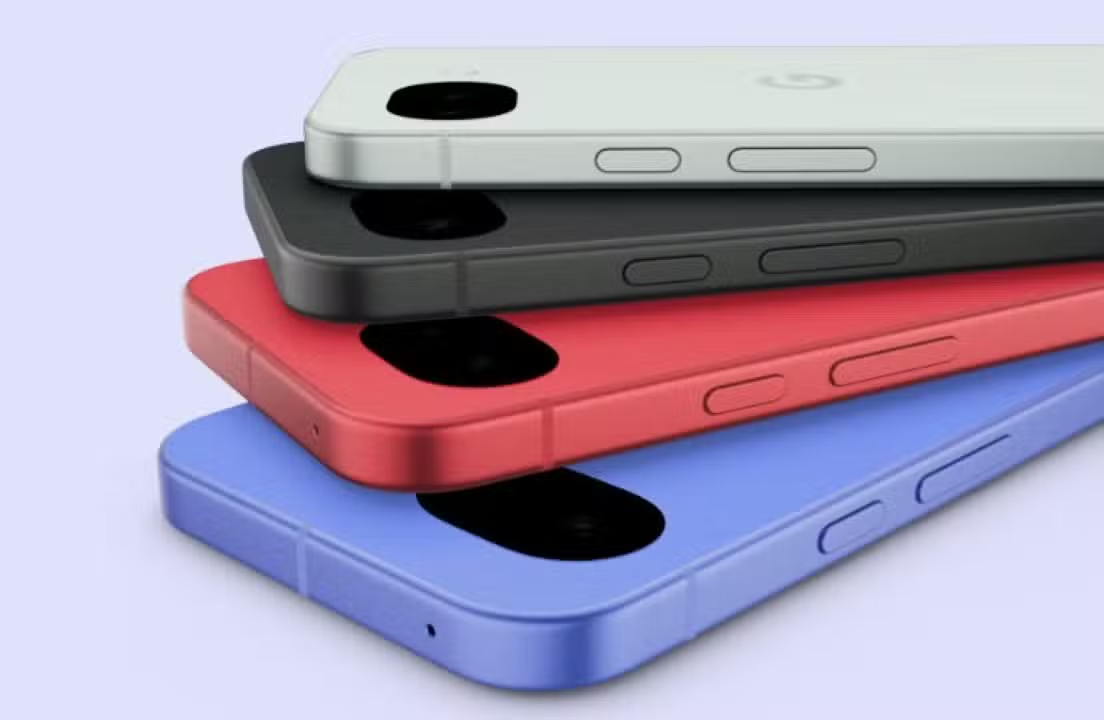
The North American technology giant has officially announced the arrival of its latest mobile device aimed at the high-performance mid-range segment. The device appears as a direct alternative for consumers looking for advanced specifications and an optimized software experience, without the need to invest the amounts charged for top-of-the-line models.
The manufacturer’s new bet maintains the line’s tradition of offering a robust photographic set combined with intelligent processing. The device has been available on international market shelves since the beginning of March, establishing a new standard of longevity for the mobile phone category.
Grab your Google Pixel 10a today ✨
Lavender, Obsidian, Berry, and Fog…pick your vibe!🪻🖤🍓💨🔗https://t.co/DDOk3kTiRI pic.twitter.com/xEA716Ie9F
—Google India (@GoogleIndia)March 6, 2026
With the promise of prolonged updates and a clean operating system straight from the factory, the smartphone tries to consolidate the brand’s presence in a highly competitive niche. The strategy involves delivering balanced hardware, focused on solving the main daily demands of modern technology users.
Physical structure and color options available
The development of the chassis prioritized ergonomics and ease of handling during long periods of continuous use. The device has exact dimensions of 153.9 millimeters high by 73 millimeters wide, with a thickness of 9 millimeters, resulting in a total weight of 183 grams. The product’s engineering combined resistant aluminum sides with IP68 certification, guaranteeing protection against immersion in water and resistance to dust accumulation. The big aesthetic difference is the rear camera module, which now adopts a completely flat format, eliminating any type of protrusion that could cause instability when the device is placed on a table or smooth surface.
The visual identity of the equipment maintains the characteristic consistency of the manufacturer’s product family, focusing on minimalist and functional lines. The front panel received fine adjustments that allowed a slight reduction in the edges around the display, maximizing the useful viewing area. Screen protection is guaranteed by Gorilla Glass 7i glass, designed to withstand accidental drops and everyday scratches. The product packaging follows a market trend aimed at reducing electronic waste, containing only items strictly essential for initial operation, as detailed below.
– Aparelho cell phone in the color chosen by the consumer.
– Cabo of data and power transfer in the USB-C standard.
– Ferramenta metal for extracting the SIM card drawer.
– Opções of shades: lavender, berry red, mist green and obsidian black.
Display quality and integrated audio system
The equipment’s screen uses Actua pOLED technology with a 6.3-inch diagonal size, delivering an Full HD+ resolution of 1080 by 2424 pixels. The panel has an adaptive refresh rate that automatically varies between 60 Hz and 120 Hz, adjusting fluidity according to the content displayed to optimize the component’s energy consumption.
The brightness level is one of the display’s high points, reaching peaks of 3,000 nits in specific media playback and maintaining an average of 2,000 nits in direct sunlight. The audiovisual set is complemented by stereo speakers that provide a high and well-distributed volume, as well as a fingerprint reader embedded under the screen that works in conjunction with the facial recognition system.
Internal processing and storage capacity
The engine that drives the smartphone’s operation is the Tensor G4 processor, developed by the manufacturer itself to maximize integration between hardware and software. The chip works together with 8 GB of RAM, a configuration that is sufficient to handle the quick transition between multiple applications open simultaneously.



The internal thermal management system has been redesigned to dissipate heat more efficiently during demanding tasks, such as running graphics-intensive games or prolonged high-resolution video recording. The consumer can choose between two versions of internal storage, the initial one with 128 GB and the more spacious one with 256 GB of capacity.
It is important to note that the project does not include memory expansion through microSD cards, requiring the user to choose the version appropriate to their needs at the time of purchase. The device’s connectivity includes support for 5G networks, the Wi-Fi 6E standard for more stable wireless connections, Bluetooth 6.0 and NFC technology for contactless payments.
Energy autonomy and recharge speed
The component responsible for keeping the device powered on is a power cell with 5,100 mAh of total capacity. Essa technical specification was designed to ensure that the user can get through a full day of moderate use without needing to look for an outlet.
Routines that involve constantly exchanging messages, browsing social networks and occasional photographic captures are easily supported by the energy management system. However, continuous use of hardware-intensive features, such as GPS navigation with the screen at maximum brightness, may require a supplementary charge in the late afternoon.
The power replenishment speed received a significant upgrade in this generation, now supporting plug adapters with up to 30W of power. Essa improvement allows the battery to recover half of its total charge in an interval of approximately thirty minutes when connected to the mains.
Magnetic induction charging is also present in the model, operating at a maximum speed of 10W. Para emergency situations, the software offers an extreme power saving mode that disables secondary functions and can extend the basic functioning of the phone for more than one hundred continuous hours.
Photographic performance and video recording
The main image capture module is equipped with a 48 megapixel sensor that works in conjunction with an optical image stabilization system. Essa combination of hardware allows the recording of photographs with a wide dynamic range, preserving details in both the brightest areas and the deepest shadows of the scene. The processing software works behind the scenes to ensure that the colors recorded are as true to reality as possible, avoiding the artificial saturation common in devices in this category. The dedicated night mode can balance exposure in low-light environments, significantly reducing unwanted grain in the night sky or indoors.
The secondary camera on the back uses an ultrawide lens with a 13 megapixel sensor, ideal for framing wide landscapes or large groups of people in well-lit locations. The front camera, also with 13 megapixels, was calibrated to preserve the natural tones of human skin, delivering consistent results for video calls and self-portraits. In the video department, the equipment is capable of recording images in 4K resolution at 60 frames per second on the main lens and 30 frames per second on the front lens. The photographic system also has tools based on artificial intelligence that help with scene composition and offer framing suggestions in real time.
Operating system and artificial intelligence tools
The device comes out of the box running the native version of Android 16, offering the software experience exactly as it was designed by the system’s developers. The user interface stands out for its fluid screen transitions and the absence of pre-installed third-party applications that tend to consume resources unnecessarily. The software package’s biggest differentiator is the deep integration with the Gemini virtual assistant, which operates proactively to facilitate everyday tasks. The system is capable of performing simultaneous translations of audio conversations, generating images from text descriptions using local processing and automatically identifying unwanted telemarketing calls. The tool that allows you to circle any item on the screen to perform an immediate search on the internet is also present, speeding up obtaining information without the need to switch applications. The manufacturer’s commitment to the security and longevity of the device is evidenced by the official guarantee of seven years of continuous updates, covering both new versions of the operating system and monthly vulnerability correction packages, something rare in the mid-range device segment.
Satellite communication and emergency resources
A vital safety feature built into the system is distress call functionality via satellite link. Essa technology allows the user to contact emergency services and share their exact location even when in remote areas, completely devoid of coverage by traditional cell phone networks or wireless internet signals.
Commercial positioning and launch values
The device was introduced to the North American market with a suggested price of $499 for the version with the smallest storage capacity and $599 for the model with more internal space. The manufacturer has not yet established an official date for the start of sales of the product in other regions, keeping availability restricted to selected markets at this point.
Acquiring the device through direct import ends up substantially increasing the final cost for the consumer, due to the incidence of customs fees and international shipping costs. In the current scenario, the model competes directly with established lines from other brands, betting on the superiority of its photographic processing and the extended warranty of software support to attract the public that values the long-term durability of the equipment.
Veja Tambem em News (EN)

Research reveals that parents are unaware of how their children use artificial intelligence

Samsung releases new system update with new features for Galaxy Watch 4 users

Digital retail reduces the value of the Galaxy S25 5G smartphone with bank bonuses and device exchange

Amazon’s wireless CarPlay adapter has a 50% discount and high approval ratings from drivers

Zach Cregger’s new Resident Evil ignores games and focuses on an unprecedented story with new characters

Rumor suggests that Nintendo is preparing a special edition of the Switch 2 with a remake of Ocarina of Time

Apple accelerates production of the iPhone 17e and develops new Air model with dual camera system

Epic Games platform releases twelve high-budget games at no permanent cost for PC users

PlayStation 5 Pro price drop accelerates digital retail sales and eliminates global stocks

New Galaxy Watch 9 firmware appears on server and confirms progress in software development

Apple’s commemorative project tests cell phone with 1.1 millimeter edge and curved screen for 2027
