
James Webb equipment detects 12 billion-year-old interstellar comet 3I/ATLAS

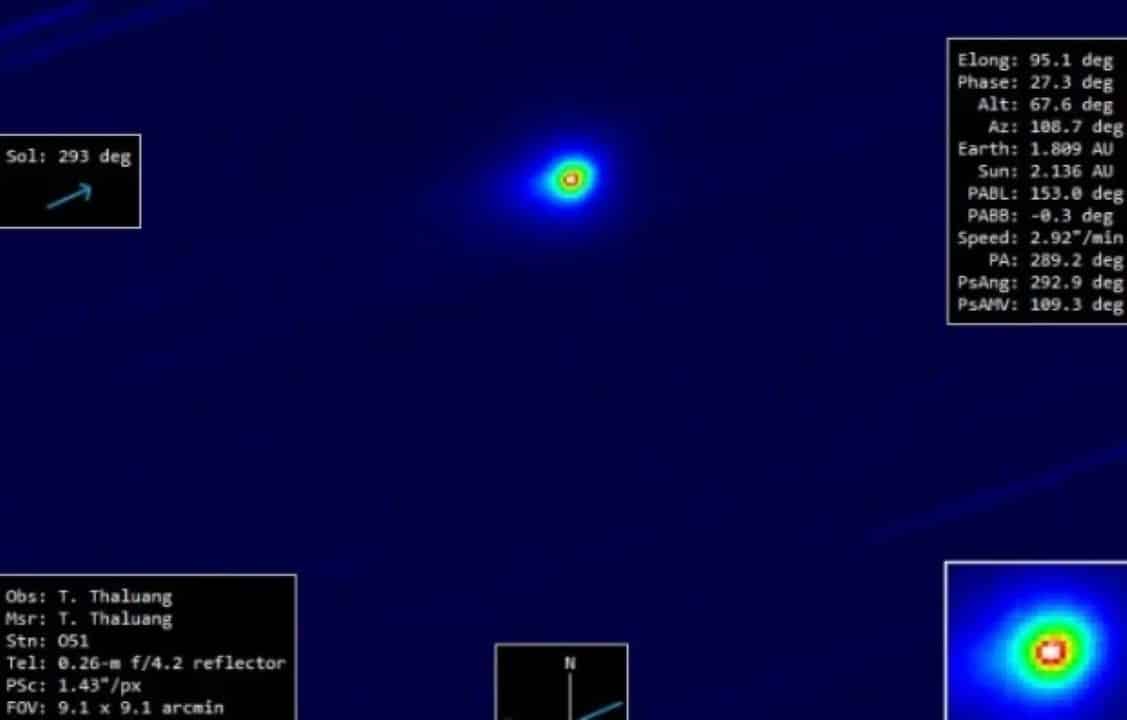
The international scientific community recorded the passage of a celestial body whose characteristics place it among the oldest objects ever documented in the history of space exploration. Trata is the interstellar comet 3I/ATLAS, which recently crossed the boundaries of our planetary system and was estimated to be between 10 and 12 billion years old by astronomical research teams.
This time frame indicates that the space rock was formed during the initial stages of structuring Via Láctea, shortly after the primordial events that gave rise to the universe. Para For direct comparison purposes, Terra and all of Sistema Solar are approximately 4.6 billion years old, which makes the interstellar visitor more than twice as old as our own cosmic habitat.
Detailed data on the object’s chemical composition and age were immediately available on scientific preprint platforms. Essa rapid release of captured metrics allows different global research centers to cross-reference information to understand the physical conditions prevailing in the universe during its initial formation phase.
Atypical trajectory and extreme speed in space
The identification of 3I/ATLAS occurred at a time when terrestrial monitoring systems recorded an object moving at a speed of 221 thousand kilometers per hour. Esse acceleration index is considered totally incompatible with the dynamics of celestial bodies that orbit Sol regularly.
In addition to the extreme speed, the angle of entry into the planetary system diverged abruptly from the standard orbital plane, where the planets and local comets are located. The Essa combination of physical factors provided definitive proof that the rock did not originate in the Nuvem of Oort or the Cinturão of Kuiper.
High-precision equipment, including the Telescópio Espacial Hubble, was directed to track the object’s rapid passage and establish its physical dimensions. Optical measurements determined that the comet’s nucleus has a variable diameter, estimated to be between 440 meters and 5.6 kilometers long.
After performing a gravitational assistance maneuver around Sol, the celestial body resumed its route towards deep outer space. The records point to unique characteristics, such as an entry route perpendicular to the plane of the Sistema Solar, an escape velocity greater than the gravitational attraction of the Sol and the absence of previous orbital interactions with local gaseous planets.
Data capture by infrared observatory
The precise determination of the comet’s advanced age depended directly on the technological intervention of Telescópio Espacial James Webb. The state-of-the-art equipment carried out focused observations exactly at the moment the object reached its closest approach to Terra, passing at a distance of 270 million kilometers.
The observatory’s high-sensitivity infrared sensors were able to capture the subtle chemical emissions coming from the comet’s coma. Essa cloud of gas and dust forms when solar radiation heats the icy surface, causing the sublimation of volatile materials that have remained frozen in the vacuum of space for millennia.
Chemical signature and isotope analysis
The material ejected by the cometary nucleus carries the exact composition of the place where the rock originally formed, functioning as an intact fossil record. By analyzing the spectrum of light that passes through these gases, scientific instruments can identify the chemical elements present and their respective concentrations. The main focus of the investigation was on isotopes, which are variants of the same chemical element with slightly different atomic masses. The specific ratio between different isotopes acts like an astronomical fingerprint, revealing the exact temperature and radiation conditions of the celestial body’s home environment.
The measurement results showed an atypical concentration of deuterium in the water ejected by 3I/ATLAS during its solar approach. Deuterium acts as a heavy isotope of hydrogen, and its abundance in this particular comet is drastically greater than that found in the water of Earth’s oceans or in comets native to our planetary system. Spectral analysis also detected significant anomalies in the carbon isotope ratio. Essa chemical divergence in relation to local patterns reinforces the thesis that the object condensed in a region of the galaxy with physical characteristics completely different from those that formed Sol.
Structural formation at extreme temperatures
The deuterium and carbon levels measured by the space observatory indicate that 3I/ATLAS materialized in an environment subjected to extreme and constant cold. Thermodynamic calculations applied by the researchers suggest that the region of origin had temperatures in the range of 30 kelvins, which is equivalent to approximately negative 243 degrees Celsius. Esse severe level of freezing is a physical factor strictly necessary to trap the observed isotopic ratios in the comet’s ice structure before stellar radiation could alter the local chemistry irreversibly. Astronomers estimate that this primordial cosmic nursery was, most likely, a dense protoplanetary disk, characterized as a vast structure of gas and dust rotating around a newborn star. The intact preservation of these primitive chemical characteristics transforms the comet into a true galactic fossil, offering modern science direct and tangible evidence about the exact composition of the molecular clouds that existed in the first billion years after the formation of the known universe.
Complex molecules in the early universe
The detection of structured molecular compounds in the comet’s ejected material raises fundamental questions about the distribution of essential elements across the galaxy. The presence of these molecules indicates that sophisticated chemical processes were already actively occurring in the early days of Via Láctea.
These processes are often associated with the basic building blocks necessary for the emergence of biological structures. The fact that an object more than 10 billion years old carries this chemical complexity suggests that precursor ingredients are not exclusive to younger stellar systems.
On the contrary, analyzes indicate that these elements may have been synthesized and spread throughout interstellar space long before the formation of Terra itself. Eles travel frozen within billions of wandering celestial bodies that continually cross the vast void between the stars.
Gravitational dynamics in Via Láctea
During its long journey of 12 billion years, the comet crossed different spiral arms of the galaxy, facing several changes in route. Cada passage near massive star systems, black holes, or dense molecular clouds exerted gravitational forces that subtly altered their original direction and speed.
This complex network of interactions acts as a mechanical system on a colossal scale, where every millennium the primary trajectory was erased by successive disturbances imposed by the galactic environment. Interstellar space functions as a dynamic medium in constant structural movement.
The enigma of the point of origin
Despite the wealth of chemical data collected by telescopes, tracking the exact star that served as cradle for 3I/ATLAS is considered an unfeasible procedure for current technology. Contemporary mathematical models cannot rewind the comet’s orbit with sufficient precision due to the countless deflections it has undergone, leaving the space rock as an anonymous messenger from a distant era.
Advances in modern astronomical exploration
The documented passage of this interstellar artifact validates recent investments in fast-scanning telescopes and infrared observatories focused on deep space. The technical ability to detect and analyze high-speed objects before they leave the solar system represents a significant leap forward for aerospace engineering.
Research centers now maintain continuous monitoring of the night sky, operating algorithms specifically designed to identify orbital anomalies in real time. The expectation of the scientific community is that new visitors from outside the solar system will be cataloged in the coming years, expanding the database on primordial chemistry.




