
New NTT Docomo fee increases upgrade cost for iPhone 17e by more than 50 thousand yen
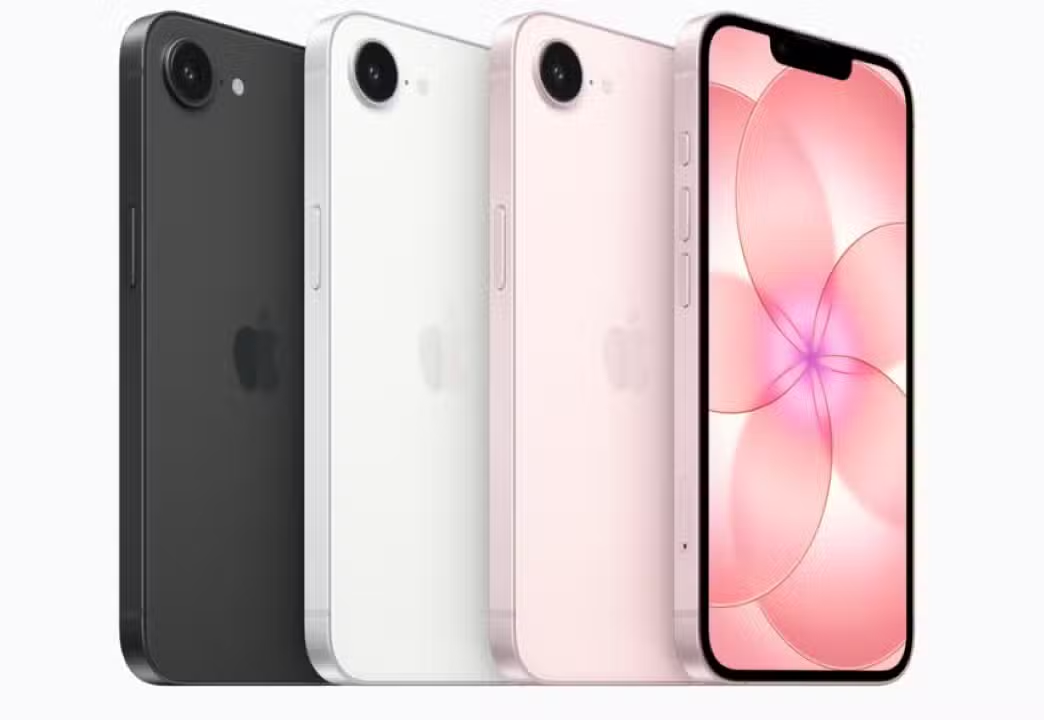
NTT Docomo implemented a substantial change to its Programa from Recall to The measure reconfigures the dynamics of acquiring cutting-edge mobile devices, with immediate impacts on the costs assumed by consumers in the telecommunications market. The main focus of recent sector analyzes falls on the recently launched iPhone 17e, whose purchase conditions highlight the operator’s new commercial stance in relation to hardware subsidies.
The device from the North American manufacturer, in its version with 256 GB of internal storage, is listed on the operator’s official channels for 119,900 yen. Este amount is considerably higher than the list price of 99,800 yen charged directly in the official stores of the brand that created the device. The financial engineering behind the return program establishes a residual value of the equipment after a period of 24 months of use, which varies drastically depending on the nature of the customer’s contractual relationship with the company providing the service.
For users who perform number portability or sign new service contracts, the residual value of the smartphone is set at 76,560 yen. On the other hand, customers already integrated into the operator’s base who just want to update their models face a residual value reduced to 60,720 yen. The combination of this mathematical difference with the new usage rate creates a financial abyss between the different profiles of consumers seeking access to cutting-edge technology.
Structural changes in device financing
The introduction of the 22,000 yen fee acts directly on the financing modality with a return option, a format widely adopted in the telecommunications sector to facilitate access to high initial cost hardware. The mechanism works as a type of extended lease, where the customer pays a fraction of the total value of the device over two years and, at the end of the stipulated cycle, returns the equipment in good condition to pay off the remaining outstanding balance. The additional charge applies exactly when the user decides to exercise this return option to purchase a more modern smartphone within the same company’s portfolio.
Regulatory guidelines for the communications sector impose strict limits on the direct discounts that operators can offer when selling devices, aiming to maintain healthy competitiveness and avoid monopolies in the market. Para To circumvent these legal restrictions and continue to subsidize equipment indirectly, companies adjust residual values and create specific operating rates for different scenarios. In the case of the operator in question, exemption from the new fee only occurs in very specific situations, such as transactions carried out exclusively through the company’s virtual environment or by joining loyalty programs based on the accumulation of monthly points.
Discrepancy in values between contract types
Number portability is consolidated as the most advantageous option within the current price structure presented to consumers. Customers from competing companies receive aggressive financial incentives to permanently migrate their telephone lines.
One of the main attractions of this modality is the welcome discount for 5G technology, which injects a direct rebate of 43,307 yen into the total cost of the commercial operation. Esse benefit intentionally approaches the maximum limit of 44,000 yen allowed by regulatory authorities for subsidies for devices linked to communication plans.
When this significant discount is added to the higher residual value guaranteed to new entrants, the monthly cost of the device drops sharply. In specific configurations of data plans and device models, the monthly hardware charge can be reduced to almost nominal amounts during the loyalty period.
The strategy demonstrates a clear focus on rapidly expanding the subscriber base by actively capturing users from direct competition. The operator absorbs a significant portion of the cost of the initial handset to ensure recurring and ongoing revenue from service packages in the long term.
Direct impact on the consumer’s pocket
Financial mathematics applied to internal model changes reveals a largely unfavorable scenario for the provider’s veteran customers. The absence of welcome discounts, added to the lower residual value established in the contract, substantially increases the amount that the user needs to pay over the 24 months of continuous use.



The disparity becomes undeniable when analyzing the final effective cost of the technological update operation. Enquanto a portability customer may have an effective cost of around 22,033 yen for the period of use of the newly launched device, the user who only upgrades the model within the same operator faces an approximate cost of 81,180 yen for the same hardware conditions.
This nominal difference, which exceeds the 50,000 yen mark, represents a considerable financial barrier to maintaining the consumption cycle. The extra amount required from loyal customers raises practical questions about the economic viability of constantly updating equipment through the service provider’s official sales channels.
Strategies for attracting new users
The mobile phone market has historically operated with narrow profit margins and high user saturation, which makes acquiring new customers a complex and highly expensive operation. Operators use the annual launches of high-end smartphones as primary commercial tools to move industry statistics.
By heavily subsidizing the device for those who bring the number from another network, the corporation is betting on the full recovery of the investment through fixed monthly fees for data, voice and value-added service packages. The aggressive pricing tactic aimed exclusively at entrants is a classic mechanism for expanding market share in the consumer technology segment.
Barriers to retaining the current base
The direct counterpart to this massive attraction policy is the potential dissatisfaction of the user base already established and active on the network. The clear perception that prolonged brand loyalty results in higher operating costs for the acquisition of material goods can generate an organic movement of evasion towards rival companies that offer similar entry conditions.
The progressive increase in the price of internal model changes forces the average consumer to reevaluate their stay with the operator at the exact moment they decide to change their cell phone. The absence of robust financial incentives for retention creates a business environment ripe for increased customer churn in the telecommunications ecosystem.
Comparison with previous generations of smartphones
Analysis of the recent history of mobile device launches highlights a profound change in attitude when formulating prices and subsidies. Durante the commercial cycle of the previous generation of devices, the financial disparities between the different types of contracts were considerably less pronounced and punitive for the domestic consumer. On a specific occasion, the discount applied for number portability was around 42,570 yen, and the residual value of the equipment remained fixed in the range of 66,000 yen, regardless of the type of transaction carried out by the end user. The effective cost for those switching operators was 1,210 yen divided into monthly installments, while internal model switching reached around 38,280 yen. The current review of the financing program has drastically widened this financial gap, indicating that the corporation has chosen to severely restrict internal subsidies to offset rising operating costs, a marketing trend that is also beginning to be observed in negotiations involving premium devices from other competing operating systems.
Purchase alternatives in the technology market
Given the new pricing scenario and the restrictions imposed by return contracts, the direct acquisition of unlocked equipment in traditional retail or in the manufacturers’ own official stores appears as a highly attractive route for consumers who wish to avoid additional usage fees and the financial constraints of extended loyalty plans.
Veja Tambem em News (EN)

Research reveals that parents are unaware of how their children use artificial intelligence

Samsung releases new system update with new features for Galaxy Watch 4 users

Digital retail reduces the value of the Galaxy S25 5G smartphone with bank bonuses and device exchange

Amazon’s wireless CarPlay adapter has a 50% discount and high approval ratings from drivers

Zach Cregger’s new Resident Evil ignores games and focuses on an unprecedented story with new characters

Rumor suggests that Nintendo is preparing a special edition of the Switch 2 with a remake of Ocarina of Time

Apple accelerates production of the iPhone 17e and develops new Air model with dual camera system

Epic Games platform releases twelve high-budget games at no permanent cost for PC users

PlayStation 5 Pro price drop accelerates digital retail sales and eliminates global stocks

New Galaxy Watch 9 firmware appears on server and confirms progress in software development

Apple’s commemorative project tests cell phone with 1.1 millimeter edge and curved screen for 2027
