
Rupture of hardened crust in 3I/Atlas releases organic molecules such as methanol, water and hydrocyanic acid on an interstellar trajectory

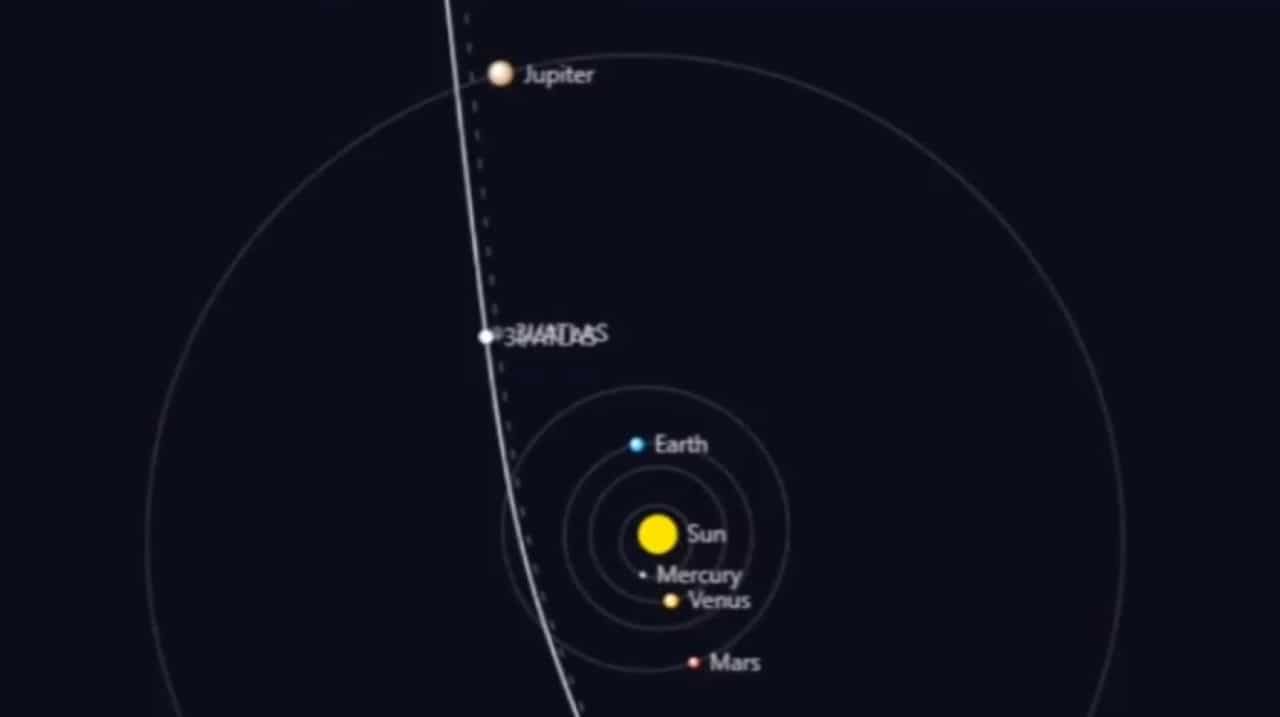
The interstellar comet 3I/Atlas, identified as the oldest ever observed in Sistema Solar, continues to surprise the scientific community with new analyzes of its chemical composition. Descoberto in July 2025 by the ATLAS telescope system in Chile, the object follows a hyperbolic orbit that confirms its origin from outside our planetary system. Durante the recent passage through perihelion, intense solar radiation ruptured a hardened outer layer, releasing compounds that had remained sealed for billions of years. Observações carried out by several instruments, including ground-based telescopes and the James Webb, detected methanol in concentrations significantly higher than those recorded in Sistema Solar’s native comets.
The presence of hydrocyanic acid, water and various forms of carbon was also confirmed by detailed spectroscopy. Esses findings occur after the comet crossed the neighborhood of Júpiter on March 16, 2026, approximately 0.358 astronomical units from the giant planet. The gravitational interaction caused small changes in the trajectory, but it was not enough to change the object’s interstellar destiny. The high speed relative to the Sol, close to 68 km/s, ensured that the 3I/Atlas continued its journey out of the Sistema Solar without being captured. Telescópios positioned at different points on the Terra and in space captured gas and dust emissions during this critical phase.
Hardened outer crust as cosmic shield
The surface layer of 3I/Atlas, estimated to be about 20 meters thick, has undergone chemical transformations throughout its long exposure to interstellar space. Raios galactic cosmics bombarded the frozen material for eons, resulting in a crust that was denser and more resistant to initial sublimation.
This structure worked as a natural barrier, preventing the early release of volatile molecules. Somente after months of gradual heating by Sol the crust gave way, allowing intense jets to expel the internal contents. The process revealed preserved chemistry dating back to periods long before the formation of Sistema Solar.
Compounds such as methanol appeared in high proportions, exceeding by up to four times the average values observed in comets from the Kuiper or Nuvem belt of Oort. Hydrocyanic Ácido appeared in detectable amounts, reinforcing its potential role in prebiotic reactions.
🚨BOOZY ALIEN COMET ☄️
— 3I/ATLAS updates (@Defence12543)March 13, 2026
Scientists studying the interstellar comet 3I/ATLAS say it’s “bursting with alcohol.”😳
⚠️Using data from the Atacama Large Millimeter/submillimeter Array, researchers detected huge amounts of methanol gas pouring from the comet as it warmed near the…pic.twitter.com/CcXfXA8URS
Unusual activity and unique features
3I/Atlas exhibited behavior that clearly differentiates it from local comets. Non-gravitational Aceleração was recorded, indicating asymmetric release of gases. The coma expanded rapidly after perihelion, reaching visible diameters of hundreds of thousands of kilometers.
Multiple tails formed, including an antitail opposite the direction of Sol. Mudanças in the color of the coma suggests variations in the composition of dust and ice. Observações from ALMA confirmed methanol emission peaks at specific moments in the trajectory.
The presence of carbonyl sulfide and traces of ionized nickel complements the chemical profile. Essas detections indicate that the comet carries a complex mix of organic and inorganic molecules.
Age greater than 10 billion years
Estimates based on models of stellar evolution and isotopic composition indicate that 3I/Atlas is between 10 and 12 billion years old. Essa age group makes it older than Sistema Solar itself, whose formation dates back approximately 4.6 billion years.
The object likely originated in the thick disk of Via Láctea, a region rich in old stars and poor metals. Materiais preserved inside represent a chemical sample from the early phases of the galaxy.
This antiquity makes it possible to study processes that occurred long before planetary formation. Compostos organics detected suggest that prebiotic blocks may have formed in primitive stellar environments and survived interstellar travel.
Passage close to Júpiter and data collected
The approach to the giant planet occurred without drastic disturbances in the orbit. The comet briefly crossed the sphere of Hill and Júpiter, an area where the planet’s gravity temporarily dominates.
Instruments on the Juice mission and ground-based telescopes captured high-resolution images of the coma and tails. Espectros obtained at this stage revealed variations in the sublimation rate of different compounds.
Methanol emission data shows significant increase during gravitational interaction. Essas observations help calibrate models of cometary activity under extreme conditions.
Nuclear structure and detected emissions
The nucleus of 3I/Atlas has dimensions estimated between 440 meters and 5.6 kilometers, with an elongated shape typical of many comets. Imagens of Hubble indicate slow rotation and ejection of material in directional jets.
Emissions include carbon dioxide, carbon monoxide and silicate dust. The presence of water, although in a smaller fraction than in solar comets, confirms chemical diversity among interstellar visitors.
The combination of organic molecules reinforces the hypothesis of a widespread distribution of biological precursors in the cosmos.
Implications for cosmic chemistry
3I/Atlas demonstrates that hardened crusts can protect volatile compounds for billions of years in the interstellar vacuum. Quando heated by a nearby star, these materials release, revealing potentially prebiotic chemistry.
The detection of methanol in high concentration suggests that this molecule can act as an intermediary in more complex syntheses. Hydrocyanic Ácido, in turn, participates in known pathways for the formation of amino acids and nucleotides.
These observations indicate that fundamental ingredients for biological processes may be widespread on interstellar scales.
Future trajectory and scientific legacy
After leaving the neighborhood of Júpiter, 3I/Atlas heads towards deep interstellar space. Sua trajectory avoids close encounters with other giant planets, guaranteeing definitive exit from Sistema Solar.
The comet will remain active for some time, but will gradually return to an inert state. Dados accumulated during your passage remain available for future analysis.
The 3I/Atlas visit enriches the knowledge base about interstellar objects. Observações details of this body provide clues about the early chemistry of the universe.



