
Astronomers discover new type of exoplanet with sulfur-rich magma ocean 35 light years away

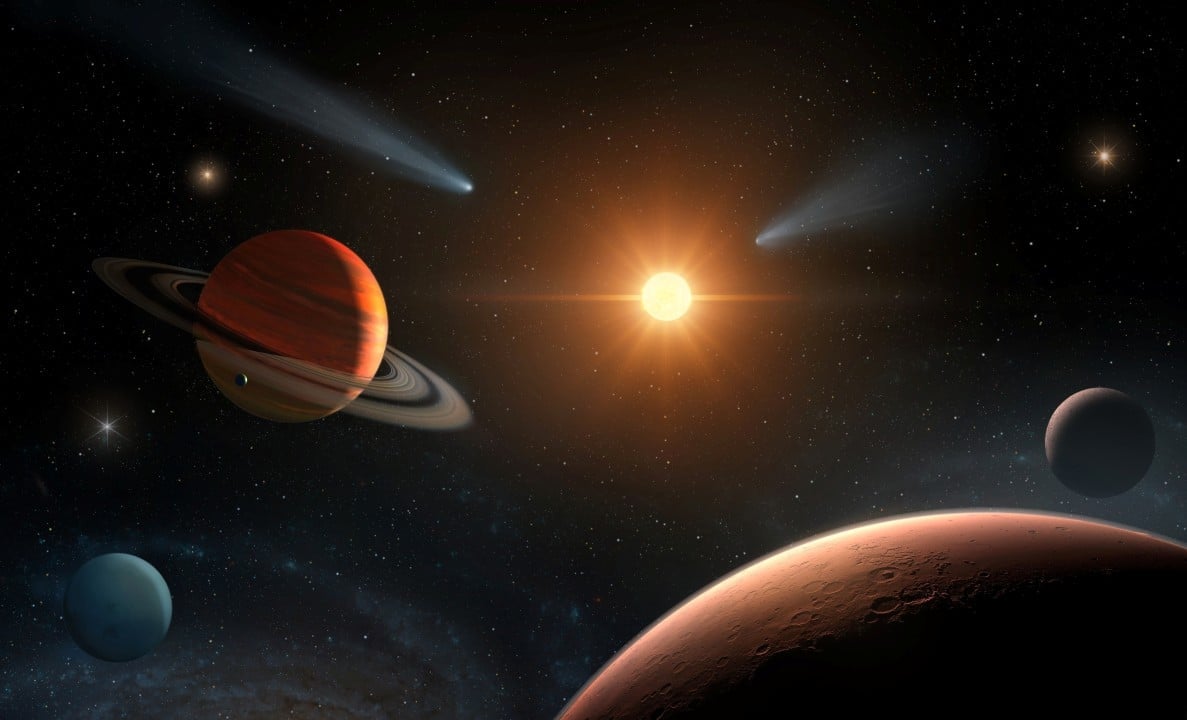
Astronomers from Universidade to Oxford, in international collaboration, have identified an exoplanet that presents unique characteristics and defies traditional planetary classifications. The celestial body L 98-59 d, located about 35 light-years from Terra, orbits a low-mass red dwarf and maintains a global ocean of magma on its surface. Temperaturas exceeding 1,500 °C prevent rocky material from solidifying, while the dense atmosphere carries sulfur compounds detected by the James Webb space telescope. Hydrogen sulfide present in the atmosphere produces the characteristic smell of rotten eggs, although the planet remains inhospitable to any known form of life.
The analysis combined spectroscopic observations of James Webb with detailed computer simulations of the planet’s internal evolution. Resultados published in Nature Astronomy in March 2026 shows that the planet has 1.6 times the radius of Terra and a reduced density, compatible with a large amount of volatiles retained inside. Esses volatiles, especially sulfur, are released gradually over billions of years, sustaining a thick atmosphere rich in hydrogen and sulfur compounds.
Extreme features of the magma ocean
The magma ocean covers the entire surface of the planet and extends into deep layers of the mantle. Rochas melted silicates form this permanent liquid reservoir, which stores sulfur in high concentrations.
The proximity to the host star generates intense heating by radiation and tides, maintaining the molten state. Esse process prevents the typical cooling observed on more distant rocky planets.
Toxic atmosphere and chemical processes
The atmosphere of L 98-59 d results from continuous degassing of the magma ocean. Compostos as hydrogen sulfide and sulfur dioxide dominate the detected composition.
Photochemical reactions driven by the red dwarf’s ultraviolet radiation transform the released gases. Esse chemical cycle contributes to a powerful greenhouse effect that reinforces high temperatures.

James Webb data and computational modeling
Transit observations with the James Webb telescope captured clear spectral signatures of SO₂ and H₂S. Esses signs indicate active release of sulfur from the interior.
Simulations have reconstructed the planet’s thermal history since its formation. The models show retention of volatiles that explain the low density observed.
- Spectral signals confirm the presence of sulfur at levels greater than 1.5% of the mass.
- The planet’s average density is around 2.2 g/cm³.
- Magma oceans last billions of years on planets near red dwarfs.
New class of sulfur-rich exoplanets
L 98-59 d does not fall into the known categories of rocky planets or oceanic worlds. The structure suggests a broad population of exoplanets with persistent magma oceans and sulfurous atmospheres.
Researchers propose that these worlds represent a common early phase in planetary formation. The finding expands the known diversity of exoplanets in Via Láctea.
Insights into early planetary formation
Magma oceans existed in Terra and Marte during their early phases. Estudos of L 98-59 d provide analogies for understanding ancient processes on Sistema Solar planets.
Remote reconstruction of the interior demonstrates the power of today’s tools. Astrônomos access information about deep layers without direct observation.
Inhospitable conditions and scientific implications
Extreme temperatures and a toxic atmosphere exclude habitability on the planet. The focus of research remains on planetary physics and chemical evolution.
The planet was initially detected by TESS in 2019. Subsequent Observações of James Webb between 2024 and 2026 revealed its unique properties.



