
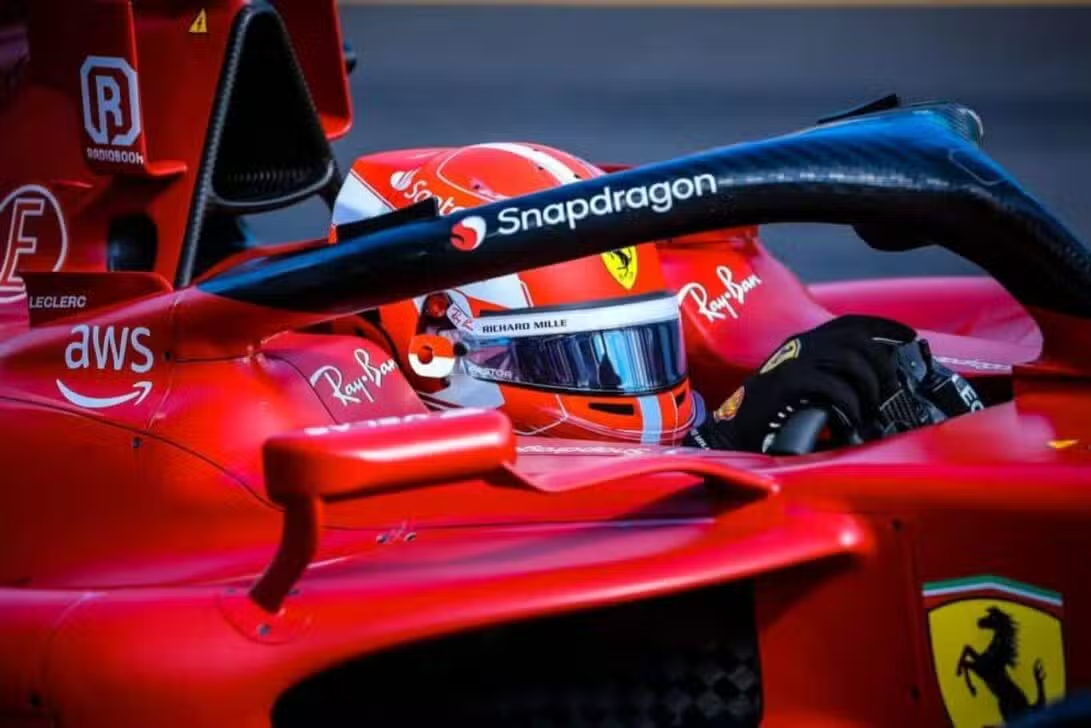
The driver Charles Leclerc, representative of the team pilot. The positioning took place shortly after the Grande Prêmio of the
Leclerc’s satisfaction with the car’s dynamic behavior did not prevent him from pointing out structural flaws that, according to him, distort the traditional competition format. The pilot highlighted that the current classification system lacks essential elements that define the essence of Fórmula 1, requiring urgent adjustments by Federação Internacional of Automobilismo. Entre the main points of his analysis stand out:
- Excessive complexity in power management during fast qualifying laps.
- Significant reduction in downforce compared to models used until 2025.
- The need for more cerebral riding and less focused solely on pure speed in certain sections.
- The direct impact of batteries on the final performance of a launched lap.
Balance between fun and artificiality on the slopes
The Monegasque driver detailed that the experience inside the cockpit changed drastically with the introduction of new overtaking buttons and extra boost systems based on electrical energy. According to the athlete, although there are times when the competition seems artificial due to the sudden depletion of an opponent’s batteries, the overall result is constant learning about the limits of the equipment. Leclerc believes that drivers are better understanding the windows of opportunity to risk maneuvers, which has generated unprecedented overtaking points on international circuits.
This positive perception contrasts sharply with the tone adopted by current champion Lando Norris and four-time champion Max Verstappen, who were vocally opposed to the changes. Verstappen even abandoned the Chinese stage and reinforced his dissatisfaction with the excess of electronic management, stating that the focus was diverted from racing ability to systems monitoring. Leclerc prefers to focus on the tactical aspect, mentioning that intense battles, like the one he fought with his companion Lewis Hamilton, prove that the entertainment is still present.
Internal dispute at Ferrari and energy management
The race in Xangai served as a practical laboratory for Leclerc to test new direct combat technologies under the 2026 regulations. Mesmo finishing behind the seven-time champion, who secured third place on the podium, Charles celebrated the quality of the dispute and the honesty of the fight between the two cars of the Italian team.
Battery management has become the heart of racing strategy in this new era, requiring drivers to make split-second decisions about when to expend or regain charge. The energy recovery system now relies heavily on specific riding techniques and previous engine map settings. Para Leclerc, this extra layer of strategy makes the event more interesting for those who like to understand the mechanics of the sport, although I admit that the difference in speed between a loaded car and an exhausted one can be brutal.
Technical changes and active aerodynamics in focus
The technical revolution of 2026 brought smaller, lighter cars equipped with active aerodynamics, a technology that changes the position of the wings to reduce drag on straight lines and increase pressure in curves. Essas innovations aim to make it easier to chase nearby cars, minimizing the effect of dirty air that hampered overtaking in previous years. Contudo, the trade-off is more skittish handling and a total dependence on the electrical flow to maintain competitiveness throughout the entire length of a lap.
- Vehicles now have reduced dimensions to favor battles on narrow circuits.
- Electrical power increased its share in the total output of the power unit.
- Mobile aerodynamic systems act automatically depending on the car’s speed.
- The minimum weight has been adjusted to compensate for the larger size of high-performance batteries.
Perspective of adjustments by Federação Internacional of Automobilismo
Recognizing the climate of partial dissatisfaction among competitors, the FIA leadership has already signaled that the regulations may undergo technical revisions this season. Nikolas Tombazis, the entity’s director of single-seaters, publicly admitted that energy use did not reach the adequate balance level originally planned. The federation is now working together with the teams to refine the way in which the power bonus is delivered to drivers, aiming to reduce the feeling of artificiality mentioned by Leclerc.
Leclerc maintains confidence that the category is on the right path, but reinforces that the classification needs to regain its characteristic shine. Ele argues that the current format makes the driver feel that something fundamental is missing from the experience of being the fastest on the track. The FIA is studying changes to specific energy delivery modes for qualifying training, allowing cars to operate at maximum capacity without the severe economy restrictions imposed during the racing regime.
Technological reality versus the essence of pure motorsport
The debate initiated by Leclerc and its rivals reflects a historical Fórmula 1 dilemma between technological innovation and sporting purity. The intensive use of energy recovery via braking and gear reduction requires a riding style that many consider far from the ideal of an elite driver simply accelerating. However, for Ferrari and its representatives, adapting to this new reality is what will define the winners of the next constructors’ and drivers’ world championships.
Kimi Antonelli’s performance in the China also serves as a reminder that young talent is quickly adapting to the new demands of next-generation hybrid engines. Enquanto veterans complain about the weight and complexity, the new guard seems to find ways to extract performance where it didn’t exist before. Charles Leclerc stands as a bridge between these two worlds, accepting technological modernity but demanding that sport not lose its primary competitive identity in the face of so many lines of code and sensors.
Challenges in qualifying for the front riders
Leclerc’s criticism of the classification model focuses on the impossibility of performing perfect laps without the battery disproportionately interfering with the final result. On circuits with many full acceleration zones, the risk of “clipping” — when the electrical system cuts power before the end of the straight due to lack of load — is constant. Isso creates frustration for pilots who manage to make purple sectors, but lose all the time gained in the final meters due to electronic and non-human limitations.
The paddock’s expectation is that conversations between the drivers and race management will result in a relaxation of the energy flow rules for Saturday’s sessions. Leclerc believes that if this adjustment is made, the 2026 cars will be remembered as some of the most challenging and rewarding to drive in recent history. Ferrari continues to invest heavily in simulations to give its pilots the best possible engine configuration, trying to mitigate the negative effects highlighted by its main pilot.
Impact of new power units on performance
The 2026 power units were designed to be more sustainable, using 100% renewable fuels and eliminating the MGU-H system, which recovered heat from the turbo. Essa change simplified some aspects of the thermal engine, but overloaded the MGU-K system, responsible for collecting energy from braking. Como result, the car depends much more on dynamic behavior when entering curves to charge the batteries that will be used when exiting.
This scenario requires the pilot to change his traditional route in search of more regeneration, which Leclerc considers an interesting tactical exercise, but which others see as an obstacle to speed. The racing dynamics changed to a game of “wait and attack”, where whoever saves the best can make the decisive overtake at the right moment. Charles argues that this track intelligence is a positive differentiator, transforming Fórmula 1 into a sport where the mind is as important as the right foot.
Expectations for the next stages of the World Cup
With partial approval from Leclerc, Ferrari seeks to consolidate its position as the leading force capable of challenging the technical dominance that other teams have established in previous years. Maranello’s team appears to have interpreted the regulation in a way that favors Charles’s style, allowing him to have fun while managing complex systems. The focus now turns to the upcoming races at Europa, where more traditional circuits will test the effectiveness of active aerodynamics in high-speed corners.
The evolution of the 2026 car concept is still in its early stages, and feedback from experienced drivers like Leclerc is critical to the long-term success of the project. If the FIA manages to balance the diversity of opinions and adjust the classification format, the category could enter a period of stability and great shows. For now, the Ferrari driver remains a lone voice of enthusiastic optimism, hoping that his rivals will also find the fun promised by the new machines.