March equinox equalizes length of days and nights and changes seasons in both hemispheres
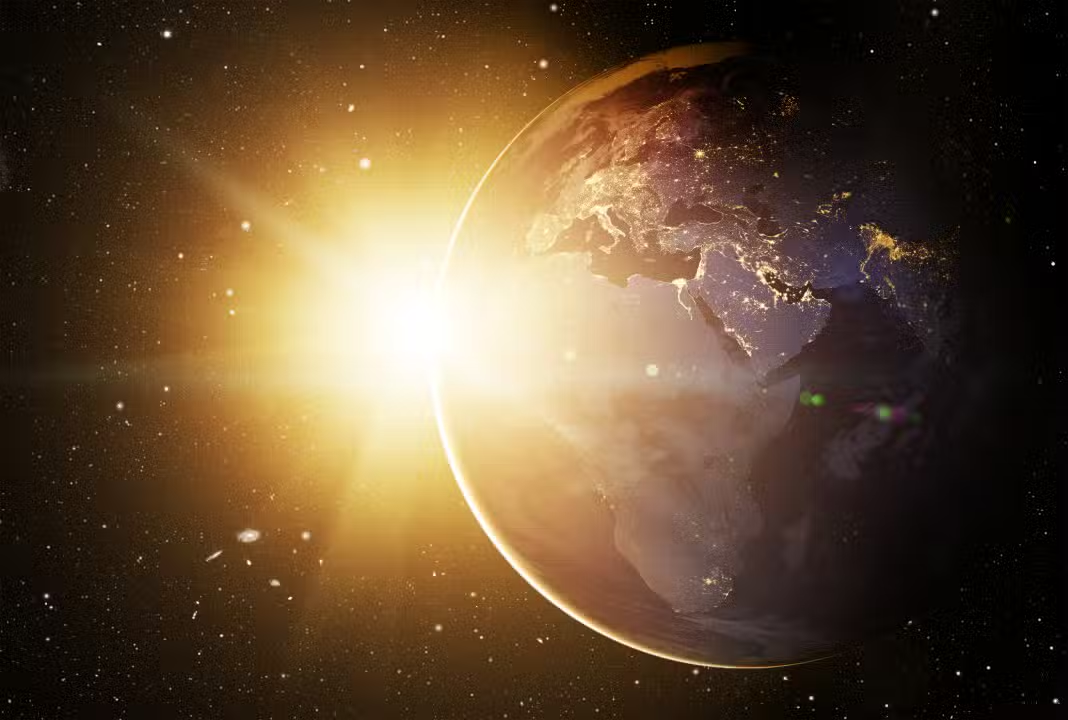
The astronomical event that marks the transition of the seasons officially occurred at 2:46 pm on Tempo Universal Coordenado, reconfiguring the distribution of sunlight over the planet. Neste at the exact moment, Sol crossed the imaginary line of the celestial equator, moving from south to north, which results in practically symmetrical lighting for both sides of the Earth’s globe.
The occurrence of this phenomenon establishes the beginning of spring in Hemisfério Norte and autumn in Hemisfério Sul. The main characteristic of this date is the almost identical duration between daytime and nighttime in all regions of Terra, with variations of just a few minutes depending on the observer’s latitude.
From this orbital landmark, the dynamics of sunlight undergoes a progressive and constant change. The inhabitants located north of the equator begin to experience gradually longer days, while the populations located in the southern portion of the planet observe the daily shortening of sunlight until the arrival of the next solstice.
Orbital dynamics and the positioning of the planet’s axis
The word that gives the phenomenon its name comes from Latin and literally translates as equal nights, a definition that accurately describes the celestial mechanics of this specific moment of the year. The inclination of the axis of rotation of Terra, which is approximately 23.5 degrees and is truly responsible for the existence of the seasons, reaches a position of neutrality in relation to the sun’s rays. Durante this brief period, the axis neither points towards the central star of the solar system nor moves away from it, allowing light radiation to reach both geographic poles in a simultaneous and balanced manner.
This unique geometric configuration in space causes Sol to rise exactly at the east cardinal point and set exactly at the west cardinal point, regardless of the observer’s geographic location on the Earth’s surface. At the equator, the star is positioned directly at the zenith at local noon, a condition that almost completely eliminates shadows cast by vertical objects. Trata is a precise mathematical alignment that demonstrates the regularity of our planet’s orbital movements and serves as a fundamental basis for counting time and structuring the calendars used by humanity over the millennia.
Differences between station measurement methods
The definition of the beginning of seasons varies significantly depending on the observation method adopted by different fields of science. The astronomical approach is based exclusively on the physical position of Terra in its elliptical orbit around Sol, using the equinoxes and solstices as exact and indisputable transition markers.
On the other hand, meteorology and climatology institutes adopt a different system, based on fixed annual climate cycles and the thermal inertia of the atmosphere and oceans. Neste model, the seasons are divided into exact blocks of three full calendar months, which makes compiling data and carrying out statistical analysis immensely easier.
For meteorologists, spring in the north and autumn in the south invariably begin on the first day of March, disregarding the orbital alignment that occurs weeks later. Esta standardization is essential for creating consistent climate databases and for comparing historical records of temperature and precipitation over decades.
The coexistence of these two systems meets different scientific needs. Enquanto astronomy seeks the mathematical precision of planetary movement, meteorology prioritizes the practical organization of atmospheric information to predict trends and understand global climate changes in a more structured way.
Optical illusions and the role of atmospheric refraction
Although astronomical theory indicates that day and night should be exactly twelve hours long during the phenomenon, the reality observed on the Earth’s surface presents a slight discrepancy. Esta difference occurs due to a physical principle known as atmospheric refraction, which acts like a gigantic lens around the planet.



The layer of gases that make up the Earth’s atmosphere deflects the light rays emitted by Sol when it is close to the horizon. Como A direct result of this luminous curvature, the solar disk becomes visible to observers a few minutes before it actually crosses the horizon line at dawn and remains visible minutes after it has geometrically set.
In addition to the atmospheric factor, the very definition of sunrise and sunset contributes to slightly longer days. The day is counted from the moment the upper edge of Sol appears on the horizon, not its center, adding extra daylighting time that breaks the perfect symmetry suggested by pure orbital calculation.
Radical transformations in the polar extremes of the globe
Regions located at the extremes of the Earth’s axis experience the most dramatic changes during this phase of the astronomical calendar. Geographic No Polo Norte, the phenomenon marks the exact moment when Sol appears on the horizon after six months of continuous darkness, ending the long polar night and beginning a period of uninterrupted light that will last until September.
Simultaneously, Polo Sul experiences the diametrically opposite process. The solar system’s central star slowly disappears below the horizon, plunging the Antarctic continent into a semester of deep darkness and extreme temperatures. Esta radical alternation of luminosity dictates the pace of scientific research and the survival of fauna adapted to these inhospitable conditions.
Architectural alignments and cultural heritage of ancient civilizations
The recognition of this orbital landmark transcends modern science and finds deep roots in the history of architecture and the traditions of several ancient civilizations. In archaeological complexes spread across the world, the domain of astronomical knowledge was immortalized in stone by people who depended on the accurate reading of the sky for agriculture and survival. The most notorious example of this technical mastery is found in Península of Yucatán, in México, where the pyramid of Kukulcán, in Chichén Itzá, was designed with frightening mathematical precision. Durante the dusk of days close to the seasonal transition, sunlight falls on the monument’s stairs in such a way that the projected shadows create the perfect optical illusion of a giant serpent descending the stone steps to the base of the structure. Este visual spectacle, which draws crowds of observers and researchers annually, demonstrates how the Maya synchronized their monumental architecture with the celestial calendar. Fenômenos similar intentional solar alignments are recorded in other global historical structures, showing that the search for understanding and demarcating the balance point of sunlight is an inherent characteristic of the development of human societies over the millennia.
Biological responses to new light patterns
The change in the daily amount of sunlight acts as a fundamental biological trigger for terrestrial ecosystems. The photoperiod, which is the proportion of time exposed to light, regulates vital processes in nature, from the migration of birds and the reproductive cycle of mammals to the flowering of plant species, which depend on this astronomical signaling to begin their growth or dormancy phases.
Lighting trajectory for subsequent months
Following the consolidation of this astronomical milestone, the distribution of solar energy over the planet’s surface enters a phase of progressive imbalance. Hemisfério Norte will receive an increasingly greater and more direct load of solar radiation, which will result in a gradual increase in average temperatures and a significant extension of the hours of natural light during the afternoons.
This process of warming and daytime expansion in the north will continue uninterruptedly until reaching its peak in June. Enquanto this, nations located south of the equator will face the continuous cooling of their air masses and a daily reduction in sunshine time, preparing the atmospheric scenario for the arrival of harsh winter in their most extreme latitudes.
Veja Tambem em News (EN)

Research reveals that parents are unaware of how their children use artificial intelligence

Samsung releases new system update with new features for Galaxy Watch 4 users

Digital retail reduces the value of the Galaxy S25 5G smartphone with bank bonuses and device exchange

Amazon’s wireless CarPlay adapter has a 50% discount and high approval ratings from drivers

Zach Cregger’s new Resident Evil ignores games and focuses on an unprecedented story with new characters

Rumor suggests that Nintendo is preparing a special edition of the Switch 2 with a remake of Ocarina of Time

Apple accelerates production of the iPhone 17e and develops new Air model with dual camera system

Epic Games platform releases twelve high-budget games at no permanent cost for PC users

PlayStation 5 Pro price drop accelerates digital retail sales and eliminates global stocks

New Galaxy Watch 9 firmware appears on server and confirms progress in software development

Apple’s commemorative project tests cell phone with 1.1 millimeter edge and curved screen for 2027