
Astronomers detect colossal collision between two giant exoplanets 1,800 light years from Earth
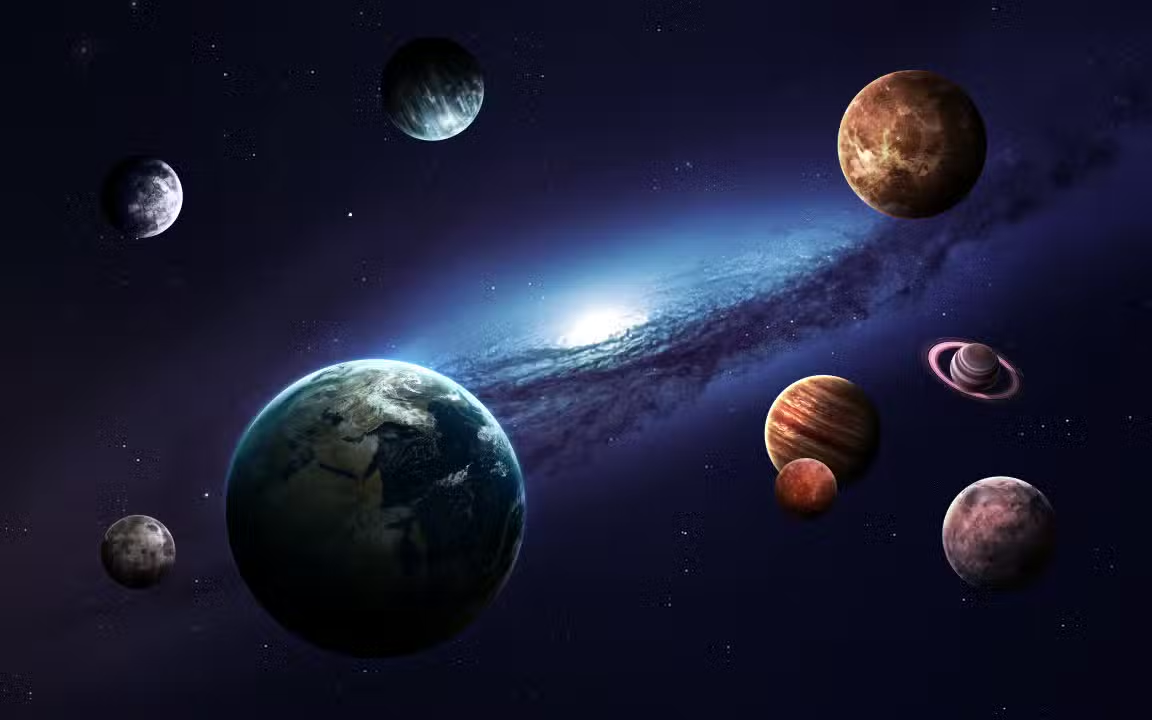
Space monitoring equipment recorded the exact moment when two celestial bodies of gigantic proportions collided violently in the orbit of a distant star. The phenomenon occurred in the system cataloged by scientists as ASASSN-21qj, located at a distance of 1,800 light years from our planet.
The host star of this system has physical and luminosity characteristics very similar to those of the Sol that illuminates the Terra. However, its age is estimated at only 300 million years, configuring a stellar environment still in the initial phase of gravitational and structural stabilization.
The record of this astronomical event provides unprecedented data on the mechanics of young planetary systems. Capturing images and thermal data required the coordination of several terrestrial and space observatories, which monitored the light anomalies emitted by the region affected by the shock.
Thermal detection and radiation emission
The identification of the planetary shock began with a drastic and sudden change in the luminous behavior of the star system, which began to emit intense radiation in the infrared range. Essa thermal anomaly was initially detected in 2018, when sensors recorded temperatures that exceeded the 1,000 mark Kelvin in the impact region. The extreme heat generated by the friction and destruction of planetary masses created an unmistakable energetic signature for the measuring instruments, acting as the first warning that an event of catastrophic proportions had unfolded at that specific spatial coordinate.
This heat emission remained detectable continuously for a period of approximately one thousand days, allowing researchers to collect a substantial amount of data on energy dissipation in a vacuum. The analysis of this cooling curve was essential to calculate the total mass involved in the collision and the impact speed. Cerca Two and a half years after the initial peak of infrared radiation, telescopes recorded a second phenomenon at the same location, characterized by a deep optical eclipse that blocked a significant part of the star’s visible light for about 500 consecutive days.
Physical dynamics of space shock
Calculations based on heat dissipation and the light curve indicate that the collision involved two exoplanets technically classified as ice giants. The masses of these celestial bodies were equivalent to tens of times the mass of Terra, resembling in size and composition planets such as Netuno and Urano.
The exact point of impact was mapped at a distance ranging between 2 and 16 astronomical units from the central star of the ASASSN-21qj system. Para establish a parallel of proportions, this spatial location is equivalent to the vast region located between the orbits of Marte and Urano in our own planetary system.
The kinetic energy released by the high-speed encounter resulted in the almost total disintegration of the outer layers of both exoplanets. The immediate mechanical shock produced an immense cloud composed of vaporized rocky debris, melted ice, and superheated material.
This mass of disintegrated matter began to rapidly expand into the surrounding space, driven by the force of the initial explosion. The dust and rocks resulting from mutual destruction did not escape into interstellar space, remaining trapped by the gravitational pull of the parent star.
Rotational structure of debris
The immediate physical result of this colossal collision was the formation of a transient astronomical structure known in scientific circles as synestia. Trata is a gigantic mass in the shape of a ring or donut, composed entirely of vaporized gas and molten rock that rotates at very high speed around its own center of mass.



This peculiar formation occurs because excess energy from the impact instantly converts into extreme heat, while the centrifugal force of the rotating material prevents the matter from immediately collapsing into a spherical shape. As the months passed, this superheated cloud began a process of gradual expansion along the original orbital path of the destroyed planets.
Luminosity variation and optical blocking
The optical eclipse that followed the initial thermal glow revealed crucial details about fluid mechanics and particle dispersion in the microgravity environment. During the 500 days in which the light from the star ASASSN-21qj was obscured, observation equipment recorded a highly variable transit depth, with a strong dependence on the wavelength of the analyzed light. Essa specific light signature provided definitive proof that the blockage was not caused by a solid, spherical body, but rather by a translucent medium composed of dispersed particulate matter. The exact two and a half year delay between the detection of the extreme heat and the start of the eclipse precisely corresponds to the orbital travel time required for the debris cloud to move from the point of impact to the direct line of sight between the star and telescopes positioned in Earth’s orbit. The constant irregularities in the light curve during this eclipse period are entirely consistent with the behavior of a cloud that has been severely elongated by orbital shear forces, transforming from an initially concentrated mass into a long, diffuse wake of dust and rock fragments that will continue to orbit and evolve around its parent star for millennia.
Parallels with planetary formation
Events of extreme kinetic violence such as the one recorded in the ASASSN-21qj system are considered natural and highly frequent processes in young stellar systems. Essas regions of space are still in the accretion phase, where available matter constantly collides to form larger celestial bodies.
Our own planetary system went through a similar chaotic and violent phase in its beginnings, more than four billion years ago. The most notorious scientific example of this dynamic is the theory about the formation of Lua, which would have originated from debris ejected after a gigantic collision between the proto-Earth and a celestial body the size of Marte.
Direct observation of the ASASSN-21qj system offers researchers an unprecedented opportunity to watch an analogous process happening in real time. The data collected helps validate mathematical models about how massive impacts shape the final chemical and physical compositions of terrestrial planets and gas giants.
Automated space monitoring
The primary identification of this rare astronomical event depended fundamentally on the uninterrupted work of automated transient search programs. Esses robotic systems systematically scan the night sky for sudden changes in star brightness, flagging any light anomalies so that large telescopes can carry out a detailed, targeted investigation.
Chemical signature tracking
Observational work now focuses on searching for specific spectroscopic signals within the extensive debris wake orbiting the star. Detailed analysis of the light that can pass through this dust cloud will allow identification of the exact volatile materials that were released during the impact.
Mapping this chemical composition is essential to refine current models of planetary evolution and understand how heavy elements are distributed after collisions of this magnitude. The ejected material will continue to clump together over millions of years, potentially resulting in the formation of new, smaller celestial bodies or the establishment of a vast system of permanent rings.
Veja Tambem em News (EN)

Research reveals that parents are unaware of how their children use artificial intelligence

Samsung releases new system update with new features for Galaxy Watch 4 users

Digital retail reduces the value of the Galaxy S25 5G smartphone with bank bonuses and device exchange

Amazon’s wireless CarPlay adapter has a 50% discount and high approval ratings from drivers

Zach Cregger’s new Resident Evil ignores games and focuses on an unprecedented story with new characters

Rumor suggests that Nintendo is preparing a special edition of the Switch 2 with a remake of Ocarina of Time

Apple accelerates production of the iPhone 17e and develops new Air model with dual camera system

Epic Games platform releases twelve high-budget games at no permanent cost for PC users

PlayStation 5 Pro price drop accelerates digital retail sales and eliminates global stocks

New Galaxy Watch 9 firmware appears on server and confirms progress in software development

Apple’s commemorative project tests cell phone with 1.1 millimeter edge and curved screen for 2027
