
Iran offensive hits Dimona nuclear facility in Israel after bombing of Natanz complex
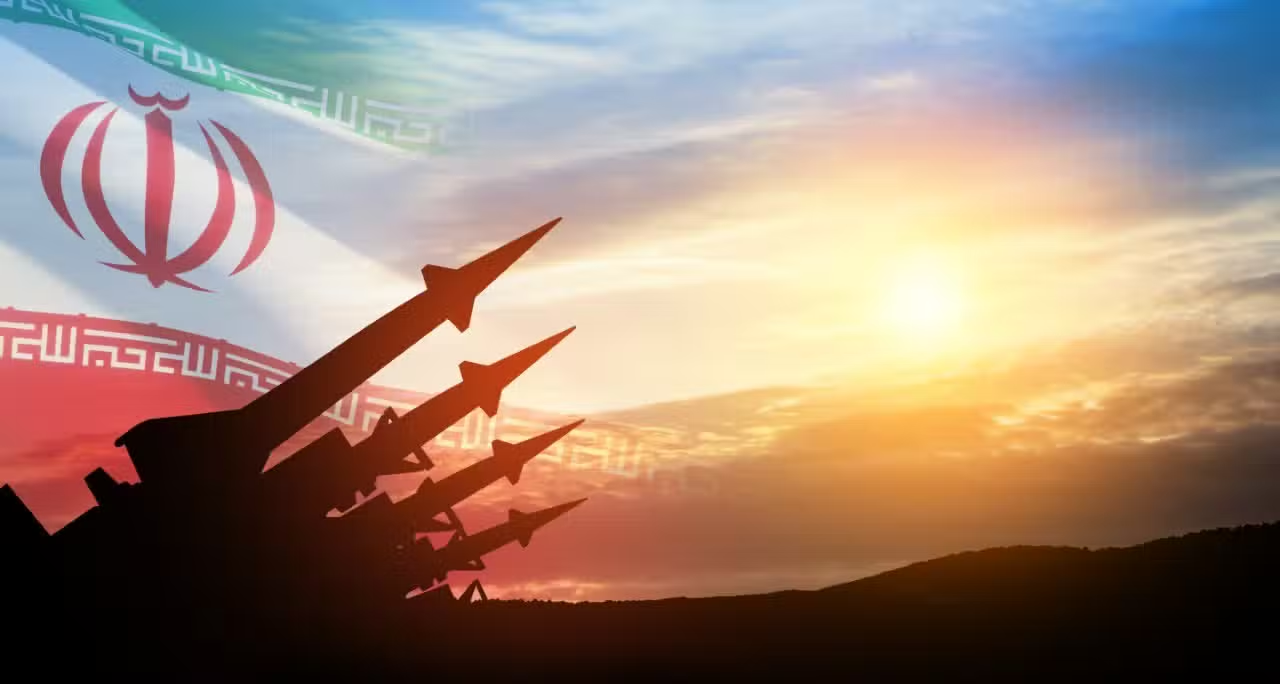
The Iranian government launched a military operation against the Israeli city of Dimona, home to the country’s main strategic nuclear installation. The military action occurred as a direct retaliation for the previous bombing of the Natanz underground complex, a key infrastructure for uranium enrichment on Iranian territory. The incident raises the international community’s level of alert due to the imminent risk of a conflict of nuclear proportions in the region. The military escalation comes at a time of extreme diplomatic volatility between the two nations.
Global reactions and repercussions on the energy market
The international community expressed immediate concern about the deployment of military actions in Oriente Médio. Agência Internacional of Energia Atômica issued a statement demanding absolute military containment to avoid any risk of nuclear accident, warning that damage to these facilities could generate incalculable environmental and humanitarian consequences. Países allies of both nations began to move their diplomatic channels in an attempt to stop the escalation of violence, while Western powers reiterated their suspicions about the development of atomic weapons in the region, justifying the need for urgent diplomatic intervention.
The economic consequences of the military confrontation directly affected the global energy markets: – The barrel of oil Brent increased by more than fifty percent in the last month. – The trading value exceeded the one hundred and five dollar mark. – Comissão Europeia recommended accelerating the filling of gas reserves to eighty percent.
Instability in the world’s main oil-producing region creates uncertainty about the safety of maritime transport routes. The Estreito of Ormuz, through which about a fifth of the oil and liquefied natural gas consumed globally transits, has become a critical choke point. Diversos countries, including European and Asian nations, have begun joint efforts to ensure the safe reopening of waterways and mitigate the effects of a potential global supply disruption.
Ambiguity strategy and military targets
The government of Israel maintains a historic policy of non-confirmation regarding the possession of an atomic arsenal. The Dimona plant, located in the Neguev desert, officially operates as a research and energy supply center, although international reports point to the manufacture of military components at the site for decades.
The complexity of these infrastructures makes any offensive a point of maximum attention for global security. Relatos indicate that the city of Dimona recorded dozens of injuries from projectile shrapnel, with significant damage to the facade of buildings directly hit by Iranian missiles.
Structural damage and direct retaliation
The offensive against Dimona demonstrates the operational capability of Iranian forces to retaliate. The previous attack on the Natanz complex, attributed to Israel, served as the trigger for the current phase of the confrontation, marking a change in the dynamics of military engagement between the two countries.
Organização of Energia Atômica of Irã reported the absence of leakage of radioactive materials in Natanz after the bombing. The statement sought to downplay the perception of nuclear damage, but confirmed the seriousness of the security breach that prompted the subsequent armed response.
Naval operations and shipping routes
The battlefronts expanded beyond air attacks, involving strategic operations on sea routes. Forças US military personnel destroyed an Iranian bunker equipped with weapons that threatened the transport of fuel by Estreito of Ormuz.
The operation aimed to reduce the capacity to block this crucial sea lane. Controlling access to this route has been used as an instrument of pressure in response to coordinated offensives in the region.
In parallel, the Israeli army conducted night operations against research centers in Teerã. The justification presented points to the use of these institutions in the development of components for nuclear weapons, demonstrating a strategy of dismantling adversary technological capabilities.



Internal political dynamics in Iranian territory
The internal political scenario of Irã is going through a delicate transition period amid the armed conflict. The succession in the country’s supreme leadership occurred after the deaths of central figures in the regime since the start of hostilities.
Mojtaba Khamenei assumed the highest position in the Islamic republic, succeeding his father. The new leader’s absence of public appearances has raised questions about the stability of the transition of power during the military crisis.
The new supreme leader’s lack of participation in traditional religious celebrations, such as the prayers that mark the end of the fasting period, intensified uncertainty. Esses events have extreme political and religious importance in the local power structure.
Instability at the top of the government can directly influence the conduct of military operations. The leadership reorganization process occurs simultaneously with the need to respond to international military and diplomatic pressure.
Territorial expansion of the armed conflict
Hostilities went beyond the initial borders and began to involve neighboring monarchies in the Golfo region. Relatos of air strikes against allied territories indicate a diversification of targets and a worrying geographic expansion of the theater of military operations. The inclusion of new actors in the confrontation increases the risk of a large-scale regional war, requiring the repositioning of defense forces across the Arabian peninsula.
Iranian military forces had previously issued warnings about severe responses to any moves against strategic islands controlled by Teerã. The dispute over the sovereignty of these territories, located at critical navigation points, adds an extra layer of complexity to the security scenario. The intersection between historic territorial disputes and the current nuclear crisis makes stabilizing the region an unprecedented diplomatic challenge.
Continuity of operations and military projections
Israel defense authorities have publicly stated that the intensity of military operations will increase considerably in the coming days, signaling the absence of a ceasefire in the short term. The determination to achieve all the strategic objectives outlined by the military command indicates that the current phase of the conflict could last for weeks. Especialistas in geopolitics assess that Iranian forces maintain a significant arsenal and intact operational capacity to conduct new waves of retaliation. The resilience of military infrastructures on both sides suggests a scenario of prolonged attrition, where precision strikes against critical installations will continue to dictate the pace of hostilities. The absence of direct dialogue channels and the failure of initial attempts at international mediation reinforce the perspective that the resolution of the crisis will depend on the exhaustion of military capabilities or a diplomatic intervention of global proportions that imposes clear limits on offensive actions.
Continuous monitoring of facilities
Monitoring of nuclear and military installations remains active through satellites and international intelligence agencies. The global community awaits the next developments, aware that any miscalculation in attack or defense operations could trigger a humanitarian and environmental crisis unprecedented in the recent history of Oriente Médio.
Veja Tambem em News (EN)

Research reveals that parents are unaware of how their children use artificial intelligence

Samsung releases new system update with new features for Galaxy Watch 4 users

Digital retail reduces the value of the Galaxy S25 5G smartphone with bank bonuses and device exchange

Amazon’s wireless CarPlay adapter has a 50% discount and high approval ratings from drivers

Zach Cregger’s new Resident Evil ignores games and focuses on an unprecedented story with new characters

Rumor suggests that Nintendo is preparing a special edition of the Switch 2 with a remake of Ocarina of Time

Apple accelerates production of the iPhone 17e and develops new Air model with dual camera system

Epic Games platform releases twelve high-budget games at no permanent cost for PC users

PlayStation 5 Pro price drop accelerates digital retail sales and eliminates global stocks

New Galaxy Watch 9 firmware appears on server and confirms progress in software development

Apple’s commemorative project tests cell phone with 1.1 millimeter edge and curved screen for 2027
