
James Webb Telescope identifies planet with ocean of magma and sulfur 35 light years from Earth

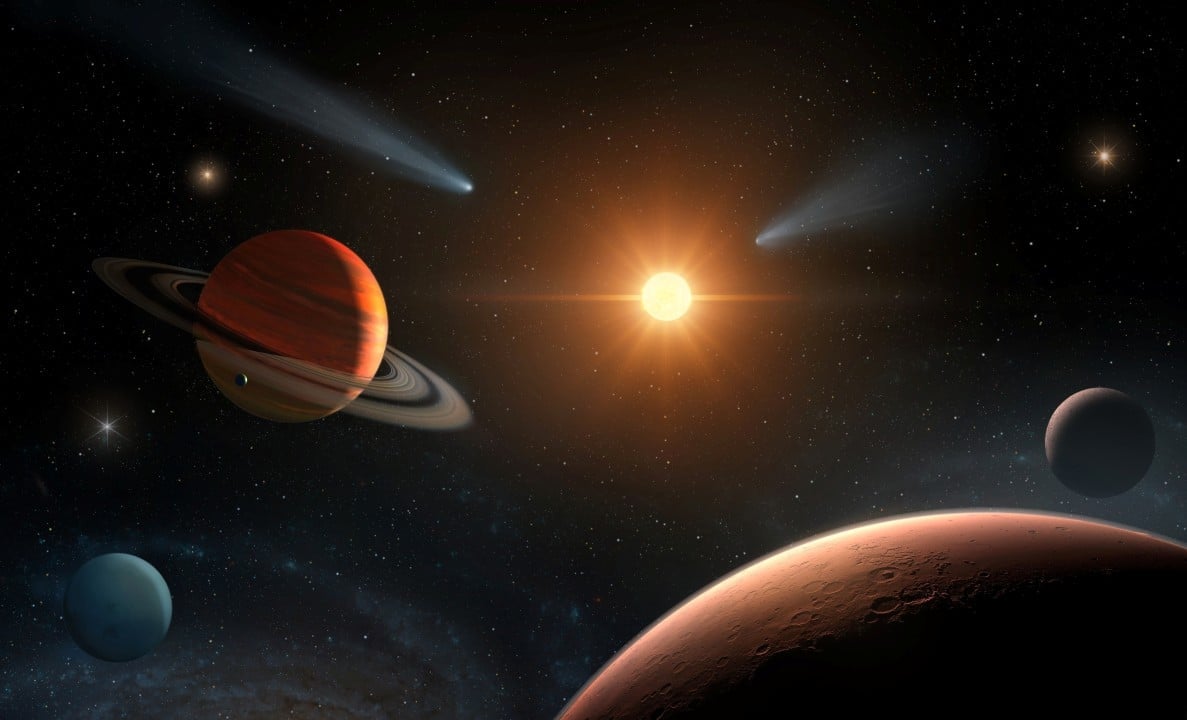
Space exploration has reached a new milestone with the identification of a celestial body that defies traditional planetary classifications established by science. The exoplanet L 98-59 d, located at a distance of approximately 35 light years from Terra, was analyzed in detail by an international collaboration of researchers. Este distant world orbits a low-mass red dwarf star and has an extreme geological feature, maintaining a global ocean of liquid magma across its surface.
The environmental conditions recorded at the site are severe, with surface temperatures exceeding the 1,500 °C mark, an intense heat that prevents any possibility of solidification of the rocky material. The dense atmosphere surrounding the planet carries a massive amount of sulfur compounds, elements that have been accurately detected by the advanced instruments of the James Webb space telescope. The extreme proximity to the host star is the main driver of this constant warming.

The abundant presence of hydrogen sulfide in the atmospheric composition produces a peculiar chemical effect, generating a characteristic odor similar to that of rotten eggs, if the gas could be inhaled. Apesar of the wealth of chemical and geological data provided by this discovery, the extreme temperatures and air toxicity ensure that the planet remains completely inhospitable to any known life form by current biological parameters.
Detailed analysis of atmospheric and rock composition
The scientific investigation combined high-resolution spectroscopic observations captured by James Webb with complex computer simulations focused on the internal evolution of celestial bodies. The results of this rigorous survey, published in the scientific journal Nature Astronomy in March 2026, reveal that the exoplanet has dimensions equivalent to 1.6 times the radius of Terra. Apesar larger in size than our planet, the recorded density is considerably reduced, an anomaly that scientists point out is perfectly compatible with the existence of a large amount of volatile materials retained in the deepest layers of its interior.
These volatile elements, with absolute emphasis on sulfur, undergo a process of gradual and continuous release that extends over billions of years of geological activity. Essa constant degassing is the fundamental mechanism responsible for sustaining an extremely thick atmosphere, which remains rich in hydrogen and various sulfur compounds. The dynamics between the molten interior and the external gaseous layer creates a complex planetary system, where the exchange of matter and energy occurs uninterruptedly, shaping the physical and chemical characteristics observed by equipment in Earth orbit.
Thermal dynamics of the global magma ocean
The magma ocean is not limited to isolated puddles or lakes, but covers the entire surface of the planet, also extending into deep layers of the geological mantle. Rochas silicates in a state of permanent melting form this vast liquid reservoir, which acts as a natural deposit to store sulfur in exceptionally high concentrations.
The orbital location of the exoplanet plays a determining role in maintaining this extreme physical state. The close proximity to the host star generates intense heating driven by both direct radiation and gravitational tidal forces acting on the planet’s structure.
This continuous process of energy transfer prevents the natural cooling that is usually observed on rocky planets located at greater distances from their respective stars. The energy dissipated within the planet ensures that the crust never reaches the point of solidification, keeping the surface in a state of perpetual fluidity.
Chemical processes driven by stellar radiation
The formation and maintenance of L 98-59 d’s atmosphere results directly from the continuous degassing promoted by the boiling magma ocean, presenting specific dynamics captured by the researchers:
– Compostos Primary chemicals such as hydrogen sulfide and sulfur dioxide largely dominate the gaseous composition detected by spectroscopy instruments.
– Reações intense photochemistry, driven by the constant ultraviolet radiation emitted by the red dwarf, rapidly transforms the newly released gases into the upper atmosphere.
– Esse uninterrupted chemical cycle contributes to the formation of an extremely powerful greenhouse effect, which acts by retaining even more heat on the surface and reinforcing high temperatures permanently.
Spectroscopy data captured by the space telescope
Observations carried out using the planetary transit method with the James Webb telescope allowed clear spectral signatures of sulfur dioxide and hydrogen sulfide to be captured. The planet’s passage in front of its star filtered light through the atmosphere, leaving unmistakable marks of these elements in the data collected.
These specific light signals indicate an active and voluminous release of sulfur from the interior of the celestial body. Additional Simulações have reconstructed the planet’s thermal history since its initial formation, demonstrating that prolonged retention of volatiles is the primary explanation for the observed low structural density.
Numerical evidence on the mass and density of the celestial body
Quantitative analysis of the spectral signals confirms that the presence of sulfur reaches levels greater than 1.5% of the planet’s total mass, while the average density remains in the range of 2.2 g/cm³. The applied mathematical models indicate that magma oceans with these structural characteristics can last billions of years on planets that orbit very close to red dwarf stars.
Unprecedented classification in the catalog of astronomical discoveries
The exoplanet L 98-59 d has such unique properties that it does not fit into the previously known categories of traditional rocky planets or oceanic worlds composed of water. The newly discovered geological and atmospheric structure suggests the existence of a much broader population of exoplanets that harbor persistent magma oceans and densely sulfur atmospheres.
Researchers involved in the project propose that these extreme worlds actually represent a common initial phase in the process of planetary formation in several star systems. The finding significantly expands the understanding of the diversity of exoplanets spread across Via Láctea, forcing a review of theoretical models of stellar and planetary evolution.
Scientific parallels with the formation of Sistema Solar
Geological records and theoretical models indicate that similar magma oceans existed in Terra and in Marte during the earliest and most violent phases of their respective formations. In-depth studies of L 98-59 d provide direct, observable analogies so that the scientific community can more clearly understand the ancient processes that shaped the planets of our own Sistema Solar billions of years ago. The remote reconstruction of this exoplanet’s interior demonstrates the sheer power of current technological tools employed in modern astronomy. Astronomers can now access precise information about the deepest layers of distant worlds without the need for any type of direct observation or sending physical probes. Essa The ability to map chemical composition and thermal dynamics tens of light years away transforms understanding of how rocky planets process volatile elements before eventually cooling and forming solid, stable crusts in the universe.
Detection History and Advances in Continuous Observation
The original identification of this planetary system occurred through the instruments of the TESS satellite in 2019, which noticed the first anomalies in the host star’s light curve. Essa preliminary detection marked the celestial body as a priority target for future more detailed investigations by space agencies.
Subsequent observation campaigns, conducted with James Webb’s superior infrared technology between the years 2024 and 2026, were responsible for revealing the planet’s unique chemical properties and extreme temperatures. The ongoing research focus remains narrowly focused on planetary physics and the chemical evolution of worlds subjected to extreme radiation conditions in deep space.



