
Japanese broadcaster shows Monsters University with extra short and Detective Conan marathon schedule
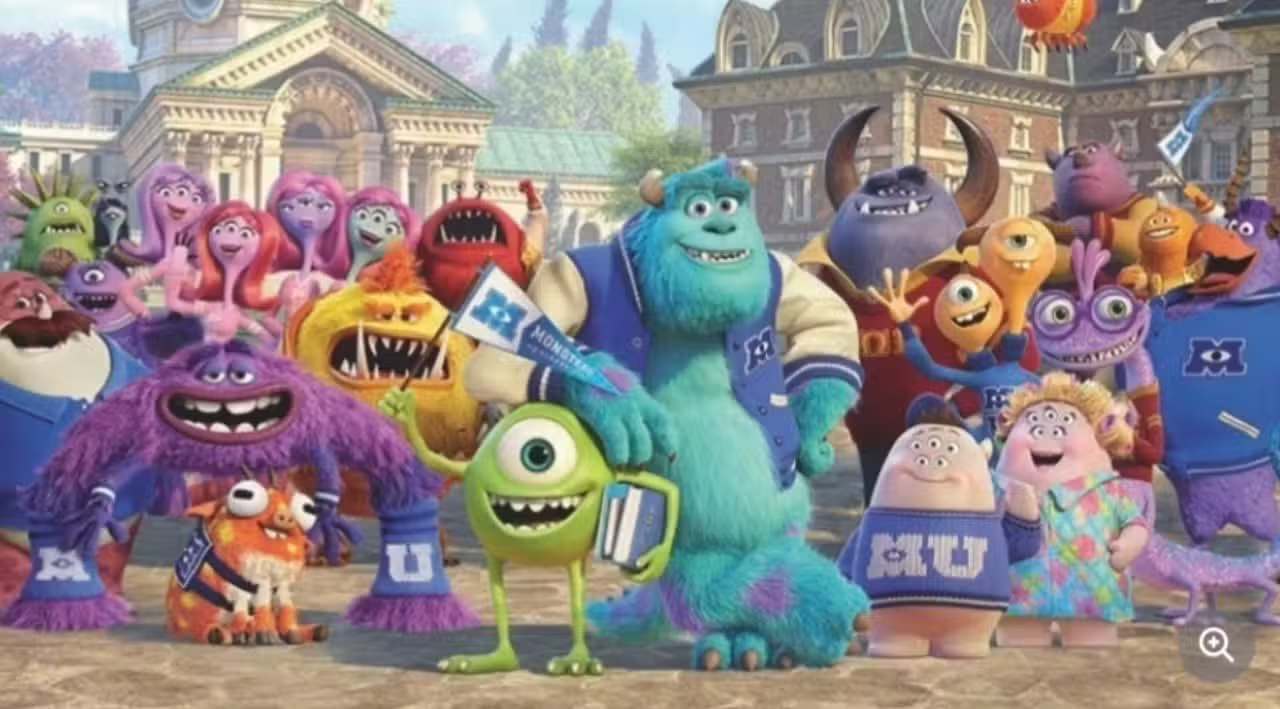
The Japão television network scheduled a special screening of the animated feature film that narrates the origin of the friendship between the characters Mike and Sulley. The broadcast takes place in the station’s traditional nightly film block, a space already established for presenting major cinematographic productions to the local public.
The difference with this specific exhibition is the addition of ten minutes of extra content right after the end of the main work. The complementary material is a short film focused on the same characters, functioning as a direct extension of the universe presented in the original animation.
The channel’s management chose to broadcast this bonus without commercial breaks between the end of the film and the beginning of the additional content. The tactic aims to maintain the viewer’s attention throughout the entire time slot, avoiding the distraction common during the showing of the final credits.
Display strategy and additional content in the night schedule
The broadcaster’s approach involves specific elements to hold the audience, focusing on showing the main film with a strong appeal of multigenerational nostalgia. The broadcast of the new short film on open television immediately afterwards serves as an exclusive attraction that enhances the Friday night session. The film block has an established history of using themed screenings to maintain high audience ratings, attracting everyone from children who are just discovering the works to adults who have been following the franchise for years.
Shortly after this special program, the communication network will begin a cycle of exhibitions dedicated to another highly successful franchise in the Asian country. The schedule foresees consecutive weeks of films focused on investigations and mysteries, changing the direction of nighttime entertainment. The main purpose of this change is to prepare viewers for future releases in local theaters, demonstrating the late-night block’s flexibility in attracting different niche viewers and maximizing the brand’s reach.
Origin of the rivalry between Mike Wazowski and James P.
The film’s main narrative presents the academic journey of Mike Wazowski, a short, spherical-shaped monster who has the rigorous objective of becoming a professional scarer. The character’s motivation arises in childhood, during a school trip to the facilities of the main energy company in his world.
There, the young man witnesses the work of elite professionals and decides to follow the same career, dedicating years to theoretical study. Upon entering university, the protagonist meets James P. Sullivan, a large monster who carries the weight of belonging to a famous lineage of scary people.
Unlike his focused colleague, who dedicates intense hours to studies and memorization techniques, Sullivan relies entirely on his natural talent and physical size. The difference in approaches and personalities causes immediate friction between the two students in the first weeks of class.
The constant competition for the prominent position in practical classes results in incidents that harm the performance of both before the institution’s teaching staff. The two characters try to prove superiority at all times, creating an atmosphere of continuous tension on the university campus that affects the entire class of beginners.
Consequences of the dispute and expulsion from the scare program
The critical point in this dispute occurs during the final exam of the semester, when valuable university equipment ends up destroyed in an accident caused by an argument. The program director assesses the situation as a serious breach of conduct and lack of discipline on the part of the students, taking an immediate and severe decision.



As a direct consequence of the infraction, the management decides to expel the pair of students from the coveted scare course, forcing them to look for alternatives within the institution. Sem the possibility of attending practical classes, they are transferred to the energy cylinder manufacturing course, which forces them to rethink their attitudes.
Competition dynamics and team formation
To regain their place in the scare program, the protagonists sign an agreement with the university management, betting on remaining at the institution in a traditional competition. The tournament rules require participation in teams, which forces the pair to join the Oozma Kappa fraternity, a group made up of monsters rejected by the academic system.
The team must overcome elite fraternities in a series of physical and psychological tests that test stealth, agility and logical reasoning. The group’s biggest obstacle is learning to work as a team under extreme pressure during the knockout stages, requiring quick adaptation and intelligent use of each member’s characteristics.
During the training period, the group’s dynamics undergo significant transformations, with the technical leadership of Mike combined with the brute force of Sullivan creating an effective teaching method. The tests include complex challenges, such as crossing a library without making sounds and simulating invasions of children’s rooms under adverse lighting conditions.
Details of extra material focused on the university experience
The additional ten minutes included in the television broadcast correspond to a short film that portrays the events that occurred shortly after the consolidation of the Oozma Kappa fraternity on the university campus. In the plot of this supplementary material, the group members decide to organize a party at their residence to celebrate recent achievements, but face the total absence of guests. The reason for the emptying is that all students attended the rival fraternity’s event, Roar Omega Roar, which has more resources and popularity among students. Para solve this logistical problem, the protagonists use dimensional port stations, the central equipment of transportation technology in the franchise’s universe. The idea is to create a secret shortcut between the two parties, allowing direct intervention in the competing event. Através Through this ingenious spatial manipulation, the group manages to discreetly steal food, music and, eventually, the rival team’s own guests. The operation transfers everyone to the Oozma Kappa residence so quickly that the participants barely notice the change of location, demonstrating the practical application of the infiltration skills developed during the student competition. O resultado final é o sucesso absoluto do evento, elevando definitivamente o status social do grupo dentro da universidade.
Transition of programming to the investigative genre
After showing the universe of monsters, the television network restructures its Friday programming to focus on an investigative series starring high school detective Shinichi Kudo. The main character, who was transformed into a child after being forced to ingest an experimental substance developed by a criminal organization, adopts the pseudonym Conan Edogawa.
Under this new identity, he begins to solve complex crimes while relentlessly searching for a cure for his physical condition. The film marathon from this franchise will occupy prime time for four consecutive weeks, functioning as a commercial strategy to warm up the public and prepare viewers for the premiere of a new film production of the investigative series in local cinemas.
Audience retention in prime time on open television
The tactic of adding new content and organizing themed marathons allows televisions to remain tuned to the channel for an extended period, which translates directly into audience measurement rates. Esse performance positively affects the pricing of advertising spaces sold by the communication network. Mesmo Given the accelerated growth of on-demand platforms, the collective experience of following linear programming with fixed schedules and exclusive extra content preserves the importance of the traditional broadcasting model in the contemporary entertainment scenario.
Veja Tambem em News (EN)

Research reveals that parents are unaware of how their children use artificial intelligence

Samsung releases new system update with new features for Galaxy Watch 4 users

Digital retail reduces the value of the Galaxy S25 5G smartphone with bank bonuses and device exchange

Amazon’s wireless CarPlay adapter has a 50% discount and high approval ratings from drivers

Zach Cregger’s new Resident Evil ignores games and focuses on an unprecedented story with new characters

Rumor suggests that Nintendo is preparing a special edition of the Switch 2 with a remake of Ocarina of Time

Apple accelerates production of the iPhone 17e and develops new Air model with dual camera system

Epic Games platform releases twelve high-budget games at no permanent cost for PC users

PlayStation 5 Pro price drop accelerates digital retail sales and eliminates global stocks

New Galaxy Watch 9 firmware appears on server and confirms progress in software development

Apple’s commemorative project tests cell phone with 1.1 millimeter edge and curved screen for 2027
