
Japanese channel shows Monsters University with extra short and marathon schedule of Detective Conan
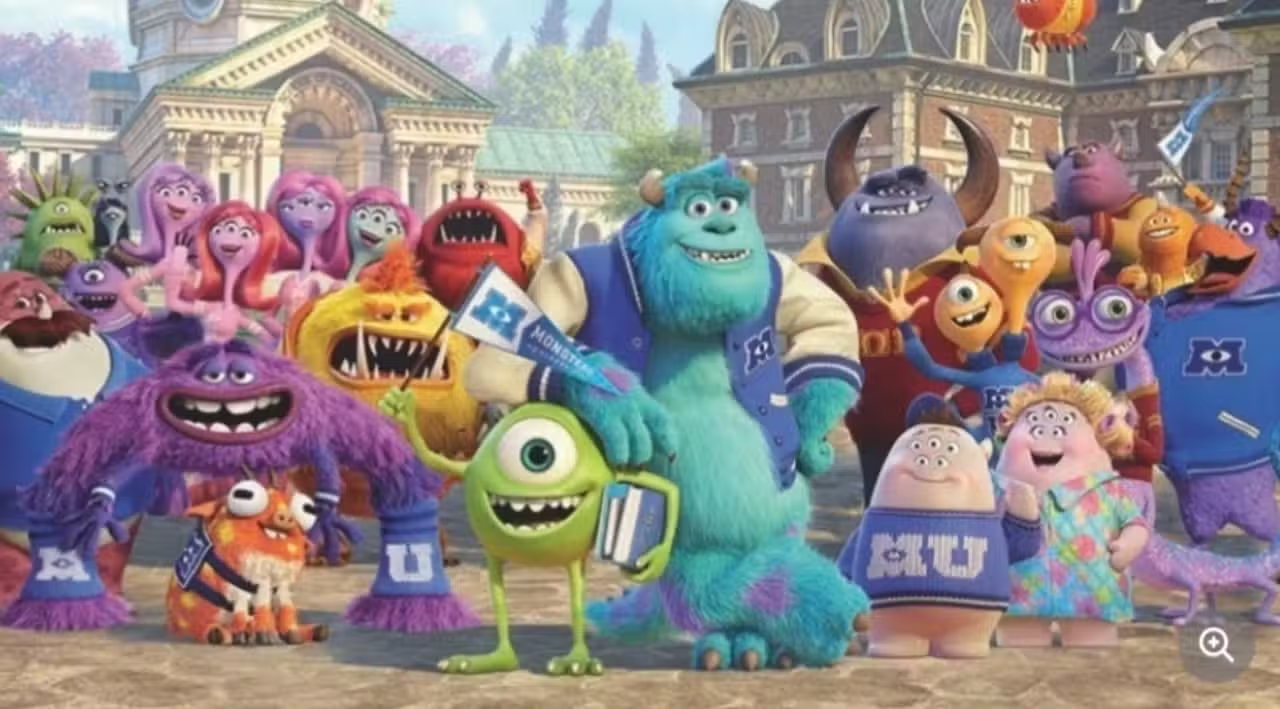
The Japanese television network scheduled a special screening of the animated feature film that tells the origin of the friendship between the characters Mike and Sulley, guaranteeing a fixed space for family entertainment on Friday nights. The broadcast takes place in the station’s traditional nightly film block, widely known by the local public for presenting major film productions and maintaining high audience ratings. The big difference of this specific exhibition is the addition of ten minutes of extra content right after the end of the main work, functioning as a direct extension of the universe presented in the original animation. The channel’s management chose to broadcast this bonus without commercial breaks between the end of the film and the beginning of the additional material, aiming to keep the viewer’s attention continuously. Logo After this special programming, the communication network will begin a cycle of exhibitions dedicated to another hugely successful franchise in the country, focused on investigations and mysteries. The main purpose of this change of direction in evening entertainment is to prepare viewers for future releases in local theaters. Essa tática de emendar conteúdos de forte apelo nostálgico com novidades exclusivas demonstra a força da televisão aberta na era digital. The careful curation of titles reflects a deep understanding of the consumption habits of contemporary audiences.
The complementary material consists of a short film focused on the same characters as the main plot, exploring events that occur shortly after the outcome of the original story. The uninterrupted display of this content serves as a strategic bridge to keep televisions tuned to the channel during schedule transitions.
The broadcaster’s strategy involves specific elements to hold the viewer’s attention throughout the entire time slot:
– Exibição of the main film focusing on multigenerational nostalgia.
– Transmissão of an unreleased short film on open TV shortly afterwards.
– Preparação of the public for a new themed marathon in the following weeks.
Primetime audience retention strategy
The broadcaster’s film block has a consolidated history of using themed screenings to maintain high audience ratings on Friday nights. The choice of animated feature films with a strong nostalgic appeal guarantees the attention of multiple age groups, from children who are just discovering the works to adults who have been following the franchise since previous decades. The inclusion of extra scenes or short films at the end of the main sessions acts as a technical tool to prevent spectators from escaping during the final credits.
The tactic of aggregating new content allows televisions to remain tuned to the channel for an extended period, which translates directly into audience measurement rates. Esse performance positively affects the pricing of advertising spaces sold by the communication network.
Even with the accelerated growth of on-demand platforms, the collective experience of following scheduled programming remains relevant in the Asian market. The offer of fixed schedules and exclusive extra content preserves the importance of the traditional broadcasting model in the contemporary entertainment scenario. Planning the television schedule requires a thorough analysis of viewer behavior, adapting deliveries according to the expectations generated by large franchises. The network’s executives structured programming based on the following operational pillars:
– Maximização of brand reach through intelligent curation.
– Valorização of advertising space with prolonged retention.
– Fortalecimento of the cultural link with the local audience.
Origin of academic rivalry between the protagonists
The film’s main narrative presents the academic journey of Mike Wazowski, a short, spherical-shaped monster who has the rigorous objective of becoming a professional scarer. The character’s motivation arises in his childhood, during a school trip to the facilities of the main energy company in his world, where he witnesses the work of elite professionals and decides to follow the same career.
Upon entering university, the protagonist meets James P. Sullivan, a large monster who carries the weight of belonging to a famous lineage of scary people. Diferente of the focused colleague, who dedicates intense hours to theoretical studies and memorization techniques, Sullivan trusts entirely in his natural talent, generating immediate friction between the two students in the first weeks of class.
Consequences of the dispute and expulsion from the program
The constant competition for the prominent position in practical classes results in incidents that harm the performance of both before the institution’s teaching staff. The two characters try to prove superiority at all times, creating an atmosphere of continuous tension on the university campus that affects the dynamics of the entire class of beginners.



The critical point in this dispute occurs during the final exam of the semester, when valuable university equipment ends up destroyed in an accident caused by an argument. The program’s management assesses the situation as a serious breach of conduct, resulting in the pair’s immediate expulsion from the coveted scare course and mandatory transfer to the energy cylinder manufacturing course.
Competition dynamics and team formation
To regain their place in the scare program, the protagonists sign an agreement with the university management, betting on remaining at the institution in a traditional student competition. Tournament rules require participation in teams, which forces the pair to join the Oozma Kappa fraternity.
This group is made up of monsters rejected by the traditional academic system and who do not have obvious natural abilities to generate fear. The team must overcome elite fraternities in a series of physical and psychological tests that test stealth, agility and logical reasoning.
The group’s biggest obstacle is learning to work as a team under extreme pressure during the knockout stages of the competition. Cada challenge requires quick adaptation and intelligent use of the peculiar characteristics of each fraternity member to advance in the tournament.
Developing skills and overcoming challenges
During the training period, the group’s dynamics undergo significant transformations, and members discover how to use their specific characteristics strategically. Mike’s technical leadership, combined with Sullivan’s brute strength, creates a teaching method that raises the level of the Oozma Kappa team in unexpected ways.
Monsters previously considered unfit begin to demonstrate hidden talents that surprise the most experienced opponents on campus. The tests include complex challenges, such as crossing a library without making a sound to avoid detection by a gigantic and relentless librarian.
Another fundamental stage involves simulating invasions of children’s rooms under adverse lighting conditions, requiring quick adaptation from competitors. The simulated environment tests each participant’s physical and mental limits, forcing them to think outside the standards established by the academy.
Success in these missions depends entirely on the harmony and tactical planning developed by the group throughout the competition. The gradual evolution of the characters demonstrates the importance of perseverance and technical study combined with natural talent.
Extra material focused on the university experience
The additional ten minutes included in the television broadcast correspond to a short film that portrays the events that occurred shortly after the consolidation of the Oozma Kappa fraternity on the university campus. In the plot of this supplementary material, the group members decide to organize a party at their residence to celebrate recent achievements, but face the total absence of guests. The reason for the emptying is that all students attended the event of the rival fraternity, Roar Omega Roar, which has more financial resources and popularity among students.
To solve this logistical problem, the protagonists use dimensional door stations, the central equipment of transportation technology in the franchise’s universe. The idea is to create a secret shortcut between the two parties, allowing direct intervention in the competing event. With this ingenious spatial manipulation, the group manages to discreetly steal the rival team’s food, music and guests. The operation transfers everyone to Oozma Kappa’s residence so quickly that participants barely notice the change of location, ensuring the celebration’s absolute success.
Transition from the grid to the investigative genre
After showing the universe of monsters, the television network restructures its Friday programming to focus on an investigative series starring high school detective Shinichi Kudo. The main character, who was transformed into a child after being forced to ingest an experimental substance developed by a criminal organization, adopts the pseudonym Conan Edogawa. Sob this new identity, he begins to solve complex crimes while incessantly searching for a cure for his physical condition. The film marathon from this franchise will occupy prime time for four consecutive weeks, changing the profile of the audience that follows the channel. Essa initiative works as a commercial strategy to warm up the public, preparing viewers for the premiere of a new film production of the investigative series in local cinemas. The selection of feature films prioritizes stories that involve the central members of the criminal organization responsible for the protagonist’s state, ensuring a thematic thread between the weekly screenings. The curatorship seeks to create a cohesive narrative for those who continuously follow the marathon, offering clues and contexts that enrich the understanding of the vast investigative universe of the work.
Impact of linear programming on the audiovisual market
The genre transition demonstrates the nighttime block’s flexibility in attracting different niches of viewers, maximizing the brand’s reach and keeping engagement high. The Japanese broadcaster’s strategy proves that intelligent curation is still a competitive differentiator in the audiovisual market, maintaining the relevance of open television compared to streaming services.
Veja Tambem em News (EN)

Research reveals that parents are unaware of how their children use artificial intelligence

Samsung releases new system update with new features for Galaxy Watch 4 users

Digital retail reduces the value of the Galaxy S25 5G smartphone with bank bonuses and device exchange

Amazon’s wireless CarPlay adapter has a 50% discount and high approval ratings from drivers

Zach Cregger’s new Resident Evil ignores games and focuses on an unprecedented story with new characters

Rumor suggests that Nintendo is preparing a special edition of the Switch 2 with a remake of Ocarina of Time

Apple accelerates production of the iPhone 17e and develops new Air model with dual camera system

Epic Games platform releases twelve high-budget games at no permanent cost for PC users

PlayStation 5 Pro price drop accelerates digital retail sales and eliminates global stocks

New Galaxy Watch 9 firmware appears on server and confirms progress in software development

Apple’s commemorative project tests cell phone with 1.1 millimeter edge and curved screen for 2027
