
Solar heat breaks comet 3I/Atlas’ shield and reveals unprecedented prebiotic chemistry near Jupiter

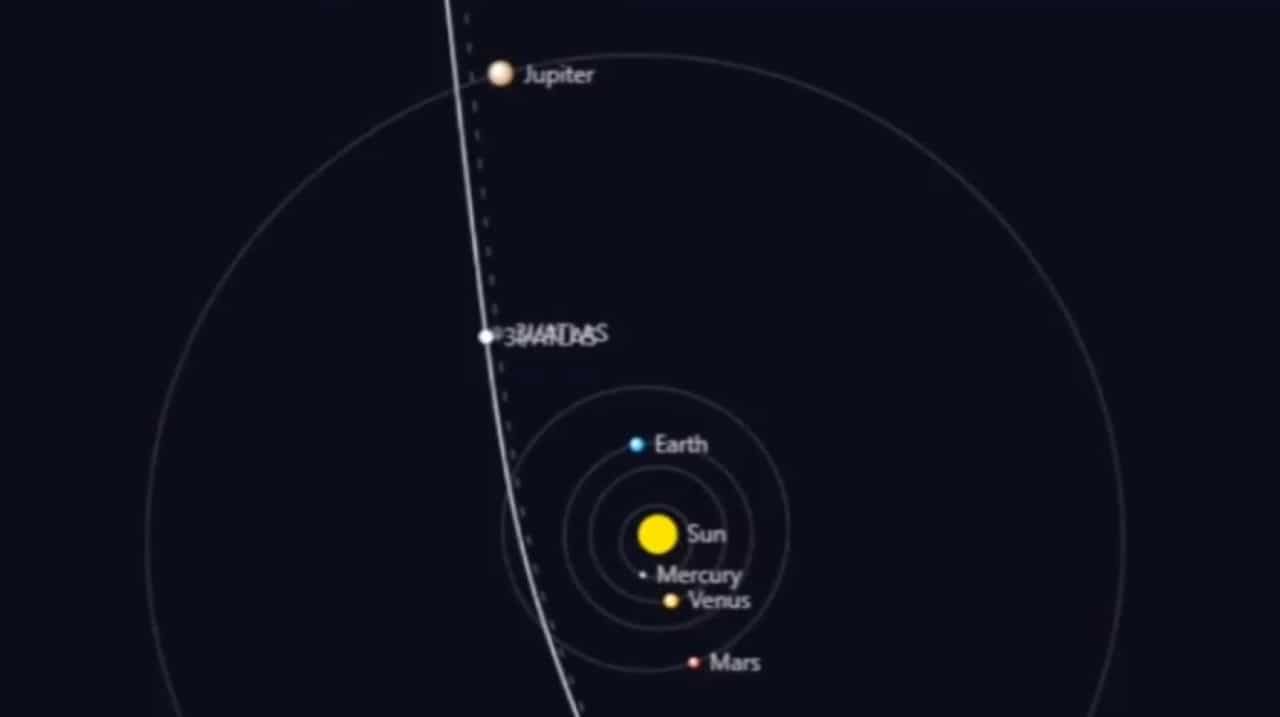
The passage of the interstellar comet 3I/Atlas through the inner Sistema Solar provided unprecedented data on the chemical composition of objects formed in the early days of Via Láctea. The celestial body, initially identified in July last year by the monitoring system at Chile, reached its closest point to Sol recently, triggering intense physical reactions on its surface.
During perihelion, extreme thermal radiation caused the fracture of a thick outer layer that had sealed the object’s core for eons. Esse Structural disruption allowed space and ground-based telescopes to record the ejection of volatile compounds that remained frozen and protected from degradation in the vacuum of deep space.
🚨BOOZY ALIEN COMET ☄️
Scientists studying the interstellar comet 3I/ATLAS say it’s “bursting with alcohol.”😳
⚠️Using data from the Atacama Large Millimeter/submillimeter Array, researchers detected huge amounts of methanol gas pouring from the comet as it warmed near the…pic.twitter.com/CcXfXA8URS
— 3I/ATLAS updates (@Defence12543)March 13, 2026
Immediate spectroscopic analysis confirmed the presence of elements fundamental to organic chemistry, ejected in high-speed directional jets. The astronomical event gains relevance due to the estimated age of the celestial body, which carries unchanged materials from a time before the formation of our planetary neighborhood.
Formation in the thick disk of Via Láctea
Astrometric calculations based on the hyperbolic trajectory of the 3I/Atlas indicate an estimated age of between ten and twelve billion years. Essa dating places the origin of the object in a primordial phase of the galaxy, long before the condensation of the molecular cloud that gave rise to Sol and the local planets.
The traced provenance points to the thick galactic disk, a vast region characterized by the presence of old stars and a considerably lower metallicity. The materials preserved inside the cometary nucleus function as a chemical time capsule, offering direct samples of the environmental conditions of this remote era.
The thermal insulation provided by the interstellar environment ensured that the original molecules did not undergo significant changes through sublimation throughout their journey. The absence of nearby stars for most of its existence prevented premature heating of the primordial ice.
This exceptional preservation allows astronomers to investigate the nucleosynthesis processes and cosmic dust formation that occurred in the first tens of millions of years after the formation of Via Láctea.
Surface shell fracture dynamics
The surface of the celestial body has developed a hardened crust approximately twenty meters thick, the result of continuous bombardment by galactic cosmic rays during its passage through the interstellar medium. Essa prolonged exposure to high-energy radiation altered the molecular structure of the outermost layers, creating a dense natural polymer that acted as a highly efficient thermal barrier against mass loss. The mechanical resistance of this shell prevented the release of volatile gases even when the object began to cross the orbit of the gas planets in our system, keeping the internal pressure contained to the physical limit of the material.
The collapse of this protective structure occurred only after months of progressive solar heating, when the temperature gradient between the surface and the interior exceeded the cohesive force of the modified ice. The fracture resulted in an explosive and asymmetric release of material, generating a non-gravitational acceleration that subtly altered the body’s orbital parameters. The rapid expansion of the coma, which reached hundreds of thousands of kilometers in diameter, revealed sublimation dynamics completely different from those observed in comets originating from the Nuvem of Oort or the Kuiper belt.
Chemical signatures of organic molecules
The breakup of the crust released anomalous concentrations of methanol, exceeding the average levels documented on native celestial bodies by up to four times. Observações at millimeter wavelengths confirmed that the emission of this alcohol occurred in specific peaks, synchronized with the rotation of the nucleus and the exposure of the cracks to solar heat.
In addition to methanol, the spectrometers detected the clear presence of hydrocyanic acid, water, carbonyl sulfide and several allotropic forms of carbon. The simultaneous detection of these elements reinforces the thesis that complex chemical reactions can occur on the surface of dust grains in cold molecular clouds.
Traces of ionized nickel were also identified in the inner coma, adding a rare inorganic component to the emission profile. The mixture of these volatile compounds demonstrates the wealth of material available in primitive stellar environments for the synthesis of organic precursors.
Gravitational interaction in the Jovian orbit
The object’s route included a strategic passage through the vicinity of Júpiter on the sixteenth of March 2026, reaching a minimum distance of zero point three hundred and fifty-eight astronomical units from the gas giant. The celestial body quickly crossed the planet’s Hill sphere, experiencing tidal forces that, although measurable, did not cause the main core to fragment.
Jovian gravity caused millimetric deviations in the hyperbolic trajectory, insufficient to capture the visitor in a closed orbit. The speed relative to the Sol, maintained at the mark of sixty-eight kilometers per second, ensured the kinetic energy necessary for the definitive escape route.
Monitoring by telescope networks
The observation campaign mobilized unprecedented global and space infrastructure to record each phase of cometary activity during closest approach. The James Webb space telescope used its mid-infrared instruments to map the thermal distribution of the ejected dust, while the ALMA observatory in the Atacama desert focused on detecting the rotational transitions of cold gas molecules in the outer coma. Simultaneamente, the telescope Instrumentos on board the Juice mission, which is en route to the Jovian system, were also calibrated to capture ultraviolet spectra of the event, complementing terrestrial data and creating a three-dimensional model of the sublimation rate of different chemical compounds under extreme irradiation conditions.
Core morphology and directional jets
Photometric analysis revealed that the nucleus has a markedly elongated shape, with a slow rotation rate that gradually exposes different hemispheres to radiation. Essa irregular geometry is responsible for the intermittent activation of jets of carbon dioxide and monoxide, which drag large quantities of silicate dust with them.
The proportion of water detected in the emissions was lower than the Sistema Solar average, showing a different ice-dust proportion. Essa morphological and compositional characteristic serves as a new reference standard for the classification of future interstellar bodies that may cross our neighborhood.
Escape route to deep space
Free from the gravitational influence of the giant planets, the celestial body follows its straight trajectory towards the limits of the heliosphere. Sublimation activity will progressively decrease as surface temperatures drop, returning the object to its original inert state for another billion-year journey through the interstellar void.




