
Space telescope detects exoplanet with ocean of magma and sulfur 35 light years from Earth

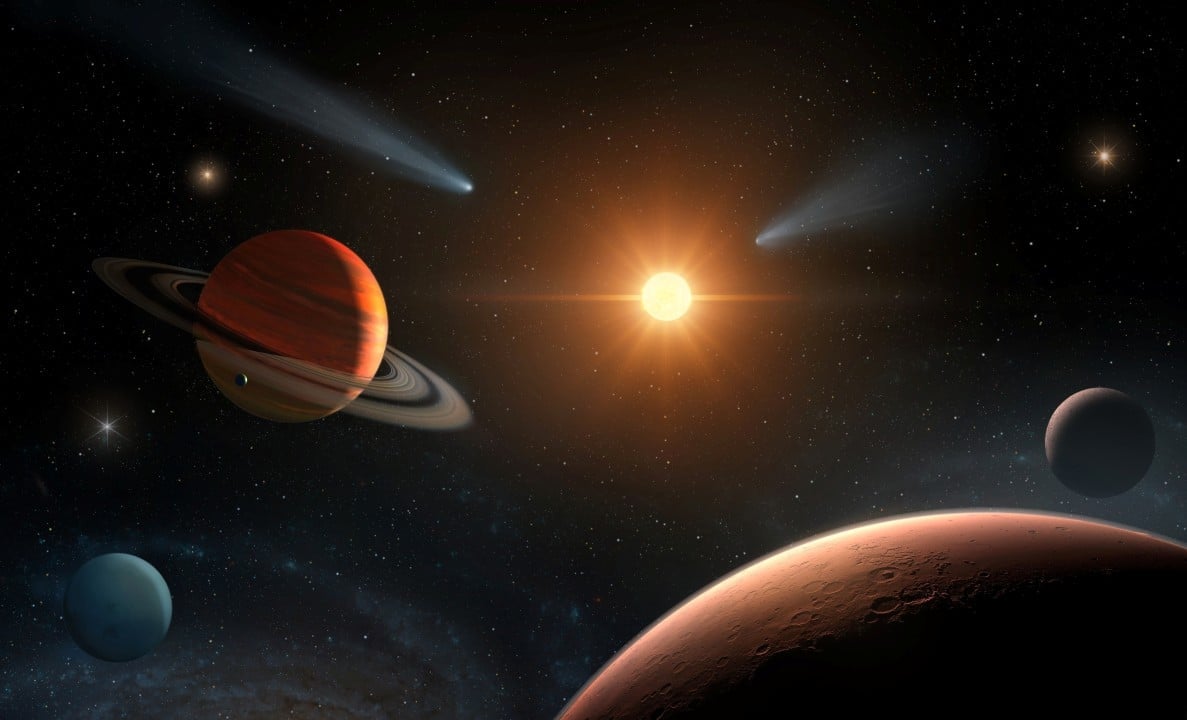
An international team of scientists has mapped the properties of a celestial body located outside Sistema Solar that presents an unprecedented geological and atmospheric configuration. The target of the study is L 98-59 d, a rocky world positioned at a distance of 35 light years from our planet, which orbits a red dwarf star. Analyzes indicate that the surface of this celestial body is entirely covered by molten rocks, forming a vast permanent liquid reservoir. Temperatures at the site exceed the 1,500 °C mark, a condition that makes the solidification of the surface mantle impossible and creates an extreme environment.
The data captured by high-precision instruments revealed a dense atmosphere loaded with specific chemical compounds, particularly hydrogen sulfide and sulfur dioxide. The abundant presence of these elements gives the place peculiar chemical characteristics, including the emission of strong odors associated with sulfur. The study, led by experts from Universidade of Oxford and published in the scientific journal Nature Astronomy, used advanced computer simulations combined with direct observations to detail the internal and external dynamics of this distant world.

The investigation shows that L 98-59 d has a radius 1.6 times greater than that of Terra, but has a considerably lower density, calculated at around 2.2 g/cm³. Essa proportion suggests the retention of a large amount of volatile elements inside, which are gradually released into the atmosphere over extensive geological eras. The discovery challenges traditional models of planetary classification, introducing a new category of worlds characterized by persistent magma oceans and highly sulfurous atmospheres.
Thermal dynamics and stellar radiation
The maintenance of the liquid state on the surface of L 98-59 d is directly linked to its proximity to the host star. The low-mass red dwarf exerts a strong gravitational attraction, generating a phenomenon known as tidal heating.
This internal mechanical process has specific characteristics:
– Impede the natural cooling of the rocky body.
– Garante that the silicate layer remains molten.
– Altera completely local geology compared to distant planets.
Atmospheric composition and chemical reactions
The thick gaseous layer that surrounds the planet is fed by an uninterrupted process of degassing of the molten mantle. The rocky material in liquid state releases large volumes of volatile compounds, saturating the environment with toxic gases.
The ultraviolet radiation emitted by the red dwarf interacts directly with these newly released gases. Essa interaction triggers complex photochemical reactions that transform the molecular structure of the atmosphere, creating a continuous cycle of chemical renewal.
The result of this dynamic is a greenhouse effect of extreme proportions, which acts as a thermal insulator. The retention of heat in the atmosphere feeds back the heating of the surface, ensuring the stability of the magma ocean for prolonged periods.
Advanced instrumentation and space data collection
The precise identification of the chemical elements present in L 98-59 d was made possible by the observation capacity in the infrared spectrum. The James Webb space telescope carried out measurements during the planet’s transit in front of its star.
During these transit events, starlight passes through the exoplanet’s atmosphere before reaching the equipment’s sensors. Diferentes molecules absorb specific wavelengths, leaving unique signatures that act like chemical fingerprints.
The researchers consolidated various information from spectrometric readings, confirming the presence of sulfur at levels greater than 1.5% of the planet’s total mass.
Furthermore, the calculated average density of 2.2 g/cm³ indicates a less compact internal structure, and models indicate that magma oceans can last for extended geological periods in red dwarf systems.
Computational modeling of planetary evolution
To understand the formation history of L 98-59 d, the team of astronomers developed thermodynamic simulations that go back to the earliest stages of the star system. The algorithms processed variables such as the core’s cooling rate, atmospheric pressure and mass loss over time. Esses mathematical models demonstrated that the planet’s low density is not the result of a composition rich in water, as occurs in traditional oceanic worlds, but rather the massive retention of volatile gases trapped in the internal layers since its primary formation.
The remote reconstruction of the planetary interior proves the effectiveness of new astrophysics tools in analyzing inaccessible celestial bodies. By crossing spectroscopic data with fluid mechanics simulations, scientists were able to map the temperature distribution from the core to the upper atmosphere. Esse level of detail allows us to understand how sulfur, a relatively common element in the universe, can dictate the entire geological and climatic evolution of a planet when subjected to extreme conditions of continuous pressure and heat.
Parallels with the formation of Sistema Solar
The discovery of a world with an entirely molten surface offers a natural laboratory for studying early phases of planetary evolution, processes that also occurred in our own system. Durante The first few million years after their formation, both Terra and Marte went through a global magma ocean stage, resulting from the intense bombardment of asteroids and the heat generated by the disintegration of radioactive isotopes. However, due to the greater distance from Sol and different cooling dynamics, these primordial oceans solidified, forming the rocky crusts we know today and allowing the subsequent accumulation of liquid water. The detailed study of L 98-59 d allows planetary geologists to observe in real time the mechanisms of degassing and chemical differentiation that shaped telluric planets more than four geological millennia ago. Understanding how volatile elements, such as sulfur and carbon, are distributed between the liquid mantle and the early atmosphere is fundamental to determining the factors that lead a planet to become a sterile environment or to develop conditions conducive to prebiotic chemistry.
Detection and monitoring history
The celestial body was initially cataloged in 2019 by the TESS satellite, which identifies exoplanets through small drops in the brightness of stars. Subsequent observation campaigns, carried out with new generation instruments, were essential in revealing the anomalous properties that differentiate it from established astronomical classifications.
New category in the astronomical catalog
The physical and chemical structure documented in this study requires a review of the parameters used to categorize intermediate-sized exoplanets. L 98-59 d does not fit the profiles of dense rocky super-Earths or so-called gaseous mini-Neptunes.
The consolidation of this new class of sulfur worlds expands the understanding of planetary diversity in Via Láctea. Continued mapping of systems around red dwarfs should reveal other celestial bodies undergoing similar thermal dynamics.



