
Tehran attacks Israeli Dimona nuclear facility in retaliation for Natanz bombing, raising regional tensions
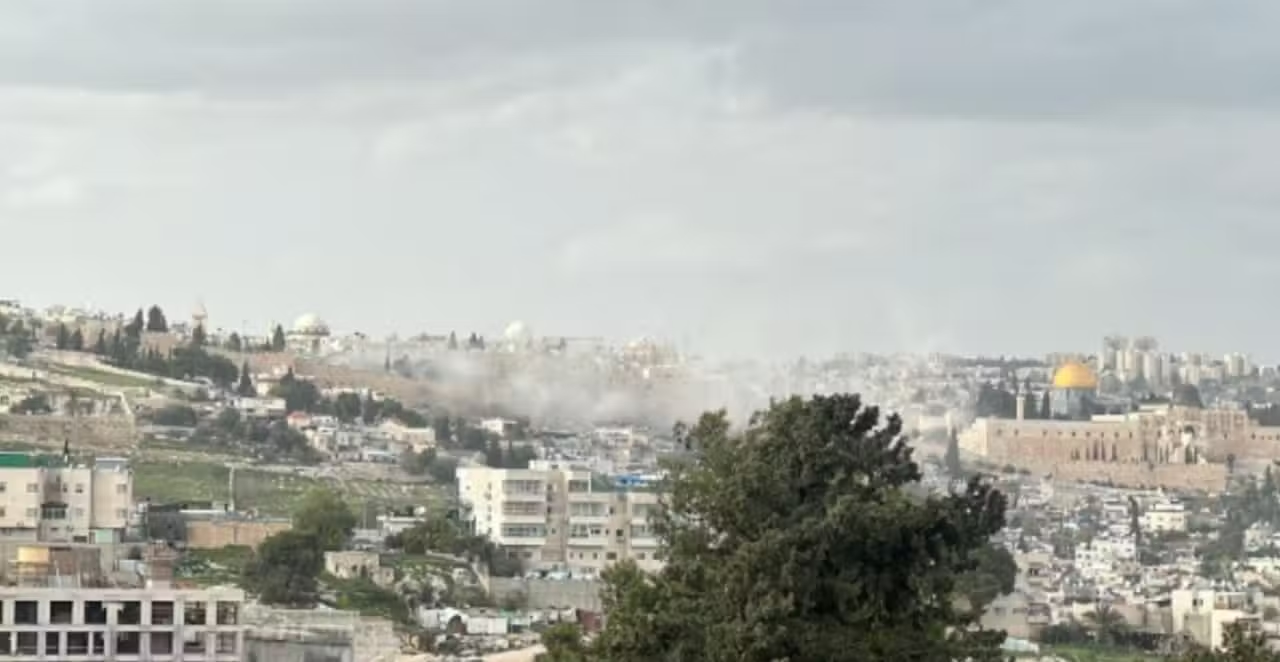
The Iranian government announced this Saturday, March 21, 2026, that it had launched an attack against the Israeli city of Dimona, site of the country’s strategic nuclear installation. The action was presented as a direct “response” to the previous bombing suffered by the Natanz underground complex, a crucial Iranian facility for uranium enrichment. Este incident represents a significant escalation in the already tense relations between the two nations, putting the international community on alert about the risks of a nuclear conflict in the region.
Israel, in turn, maintains a policy of “strategic ambiguity” regarding its nuclear program, never officially confirming or denying the possession of atomic weapons. The Dimona plant, located in the Neguev desert, is formally described as a nuclear research and energy supply center, but international press reports suggest its involvement in the manufacture of nuclear weapons for decades. The complexity and sensitivity of these facilities make any attack on them a point of global concern, given the imminent threat of unpredictable security consequences.
The escalation of the nuclear confrontation
The Iranian claim to have hit Dimona came to light after reports of dozens of injuries in the city, mainly from projectile shrapnel. Autoridades locals confirmed that a building in the area suffered a “direct missile strike” from Iran, and images broadcast by Israeli television showed the facade of a building significantly damaged, punctured and littered with shrapnel. The scale of the damage and the number of victims confirm the seriousness of the attack, which intensifies the rhetoric and military actions in the Oriente Médio.
The attack on Dimona is a clear demonstration of Iran’s ability to retaliate, marking a new level of confrontation. Anteriormente, the complex of Natanz, in the center of Irã, was the target of an “enemy attack”, which Teerã attributed to Israel. The Iranian Atomic Energy Organization, however, reported that there was no record of “leakage of radioactive materials” in Natanz, minimizing the scale of the nuclear damage, but not the severity of the incident itself, which served as the trigger for the most recent Iranian offensive.
International reactions and risk alerts
The international community reacted with immediate concern. The director of Agência Internacional of Energia Atômica (IAEA), Rafael Grossi, issued an urgent call for “military restraint to avoid any risk of nuclear accident”. The possibility of an incident involving nuclear installations, whether due to direct impact or containment failures, raises fears of a catastrophe with incalculable environmental and humanitarian consequences, affecting not only the region, but also the global scenario.
Rússia, a traditional ally of Irã, classified the bombing against Natanz as “irresponsible” attacks that represent “real risks of catastrophe throughout the Oriente Médio region”. Essa stance highlights the gravity of the situation and the consensus on the dangers inherent in military escalation involving nuclear targets. Potências Westerners, in turn, continue to express their suspicions that the Irã seeks to develop an atomic bomb, despite Teerã’s repeated denials, thus justifying attacks such as those launched on February 28 by Israel and
Global energy consequences
The military clashes had an immediate and drastic impact on global energy markets. Oil prices have soared, with a barrel of Brent of Mar of Norte registering an increase of more than 50% in the last month, trading at around 105 dollars. The high Essa reflects instability in the main oil-producing region and concerns about the safety of maritime transport routes, especially the Estreito of Ormuz, through which about a fifth of the oil and liquefied natural gas consumed worldwide passes.
The increase in natural gas and oil prices generated an alert in Comissão Europeia, which recommended that member countries of União Europeia accelerate the filling of their gas reserves for next winter, aiming to reach 80% instead of the previously planned 90%. The measure seeks to alleviate pressure on prices and guarantee the continent’s energy security in a winter period, mitigating the effects of a possible interruption in supply. Cerca of twenty countries, including Emirados Árabes Unidos, Reino Unido, França and Japão, declared themselves “willing to contribute to the efforts” necessary for the safe reopening of
Military actions and regional strategies
The war, now in its fourth week, shows no signs of abating in its intensity. The American Exército disclosed that it had destroyed an Iranian bunker strategically equipped with weapons that posed a threat to oil and gas shipments through Estreito of Ormuz. Admiral



This action, according to Admiral Cooper, “reduced the ability of the Irã to threaten the freedom of navigation in the Estreito of Irã has used blocking access to this maritime route as a form of pressure, in response to attacks coordinated by Israel and Estados Unidos. In another move, the Israeli Exército claimed to have attacked the Teerã university center in Teerã at night, alleging that the institution is “used by the Iranian terrorist regime to develop nuclear weapons components”, indicating a broader strategy of dismantling Iranian military and nuclear capabilities.
Iranian internal political scenario
The internal context of Irã was also marked by crucial events during the conflict. Desde the beginning of the war, several figures in the Iranian regime died, the most notable of which was the supreme leader Ali Khamenei. Sua’s death paved the way for the succession, with his son, Mojtaba Khamenei, assuming the position of supreme leader. However, Mojtaba has not been seen in public since his appointment, generating speculation about his health, the stability of the transition of power or even his actual rise to the highest post in the Islamic republic at a time of crisis.
The absence of Mojtaba Khamenei in the traditional prayer of Eid al-Fitr, a festival that marks the end of Ramadã, in Teerã, intensified doubts. Essa celebration is usually led by the supreme leader, and its absence at an event of such religious and political importance suggests a reorganization or delicate transition phase in the Iranian leadership. Internal political instability can have significant implications for the conduct of the conflict and for the Irã’s response to international pressure, in an already complex and high-tension scenario.
Developments in regional dynamics
The war quickly expanded, turning into a regional conflict that involved the neighboring monarchies of the Golfo. Os Emirados Árabes Unidos claimed to have been targets of air strikes by Irã, which represents a geographic expansion and diversification of the targets of the conflict. The expansion of the combat scenario beyond the direct borders of Israel and
Previously, the Iranian Exército had issued a warning to the Emirados, indicating that it would respond with “strong attacks” to any offensive against the islands of the Golfo of Abu Musa and Tumb Mayor. Estas islands, controlled by Teerã, but whose sovereignty is claimed by Abu Dhabi, are strategic points in Estreito of Ormuz. The threat and subsequent attacks demonstrate the interconnectedness of territorial disputes with nuclear conflict, adding further layers of complexity and risk to an already volatile region where stability is a constant concern.
Perspectives and caveats
Israel warned that the intensity of its attacks will “increase considerably” in the coming days, reaffirming its determination to continue the offensive. Israel Katz, Israeli minister of Defesa, declared that the country “will not stop until all war objectives have been achieved.” Essa postura belicosa indica que o conflito está longe de um desfecho, e que os dias à frente podem testemunhar uma escalada ainda maior de violência e de ações militares.
Analysts predict that Irã still has the capacity to retaliate, suggesting that the conflict “could continue for another four to six weeks,” according to Neil Quilliam, a geopolitics expert at the Chatham House center. Essa projection highlights the resilience of Iranian forces and the complexity of achieving a quick solution. In a previous incident, Teerã carried out a “failed” attack against the British-American base of
Veja Tambem em News (EN)

Research reveals that parents are unaware of how their children use artificial intelligence

Samsung releases new system update with new features for Galaxy Watch 4 users

Digital retail reduces the value of the Galaxy S25 5G smartphone with bank bonuses and device exchange

Amazon’s wireless CarPlay adapter has a 50% discount and high approval ratings from drivers

Zach Cregger’s new Resident Evil ignores games and focuses on an unprecedented story with new characters

Rumor suggests that Nintendo is preparing a special edition of the Switch 2 with a remake of Ocarina of Time

Apple accelerates production of the iPhone 17e and develops new Air model with dual camera system

Epic Games platform releases twelve high-budget games at no permanent cost for PC users

PlayStation 5 Pro price drop accelerates digital retail sales and eliminates global stocks

New Galaxy Watch 9 firmware appears on server and confirms progress in software development

Apple’s commemorative project tests cell phone with 1.1 millimeter edge and curved screen for 2027
