
Rare phenomenon: daytime fireball crosses the sky from Virginia to Ohio with a loud bang

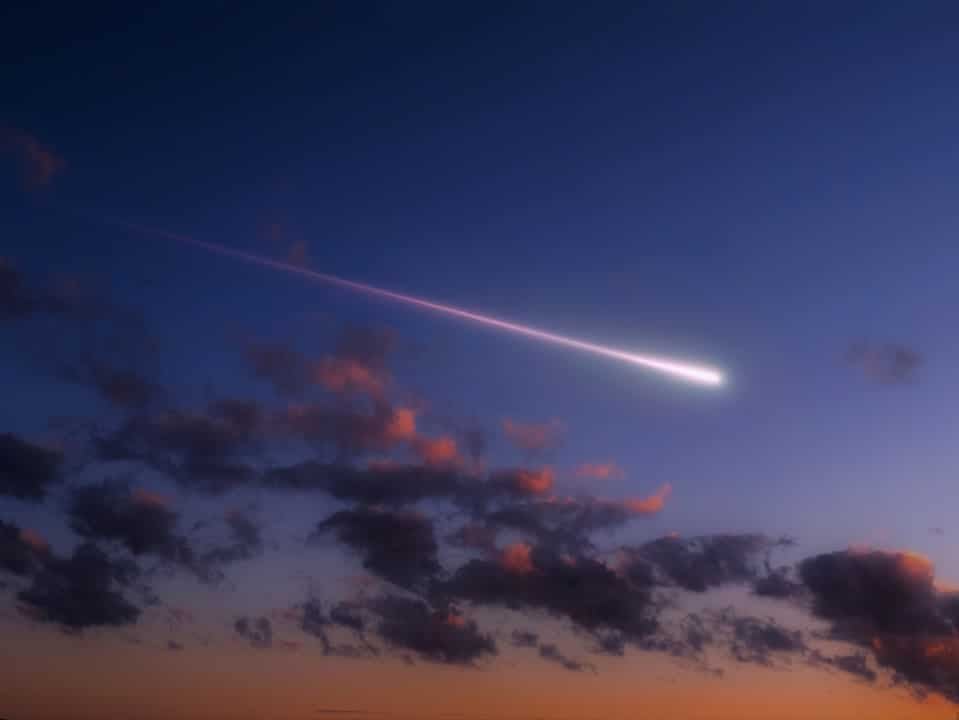
Residents of several states in the east of the Estados Unidos reported on the morning of March 17, 2026, the passage of an extremely bright fireball in the sky, visible even in daylight. The phenomenon, accompanied by a loud sonic boom, occurred around 9 a.m. Eastern Local Time (EDT). Relatos indicated that the event was observed mainly in Virgínia, Maryland, Pensilvânia and Ohio, with records of witnesses in up to 10 states and the Canadian province of
The fireball resulted from the entry into the Earth’s atmosphere of a small asteroid, approximately 1.8 meters in diameter and weighing approximately 7 tons. The object was traveling at approximately 64,400 km/h when it began to disintegrate, generating an intense luminosity comparable to or greater than that of Vênus. Satélites meteorological monitoring captured the flash, confirming the meteor’s aerial explosion.
The event drew immediate attention due to its rarity during the day, when sunlight makes it more difficult to see celestial phenomena. Testemunhas described a trail of light followed by a bright flash and an explosive noise that shook windows and structures in nearby areas.
Buenos días,
—Meredith Gay 🛋️✨ (@MerGarza)March 18, 2026
Ayer at 9am a meteorite entered the atmosphere at a speed of 45,000 miles per hour, fell in Ohio, and according to people the explosion was so great that it was heard in Kentucky and Pensilvania. Pesa to a net weighing about 7 tons.
Coffee? ☕️ ☄️pic.twitter.com/VCUaRmvCrA
Details of the meteor’s trajectory
The asteroid initially became visible at about 80 km above lake Erie, near the northern coast of Ohio. Ele followed a southeasterly direction, traveling more than 55 km in the upper atmosphere before fragmenting approximately 48 km above the city of Valley City, in the county of Medina. The fragmentation released energy equivalent to hundreds of tons of TNT, responsible for the boom heard in distant regions.
Cameras in vehicles and homes recorded the moment the meteor crossed the sky, showing a flaming ball of intense color. Serviço Nacional of Meteorologia of Pittsburgh confirmed the satellite detection, highlighting the flash captured by lightning monitoring instruments.
Reports from residents and official confirmations
Witnesses in Cleveland, Ohio, reported that the boom sounded like a nearby explosion, prompting some to contact emergency services. The noise was felt in cities such as Akron and Medina, where vibrations shook buildings. Sociedade Americana of Meteoros received hundreds of reports, including from neighboring states such as Michigan, Indiana and Kentucky.
Nasa analyzed the available data and confirmed the meteoric origin of the event. The agency indicated that most of the asteroid’s mass disintegrated during atmospheric entry, but smaller fragments may have reached the ground.
Possible fragments in the soil
Experts estimate that parts of the meteor survived the atmospheric passage and fell in an area concentrated in the county of Medina, Ohio. Caçadores of meteorites have already started searching in the region close to cities such as Hinckley, Sharon Center and Rittman. Typical Fragmentos of this type of event appear as dark fusion-crusted rocks, and recovering pieces can provide valuable data about the composition of the original asteroid.
The suspicion is that the meteorites are eucrites, a common group originating from the asteroid 4 Vesta. Até At this time, several samples have been located and confirmed in rural areas of the county.
Rarity of daytime fireballs
Fireballs visible during the day require exceptional brightness to overcome sunlight. Eventos similar ones occur less frequently than nocturnal ones, as they depend on larger objects or more energetic inputs. A previous case recorded in the southeast of Estados Unidos in June 2025 showed similar characteristics, but with more restricted visibility.
The March 17 phenomenon stood out for its combination of daytime luminosity, audible boom and detection by multiple satellites. Dados instruments such as NOAA’s Geostationary Lightning Mapper recorded the intense flash over the north of Ohio.
Impact on atmospheric monitoring
Satellite equipment used for lightning detection captured the flash generated by the disintegration of the meteor. Essa technology helps in the rapid identification of celestial events, differentiating them from other phenomena such as terrestrial explosions. The case reinforced the importance of integrated observation networks to track atmospheric inputs in real time.



