
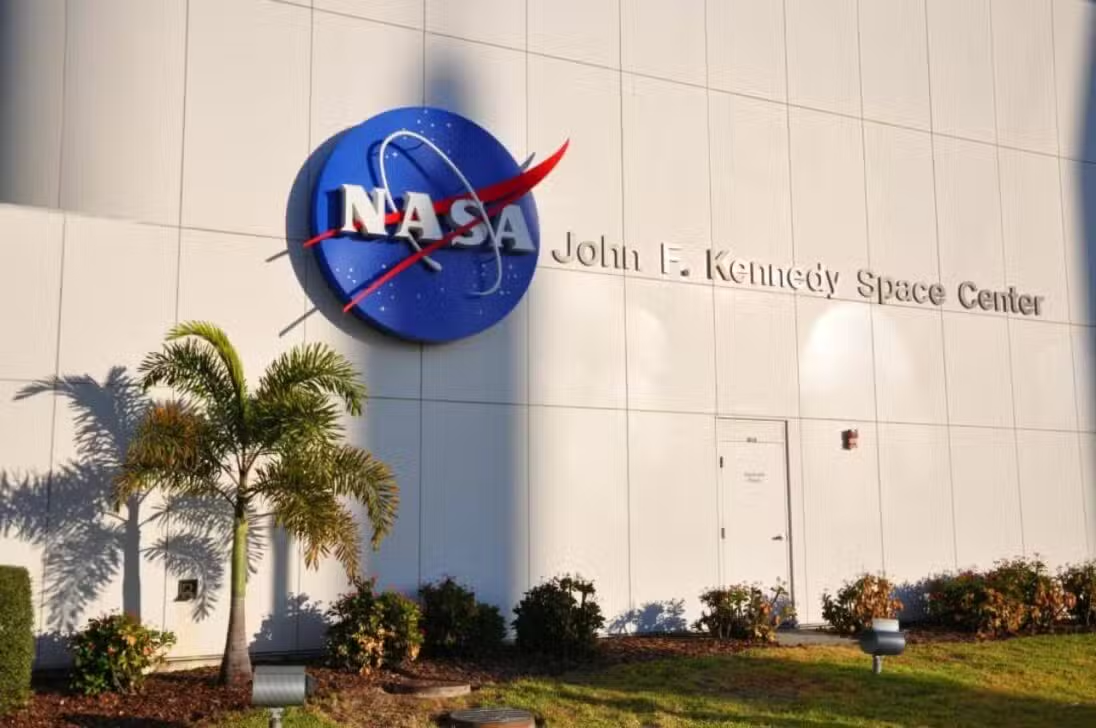
The North American space agency revised the planning of its lunar missions, establishing new deadlines for the return of humans to the natural satellite of Terra. The decision involves technical and safety adjustments to critical components of the ships and rockets, changing the initial forecast for descent to the surface. The engineering teams’ primary focus is to ensure that all life support systems operate with maximum redundancy before authorizing the launch of the next phases of the project.
Engineers identified the need for more time to test the manned capsule’s heat shield and environmental control circuits. The updated schedule reflects the absolute priority given to crew integrity during all stages of spaceflight, from liftoff to re-entry into the Earth’s atmosphere. The complexity of integrating hardware developed by different commercial suppliers also required a readjustment of integration dates at the space port.
The modifications directly affect the sequence of launches planned for the coming years, including test orbital flights and the assembly of cislunar infrastructure. The development of landing modules by private companies undergoes constant reevaluations to synchronize with new launch windows, ensuring that the mission architecture works in an integrated manner when explorers reach Lua orbit.
Technical adjustments to exploration ships
During the atmospheric reentry tests of the previous unmanned mission, the capsule’s heat shield showed anomalous wear, greater than that projected by computer simulations. The technical team now performs in-depth analyzes in wind tunnels and high-temperature furnaces to understand the behavior of the ablative material under extreme friction conditions.
The ventilation, air purification and humidity control systems also undergo redesigns to ensure uninterrupted operation during the round trip. Replacing pressure valves and navigation electronic circuits requires an additional battery of tests in thermal vacuum chambers, simulating the hostile environment of deep space.
Crew training for orbital flight
The four astronauts selected for the program’s first manned mission continue their intensive preparation in high-fidelity flight simulators. Training covers emergency procedures, manual navigation of the spacecraft, and operation of control panels during critical trajectory correction maneuvers.
The preparation routine includes rescue simulations in the ocean, where the capsule will land after returning from lunar orbit, withstanding the impact with water. Equipes marine recovery personnel participate in practical exercises to align protocols for rapid and safe crew extraction in different tidal and weather conditions.
The itinerary for this specific flight does not include the descent to the lunar soil, focusing on bypassing the satellite and testing long-range communication. The free return trajectory ensures that the spacecraft returns to Terra using lunar gravity as a natural slingshot, minimizing the need for prolonged firing of the main engines.
Development of the commercial lander
The construction of the vehicle responsible for taking astronauts from orbit to the lunar surface is the responsibility of the private sector, using a service provision contract model. The project requires the transfer of cryogenic propellant in space, an unprecedented logistical maneuver in the history of space exploration that requires millimeter precision.
The landing vehicle needs to perform multiple unmanned refueling flights in Earth orbit before heading to Lua and awaiting the arrival of the capsule with the crew. Testing of Raptor engines and autonomous navigation systems takes place at launch facilities south of Texas, with rigorous flight stability assessments.
The mission’s architecture determines that two astronauts descend to the lunar south pole while the other two remain in the capsule in orbit, monitoring the communication systems. The commercial module will serve as a base of operations and temporary habitat during the satellite’s approximately one-week stay on the surface.
Engineers are working on adapting the module’s elevators and airlocks to facilitate the exit of explorers equipped with their heavy spacesuits. The vehicle’s considerable height requires redundant and safe mechanisms for transporting scientific equipment, rovers and geological samples between the cabin and the lunar soil.
Preparations for the cislunar orbital station
The agency’s long-term planning includes assembling a space station in Lua’s orbit, designed to serve as a logistical support point for future missions and continued exploration. The first modules of this structure, focused on propulsion and basic housing, are in the final stages of assembly and integration testing, with launch scheduled to coincide with the most advanced phases of the exploration program. The station will allow crews to more safely transfer between ships, store supplies for extended expeditions, and conduct scientific research without the need to immediately return to Terra.
Different international space agencies contribute vital components to the station, including precision robotic arms, life support modules and broadband communications systems. The elliptical orbit chosen for the installation provides continuous access to sunlight for power generation and uninterrupted communication with ground control centers. Esta infrastructure is considered the fundamental pillar for the sustainability of human presence in deep space, serving as a testing laboratory for technologies that will be used in the future in manned travel to more distant destinations in the solar system.
Scientific exploration at the lunar south pole
The southern region of Lua attracts immediate interest from the global scientific community due to the confirmed presence of water ice at the bottom of permanently shadowed craters, where sunlight has not reached the ground for billions of years. The extraction, purification and processing of this natural resource are fundamental steps for the local production of oxygen for astronauts’ breathing and hydrogen for rocket fuel, drastically reducing dependence on heavy supplies sent from Terra. Explorers will be tasked with collecting deep geological samples using specialized drills, installing advanced seismographs to map internal tectonic activity, and measuring radiation levels in the lunar surface environment. The extremely rugged topography of the South Pole requires extremely high-precision landing systems, equipped with LIDAR sensors capable of identifying and avoiding rocks and steep slopes in the last critical seconds of descent. Continuous orbital mapping, carried out by unmanned probes, provides topographic and thermal data essential for selecting the safest landing zones with the greatest potential for significant scientific discoveries.
Evolution of spacewalk suits
The new spacesuits offer greater mobility in the shoulder and hip joints, allowing explorers to walk more naturally and kneel easily to collect soil samples. The design incorporates advanced thermal regulation systems and high-strength composite materials to protect against abrasive lunar dust, ensuring safety during prolonged extravehicular activities.
Supply logistics and surface infrastructure
Consolidating an operational lunar base requires the prior deployment of unmanned rovers, solar panel arrays, and expandable modular habitats. Foguetes of heavy cargo will be used to position this equipment strategically on the ground before the arrival of long-duration manned missions, ensuring that the basic infrastructure is ready for immediate use.
The surface communication network will depend on relay satellites positioned in specific orbits around Lua, forming a dedicated constellation. Essa network architecture will ensure the transmission of high-definition video, spacesuit telemetry and real-time scientific data to technical support teams and researchers at Terra.
Preparation of ground launch pads
Spaceport facilities undergo severe structural modifications to withstand the thrust force and extreme vibration generated by the program’s new super-heavy rockets. The umbilical towers, responsible for supplying liquid hydrogen and oxygen, received upgrades to their quick disconnect systems to prevent dangerous leaks during the final moments of the countdown. The water flood sound suppression system was expanded to protect the concrete platform and the vehicle itself from destructive acoustic shock waves at the precise moment of ignition of the main engines. Ground engineering teams perform repeated cold fueling tests, simulating all critical steps on launch day to validate the reliability of ground equipment before authorizing the deployment of the manned spacecraft to the base.