
James Webb Telescope reveals unprecedented details of the PMR 1 nebula nicknamed the exposed skull

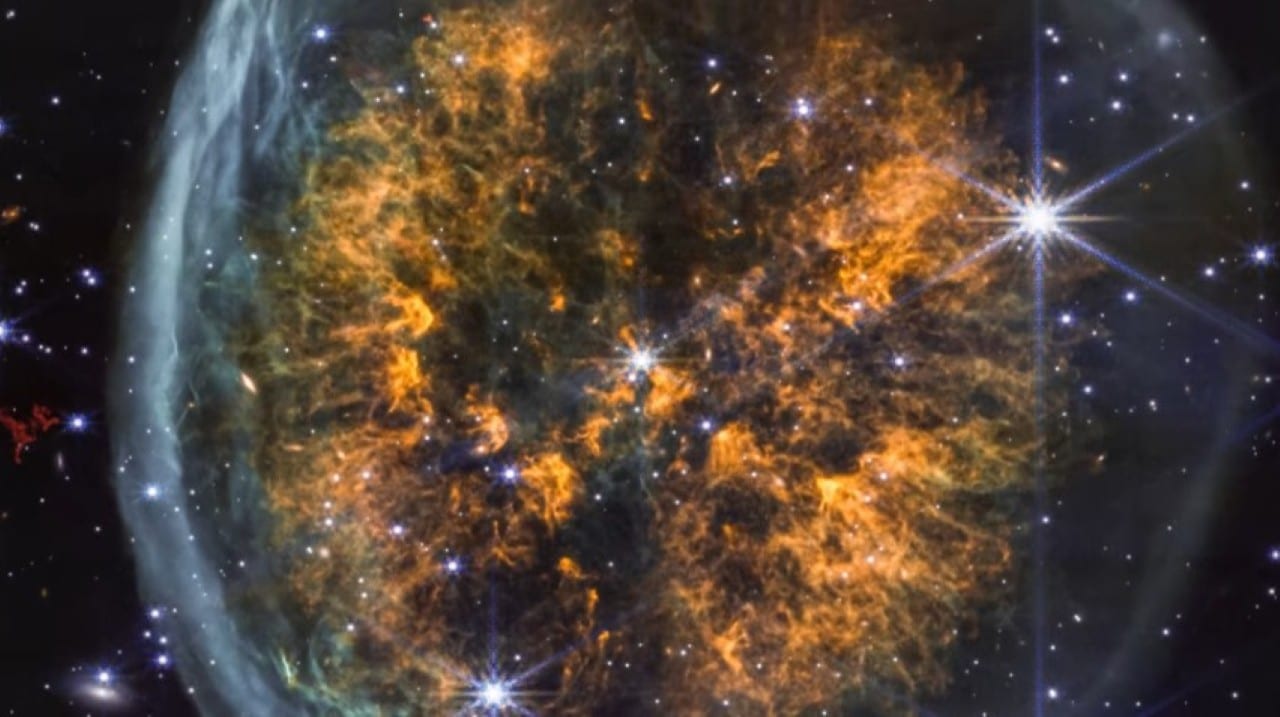
Telescópio Espacial James Webb captured high-resolution images of the planetary nebula PMR 1, located approximately 5,000 light-years from Terra in the constellation of Vela. The structure earned the nickname “exposed skull” due to its resemblance to a transparent skull that reveals a brain inside. Observations use near- and mid-infrared light to display features never before seen so clearly.
The nebula appears in the final stage of the life of a star similar to Sol. Quando the star ages, expands and ejects outer layers of gas and dust into space. Ultraviolet radiation from the remnant star ionizes the ejected material, creating the planetary nebula’s characteristic glow.
Unique structure of the PMR 1 nebula
The outer layer of PMR 1 appears in light bluish tones in the images. Essa region consists mainly of cold hydrogen initially ejected by the star. The inner part has orange and white colors, formed by hotter gases and cosmic dust released in later phases.
A vertical dark band runs through the center of the nebula. Essa characteristic divides the structure into two halves, reinforcing the cerebral appearance. Astrônomos associate the band with polar jets ejected by the central star, which push gas outward.
Differences between James Webb instruments
The NIRCam instrument captures background stars and galaxies visible through the nebula. The near-infrared view highlights the clear outer bubble and detailed inner clouds. Já MIRI emphasizes the glow of hot dust and shows ejections of material at the upper and lower poles.
These differences demonstrate how varying wavelengths reveal different aspects of the same structure. The combined observations make it possible to reconstruct the three-dimensionality of the nebula and better understand the dynamic processes involved.
Origin and evolution of the nebula
The PMR 1 nebula was discovered in the late 1990s. Previous Observações with Telescópio Espacial Spitzer already indicated its peculiar shape in infrared. The new images from James Webb surpass in resolution and sensitivity, exposing layers of successive ejections.
The central star continues to expel material. The process creates distinct regions that mark different moments of stellar mass loss. The dark central band suggests directional ejections that shape the current morphology.
Observations reveal phases of stellar death
NIRCam images show the outer bubble as a remnant of the initial hydrogen ejection. Orange inner clouds indicate denser, more complex material released later. MIRI highlights heated dust and vertically expelled gas streams.
This distinction captures multiple stages of the star’s evolution in a single view. The data helps to understand how solar-mass stars end their lives and enrich the interstellar medium with elements.
Future of the central star
The exact mass of the central star still requires precise measurements in future observations. Caso has a mass similar to that of Sol, it will transform into a white dwarf after expelling its outer layers. The nebula will continue to expand and gradually dissipate into space.
The James Webb images provide valuable evidence about the ultimate fate of these stars. Elas show the moment when the ejected material interacts with the circumstellar environment.
Details captured in infrared
The combined observations highlight the complexity of PMR 1. The mid-infrared view reveals dust that glows brightly. Já near infrared allows us to see through the outer layers, exposing internal structures and the cosmic background.
These data improve understanding of the formation and evolution of planetary nebulae. PMR 1 serves as an example of how dying stars shape structures visible thousands of light-years away.



