
Astronomical phenomenon blocks the sun for six minutes and crosses continents in the biggest eclipse of the century

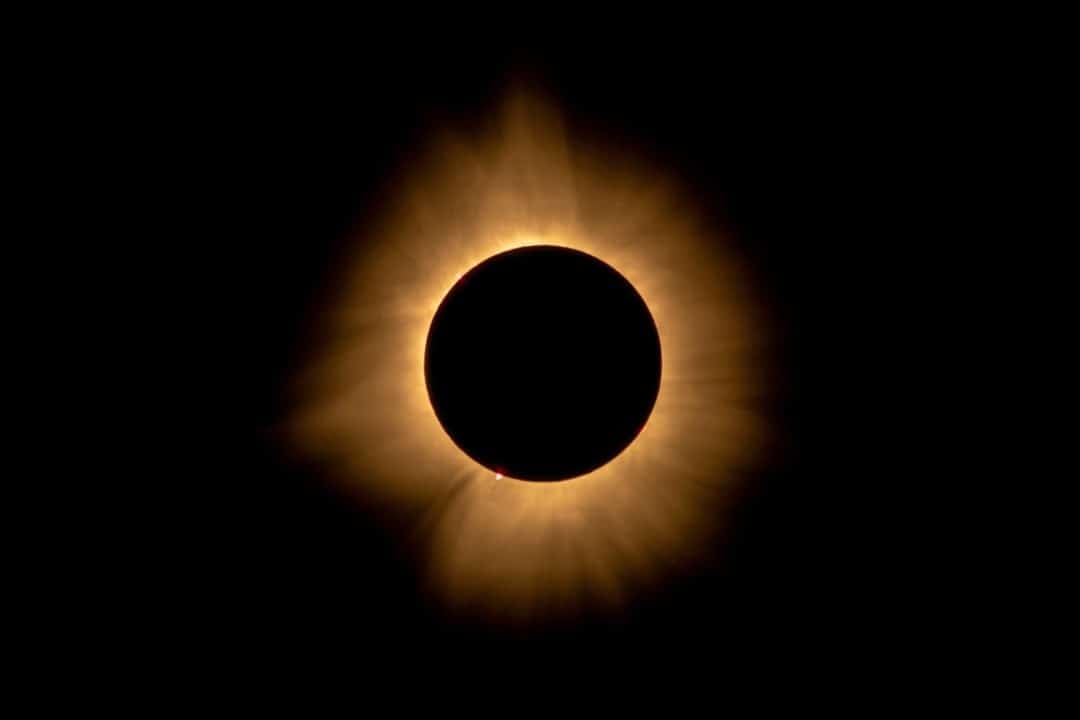
The most anticipated astronomical event in recent decades will take place on August 2, 2027, when daylight will be temporarily replaced by darkness in several parts of the planet. The moon will be positioned perfectly between Terra and the sun, casting a gigantic shadow that will cross multiple countries. The phenomenon will last a maximum of six minutes and twenty-three seconds, setting an absolute record for the current century.
The celestial mechanics responsible for this long duration involve the precise alignment of three celestial bodies at specific positions in their respective orbits. The natural satellite of Terra will be close to its perigee, the point of shortest distance from our planet, making its apparent disk larger. Simultaneamente, to Terra will be close to aphelion, the furthest point from the sun, reducing the star’s apparent size.
This rare geometric combination allows the total blockage of light to extend for a period much longer than the historical average for similar events. Especialistas from several space agencies already monitor orbital trajectories to provide accurate data on the shadow’s path. The precision of the mathematical calculations ensures that observers in specific regions can plan their logistical activities years in advance.
Shadow trajectory across continents
The path of totality will begin its journey over the eastern waters of Oceano Atlântico, advancing rapidly towards the European and African continent. The band of darkness will initially cross south of Espanha, providing residents and visitors to Península Ibérica with their first glimpses of solar blocking. Then, the lunar umbra will cross Estreito from Gibraltar and enter the north of África, covering vast tracts of land.
North African countries will be on the main route of the event, with the shadow passing successively through Marrocos, Argélia, Tunísia, Líbia and Sudão. Cada one of these nations will experience minutes of total darkness, temporarily altering the routine of cities and the behavior of local fauna. The progression of the phenomenon will continue towards the east, reaching Egyptian territory, where it will reach its maximum duration point.
Egito will house the exact location where the sun will be hidden for a record time of more than six minutes, attracting global attention to the region. Após crosses the Egyptian desert and Mar Vermelho, the trajectory of the umbra will continue through Oriente Médio, darkening the skies of Arábia Saudita and Iêmen. The shadow’s speed of movement will vary according to the curvature of the Terra, maintaining a constant rhythm from east to west.
The final phase of totality will occur over Chifre of África, specifically in Somália, before the shadow disappears in Oceano Índico. Observadores located outside this narrow band, in parts of Europa, África and Ásia, may witness a partial blockage of light. Nesses adjacent locations, the moon will cover only a fraction of the solar disk, creating a different visual spectacle, but rigorously monitored by experts.
Opportunities for the scientific community
The unusual extent of this phenomenon offers an unprecedented observation window for researchers studying solar dynamics and the star’s upper atmosphere. Durante totality, the solar corona, which is the outermost and hottest layer of the sun’s atmosphere, becomes visible to the naked eye and can be captured by high-precision instruments. Scientists plan to use this extended time to collect data on coronal mass ejections, solar winds and temperature variations that occur in this region that is inaccessible on normal days. Equipamentos advanced, including ground-based telescopes and sensors on board high-altitude aircraft, will be strategically positioned along the route to maximize image capture and light spectra. Analysis of this information is essential to improve space weather prediction models, which directly affect communication and navigation systems on Terra.
In addition to solar physics, prolonged radiation blocking allows experiments related to the response of the Earth’s atmosphere to sudden changes in luminosity. The sudden drop in temperature and changing wind patterns during minutes of darkness provide a natural laboratory for meteorologists to test short-term climate models. Pesquisadores in biology are also preparing to record the reactions of different animal species, which often demonstrate nocturnal behaviors or signs of disorientation during totality. The integration of data collected by different scientific disciplines will transform the August event into a milestone for global interdisciplinary research. International space agencies coordinate efforts to ensure that observation stations operate synchronously, sharing results in open databases shortly after capture ends.
Visual security protocols
Direct observation of the star, even during partial phases, requires strict compliance with safety standards to avoid irreversible damage to vision. Health and astronomy authorities emphasize the absolute need to use protective glasses certified to the international standard ISO 12312-2. Esses Specific sun filters block ultraviolet and infrared radiation, in addition to reducing visible light to levels safe for the human retina.
The use of improvised methods, such as x-ray plates, tinted glasses, photographic film or conventional sunglasses, is completely contraindicated by medical experts. Exposing the eyes to concentrated light without adequate protection can cause solar retinopathy, a thermal injury that results in partial or total loss of central vision. Campanhas awareness programs are already being developed to educate the public about the risks and the correct way to acquire genuine protective equipment.
Optical devices such as binoculars, telescopes and cameras also require the installation of appropriate filters on their front lenses. Observar the sky through these instruments without the appropriate filter, even when wearing protective glasses on the face, causes immediate burning of the protective material and instantaneous eye damage. The only time when it is safe to remove the visual protection is during the exact minutes of totality when the luminous disk is completely covered.
Economic movement and infrastructure
The mathematical predictability of astronomy allows the tourism and hospitality sectors in affected regions to prepare well in advance for the massive influx of visitors. Cidades located on the main strip, especially Egito and Espanha, have already registered a significant increase in hotel and commercial flight bookings for the event period. Local governments are working on temporarily expanding transportation and security infrastructure to accommodate amateur astronomers, researchers and tourists from different parts of the world.
Specialized travel packages are being marketed by travel agencies, offering desert camps, sea cruises and charter flights that follow the path of the shadow. The injection of foreign capital into these local economies represents a considerable financial boost, stimulating the creation of temporary jobs and the development of regional trade. Civil aviation authorities also coordinate air traffic to avoid congestion at airports near key observation points.
Differences from previous events
The recent astronomical calendar features a sequence of solar blocks, but the discrepancy in the duration of totality between them highlights the uniqueness of the August 2027 event. In the year 2026, for example, a similar phenomenon will also cross parts of the northern hemisphere, including areas of Europa, but maximum darkness will last just over two minutes. Essa difference of almost four minutes less in relation to the subsequent event occurs due to continuous variations in the relative distances between Terra, the natural satellite and the central star. Quando the lunar orbit is further away from Terra, its shadow cone does not reach the Earth’s surface with the same amplitude, resulting in shorter observation times. The perfect orbital configuration that allows for more than six minutes of totality is a statistically rare alignment that requires simultaneous extreme conditions. Historiadores point out that durations of this magnitude of time usually occur only a few times each century, making them priority targets for large-scale scientific expeditions. Planning for 2027 began shortly after confirmation of its orbital data, exceeding in logistical complexity the preparations for standard duration events that occur more frequently.
Information distribution and mapping
Digital platforms and mapping applications provide detailed coordinates on the exact start, peak and end times of darkness for any geographic location. Esses systems use Tempo Universal Coordenado to synchronize global information, allowing users to adjust data for their respective local time zones. The accuracy of these tools helps observers avoid areas with a high probability of cloud cover, based on historical weather data for the region.
Educational institutions and planetariums develop teaching materials to integrate the topic into school science and basic physics curricula. The distribution of interactive maps and observation guides aims to democratize access to technical information, ensuring that communities outside large urban centers can also understand celestial mechanics. Collaboration between television networks and streaming platforms will ensure live broadcasting, connecting millions of viewers who will not be able to travel to the totality band.
Continuous Space Weather Monitoring
Monitoring atmospheric conditions in the days leading up to the date will be the determining factor for the success of terrestrial observations. Centros meteorology department will issue daily updated bulletins on cloud cover on the main routes, guiding the last-minute movement of research teams. Logistical flexibility will be essential to overcome unforeseen weather conditions and ensure visual recording of the biggest light blockage of the century.



