
Observations from the James Webb Telescope reveal the internal structure of the planetary nebula PMR 1

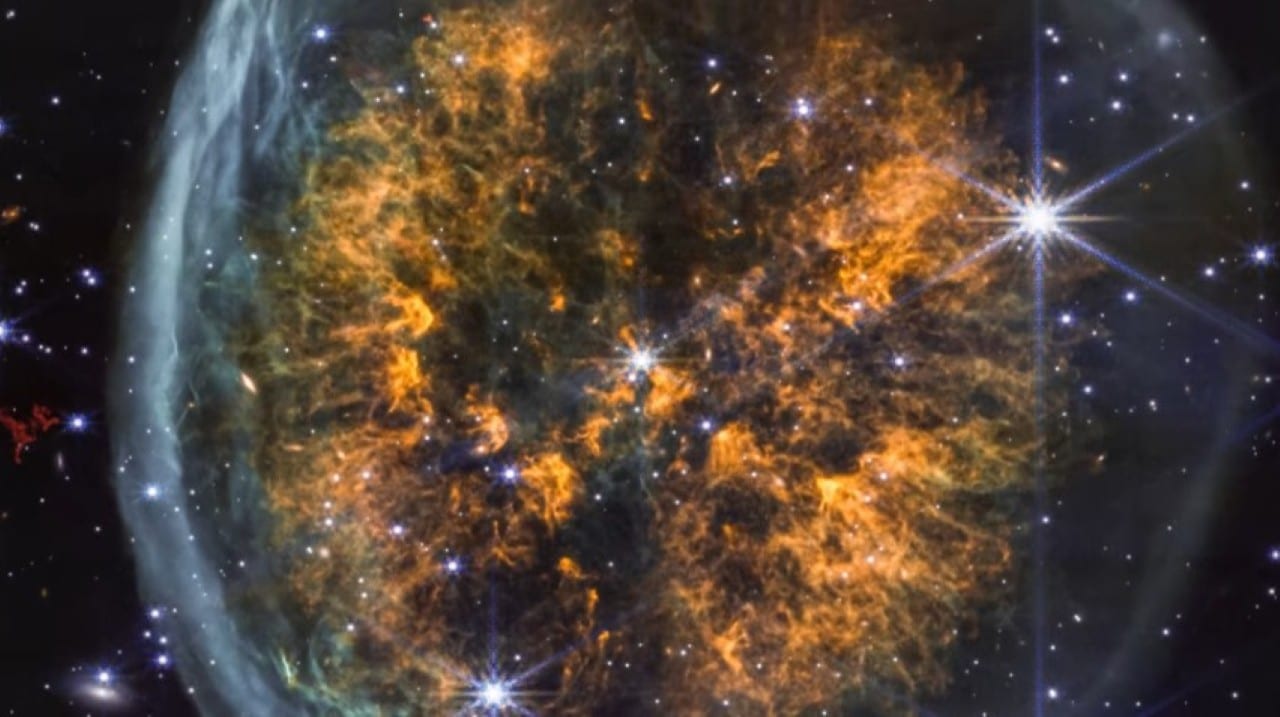
Today’s most advanced space observation equipment has captured very high-resolution images of a celestial object located approximately 5,000 light-years from planet Terra. The target of the space photographic record is a cosmic gas and dust formation located in the constellation of Vela, which presents unique visual characteristics due to its complex chemical and structural composition.
The astronomical formation gained notoriety in scientific circles due to its visual similarity with a transparent cranial structure, which allows the visualization of an internal nucleus that resembles the shape of a brain. Essa peculiar appearance is the direct result of the dynamics of stellar winds and the ejection of matter that occurs in the final stages of a star’s life.
To obtain this level of detail, astronomers used the space observatory’s near- and mid-infrared light sensors. Essa technology allows researchers to see through thick clouds of cosmic dust, revealing morphological features and physical processes that remained hidden to telescopes of previous generations.
Morphological features and anatomy of the formation
The outermost layer of the celestial object appears in the processed images in bluish and translucent tones, forming a kind of protective bubble around the core. Essa região periférica é composta majoritariamente por gás hidrogênio em temperaturas mais baixas, que foi ejetado nos estágios iniciais do processo de morte da estrela central, expandindo-se pelo vácuo do espaço ao longo de milhares de anos.
Inside this bubble of hydrogen, there is a much denser and more chaotic structure, which appears in the images in vibrant shades of orange and white. Essa internal area is formed by superheated gases and cosmic dust rich in heavy elements, released in later and more violent phases of the stellar agony. A feature that catches scientists’ attention is a vertical dark band that runs through the exact center of the formation, dividing the bright material into two symmetrical halves and reinforcing the visual analogy with the hemispheres of a biological brain.
The researchers identified fundamental elements that explain this specific spatial geometry:
– Polar jets ejected at high speed by the central star act as engines that push hot gas to opposite ends.
The dynamics of space observation instruments
The NIRCam instrument, specialized in capturing light in the near-infrared spectrum, is responsible for recording the background stars and distant galaxies that shine through the gaseous structure. Essa specific vision highlights the transparency of the outer hydrogen bubble and maps the intricate inner clouds with unprecedented clarity.
On the other hand, the MIRI sensor operates in the mid-infrared and has the function of emphasizing the thermal glow emitted by heated cosmic dust. It is this instrument that can accurately capture the ejections of material concentrated at the upper and lower poles of the object, providing crucial data on the temperature and density of the ejected material.
The life cycle of solar-mass stars
Formations like this appear exclusively in the final stage of the evolution of stars that have a mass similar to that of our Sol. Trata is a natural and inevitable process that marks the transition from an active star to an inert stellar remnant.
When the nuclear fuel in the star’s core runs out, it loses the ability to support its own weight against gravity, which generates an internal collapse followed by colossal expansion. During this red giant phase, the outer layers of the stellar atmosphere are violently ejected into interstellar space.
The remaining core at the center of the system, now exposed and extremely hot, emits massive amounts of ultraviolet radiation. Essa invisible radiation travels through space and strikes previously ejected gas, stripping electrons from its atoms in a process known as ionization.
It is exactly this energetic interaction between the radiation from the nucleus and the surrounding gas that causes the matter to shine brightly, creating the luminous spectacle that the telescopes capture from Terra. Esse mechanism is also responsible for spreading essential chemical elements throughout the galaxy.
History of discoveries and technological advances
The celestial object in question was first cataloged in the late 1990s, when terrestrial astronomical instruments began to map the region of the constellation Vela with greater precision. Subsequent Observações carried out with the Telescópio Espacial Spitzer already indicated the existence of a peculiar morphology when observed at infrared wavelengths, but the limited resolution at the time prevented an in-depth analysis. The current space observatory, with its gigantic primary mirror and state-of-the-art sensors, surpasses all previous missions in sensitivity, exposing layers of successive ejections and allowing scientists to reconstruct the structure’s three-dimensionality with mathematical precision.
The role of radiation in the visual formation of the object
The central star does not cease its activity immediately after the main ejection; she continues to expel material at varying paces. Esse continuous process creates distinct regions within the gas cloud, which act as temporal markers of different moments of stellar mass loss, allowing astronomers to read the star’s history as if they were rings in the trunk of a tree.
The dark central band seen in the images suggests the presence of a dense dust disk around the star’s equator, which blocks light and directs subsequent ejections towards the poles. Essa Directional dynamics is the primary mechanism that shapes the object’s current morphology, transforming a simple spherical bubble into a complex, multifaceted structure.
The fate of the remaining stellar core
The exact mass of the central nucleus is still a subject of study and requires more precise spectroscopic measurements in future observation campaigns. Determinar this value is fundamental to predict the thermodynamic behavior of the system in the next astronomical eras.
If current estimates are confirmed and the nucleus has a mass compatible with that of Sol, it will definitively transform into a white dwarf. Este is an extremely dense celestial body, approximately the size of Terra, which no longer performs nuclear fusion and only radiates its residual heat.
As the core slowly cools over billions of years, the cloud of gas and dust will continue to expand through the vacuum. In a few tens of thousands of years, this material will completely dissipate into the interstellar medium, leaving the white dwarf alone in space.
The importance of infrared mapping
The combined observations at different wavelengths highlight the object’s structural complexity. The ability to see through outer layers of dust exposes internal structures and the cosmic background, providing a perfect natural laboratory for studying stellar hydrodynamics.
Contributions to modern astrophysics
The data collected significantly improves scientific understanding of the mechanisms of formation and evolution of gaseous structures in the universe. Old theoretical models are being revised based on this new visual and spectrometric evidence.
The observed object serves as a clear example of how dying stars are capable of shaping the environment around them. The material ejected today will be the raw material for the formation of new stars and planetary systems in the galaxy’s distant future.



