Rocket from the Artemis II mission begins its journey to the launch pad in Florida
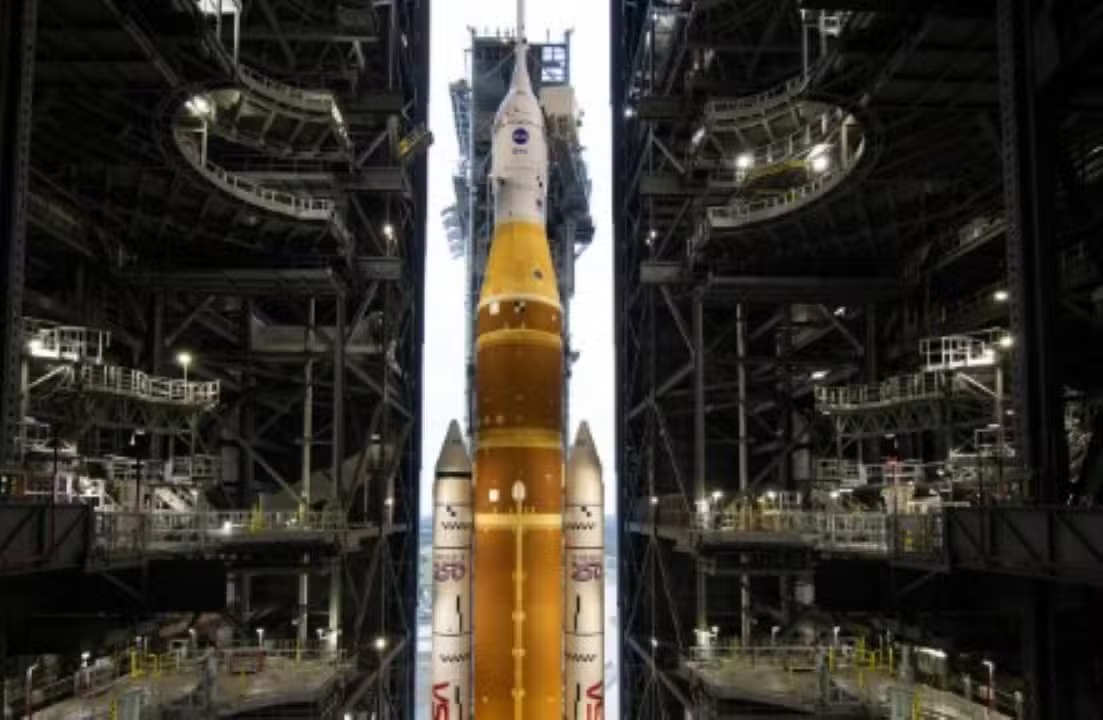
The Space Launch System launch vehicle and the Orion capsule began the return journey to platform 39B on Centro Espacial Kennedy, located on the east coast of Estados Unidos. The official movement began in the early hours of Friday morning, shortly after the dissipation of strong winds that prevented the safe start of the logistics operation.
This displacement represents a fundamental step in the advancement of the manned space program, which aims to place humans in lunar orbit after more than five decades. The route of approximately 6.4 kilometers separates the Edifício of Montagem of Veículos from the launch complex, requiring an extremely slow pace to preserve the structural integrity of the equipment.
NASA’s SLS (Space Launch System) rocket and Orion spacecraft are getting ready to roll back to Launch Pad 39B for the@NASAArtemisII mission. Teams are currently monitoring the wind speeds before rolling out of@NASAKennedyVehicle Assembly Building. Follow along:…pic.twitter.com/7mwl7j7SVY
— NASA (@NASA)March 20, 2026
The gigantic train travels on tracked conveyor number 2, a machine specifically designed to support colossal loads. Engenheiros and technicians monitor every meter of the journey, ensuring that the 98-meter-high rocket reaches its destination without suffering excessive tilts or vibrations.
Logistics operation and safety protocols on the track
Transferring the rocket to the launch ramp takes an estimated 12 hours of continuous work. Ground crews perform a series of rigorous procedures before and during transporter movement to ensure the integrity of space hardware.
– The first step involved the complete removal of the access platforms that surrounded the vehicle inside the assembly hangar.
– Durante the route, meteorologists constantly monitor the wind speed, preventing dangerous oscillations in the mobile tower.
– Operators also check telemetry systems in real time and coordinate the total isolation of the heavy traffic area.
Technical corrections to the helium pressurization system
The need to return the equipment to the assembly hangar arose after a critical failure was detected during general tests carried out in February. Sensors indicated a blockage that prevented adequate helium flow to the rocket’s upper stage. Este gas acts as a vital component for the pressurization of liquid fuel tanks, a process that must occur moments before ignition of the main engines. Sem the correct pressure, the supply of propellant to the thrusters would be compromised, creating unacceptable risks for a manned mission.
To resolve the obstruction, the engineering teams treated the case with top priority, carrying out partial disassembly inside the central stage. Technicians accessed the complex tangle of valves and pipes, removing the blockage after weeks of painstaking intervention. Subsequent pressure Testes confirmed the restoration of normal helium flow. Atualmente, the pressurization system operates strictly within the safety parameters required by crewed space flight standards.
Preventative maintenance of electronic components
The period of stay at Edifício of Montagem of Veículos allowed a comprehensive review of multiple mechanical and electronic subsystems. Especialistas activated a new set of batteries for the flight termination system, a mandatory safety mechanism designed to destroy the rocket if a dangerous deviation from course occurs.



Crews also replaced exhausted power cells in the upper stage, core stage and solid fuel boosters. The launch abort system for the Orion capsule, which has the function of ejecting astronauts in the event of an emergency on the ramp or during ascent, underwent complete load testing and software verification.
In the propulsion sector, technicians replaced a seal in the liquid oxygen supply line, eliminating a microcrack detected by thermal inspections. The service mast umbilical plate has undergone rigorous vacuum testing to ensure an airtight seal against cryogenic fluid leaks.
Crew preparations for the orbital journey
The space expedition will be led by astronauts Reid Wiseman, Victor Glover and Christina Koch, from the North American space agency, together with Jeremy Hansen, a representative of the Canadian agency. The group will be the first to test the Orion spacecraft’s life support systems in a real deep space radiation environment.
The flight plan calls for a journey of approximately 10 days, using a free return trajectory driven by lunar gravity. The astronauts will validate approach maneuvers, long-distance communication systems and the resistance of the capsule’s heat shield during re-entry into the Earth’s atmosphere at very high speed.
Conveyor engineering and ground infrastructure
The tracked vehicle responsible for the displacement is among the heaviest land machines ever built, registering around 2,700 tons of gross weight without the payload. Este colossal equipment supports the Plataforma of Lançamento Móvel, which serves as the structural base for the giant rocket. Para To avoid damage to the space vehicle, the transporter uses a dynamic hydraulic leveling system, continuously adjusting to ensure that the top of the rocket does not tilt more than a fraction of a degree, even on uphill sections. The track dedicated to this operation has a thick base of river rocks extracted from specific quarries, selected for their ability to support extreme weight without generating sparks caused by friction. Essa paving and transport technology, although inherited from missions of past decades, has received extensive modernizations to accommodate the significantly greater mass of the current launch configuration.
Operational transparency and public monitoring
The space agency broadcasts the movement live through official channels, allowing public monitoring of each stage of the operation. Especialistas safely walk alongside the giant conveyors, visually inspecting the ground and metal structure for any anomaly that requires the immediate interruption of the train.
Launch ramp connection procedures
Once the rocket reaches its final position at the top of complex 39B, ground teams will begin the process known as rigid fixation. Esta stage takes several hours of work and involves securing the mobile structure to the ramp’s support pillars, ensuring absolute stability against coastal winds.
Next, technicians will connect fluid service lines, electrical power cables and data transmission networks. The completion of these physical interfaces will prepare the vehicle for integrated tests with the control center and for final cryogenic propellant supply trials.
Security reforms at the space complex
The platform’s infrastructure underwent extensive renovations to meet the specific requirements of the new super-heavy vehicles. The modifications include the installation of an updated water sound suppression system designed to absorb the extreme sound energy generated when the engines are ignited.
The complex also received improvements to the lightning protection network, shielding the rocket’s sensitive electronic systems. Newly installed batteries and tested seals ensure that the vehicle has the autonomy to wait on the ramp for extended periods, should weather conditions require delays in the countdown.
Veja Tambem em News (EN)

Research reveals that parents are unaware of how their children use artificial intelligence

Samsung releases new system update with new features for Galaxy Watch 4 users

Digital retail reduces the value of the Galaxy S25 5G smartphone with bank bonuses and device exchange

Amazon’s wireless CarPlay adapter has a 50% discount and high approval ratings from drivers

Zach Cregger’s new Resident Evil ignores games and focuses on an unprecedented story with new characters

Rumor suggests that Nintendo is preparing a special edition of the Switch 2 with a remake of Ocarina of Time
Apple accelerates production of the iPhone 17e and develops new Air model with dual camera system

Epic Games platform releases twelve high-budget games at no permanent cost for PC users

PlayStation 5 Pro price drop accelerates digital retail sales and eliminates global stocks

New Galaxy Watch 9 firmware appears on server and confirms progress in software development

Apple’s commemorative project tests cell phone with 1.1 millimeter edge and curved screen for 2027