
Scientists map the Sun’s magnetic boundary and discover 30% expansion in the solar corona

Exploration of the heliosphere reached a new level with the creation of the first continuous, two-dimensional mapping of the surface of Alfvén. Esta specific region marks the outer limit of the atmosphere of our system’s star, configuring the exact point where stellar material escapes gravitational and magnetic attraction to form the continuous particle stream that travels through space.
The boundary is physically defined as the transition zone where the speed of stellar plasma exceeds the speed of magnetic waves. The unprecedented mapping was made possible by processing a vast volume of data collected over several years of operation in deep space, requiring extreme precision in reading the instruments on board the spacecraft.
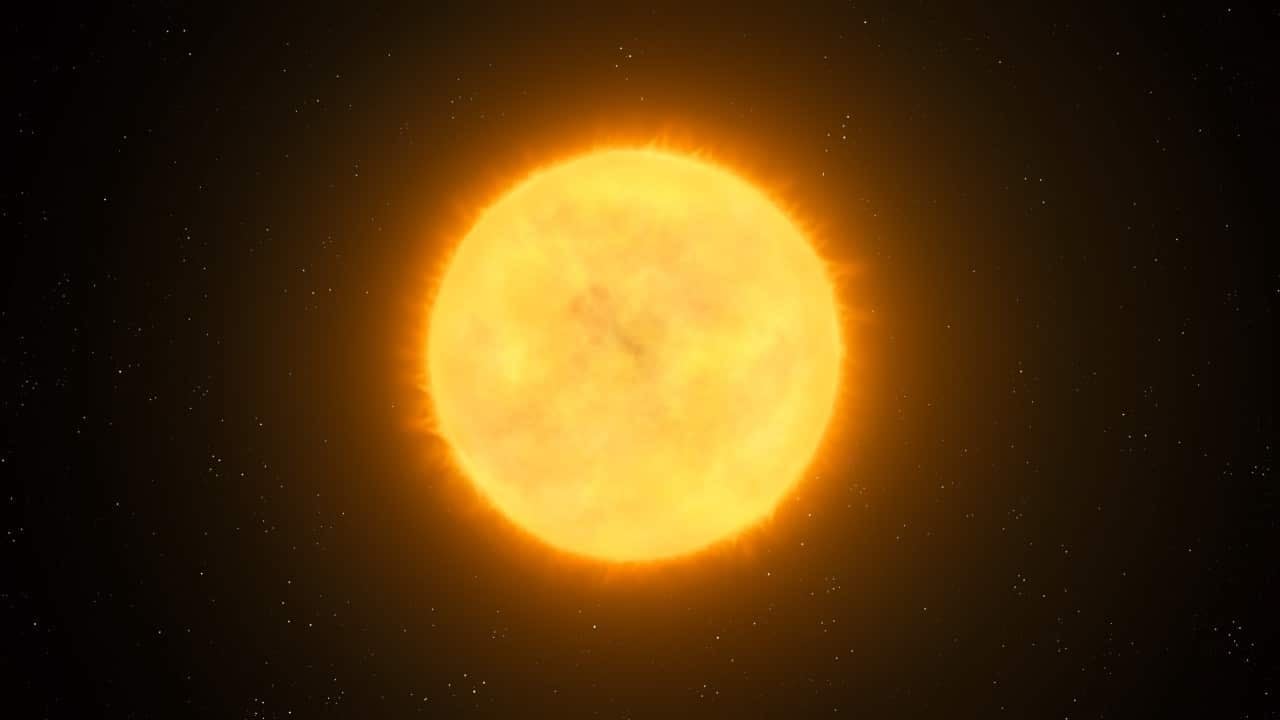
The survey required the integration of direct observations carried out in the stellar corona with remote measurements made by other missions positioned at different points of gravitational equilibrium. The results demonstrate that the structure does not have a perfect spherical shape and presents drastic changes in its morphology over time.
Dynamics of the magnetic boundary during activity cycles
Continuous monitoring over six years revealed that the average surface height of Alfvén registered an increase of approximately 30% in response to intensified stellar activity. The 11-year cycle dictates the behavior of the magnetic field, alternating between periods of calm and extreme turbulence, which directly affects the expansion of the corona and the amount of material ejected into the planetary system.
During the phases of maximum approach, the equipment recorded that the border expands and acquires a highly irregular configuration. During periods of minimal activity, the outer layer presents a more restrained and smooth appearance, but as the peak of the cycle approaches, the structure develops extensive bulges and spiky shapes that project into interplanetary space. The probe made multiple passes through these structural anomalies, providing the first in situ validation of estimates that were previously based solely on mathematical models and distant observations.
- The equipment recorded direct crossings of the surface during the most recent perihelia.
- In phases of maximum activity, the trajectory allowed deep dives below the magnetic layer.
- The two-dimensional mapping highlights a spatial architecture full of protrusions and plasma spines.
Spacecraft operations in the stellar atmosphere
The spacecraft responsible for primary data collection represents a significant technological advance in the exploration of stellar physics. Applied engineering allowed the structure to withstand extreme temperatures to get closer to the center of the system than any other machine previously built by humanity.
Equipped with sensors specialized in particle counting and analysis, the mission was able to extract essential information directly from the interior of the corona. Successive approaches ensured in situ measurement of the sub-Alfvénic region, an environment where magnetic forces still dictate the movement of ionized material.
Remote data projection methodology
The construction of the two-dimensional map required the development of a complex data scaling technique. The researchers used solar wind measurements captured at greater distances and applied algorithms to project this information back to the region close to the central star.
This mathematical projection was rigorously tested and validated by physical crossings carried out by the exploration vehicle. The overlay of theoretical information with real data collected in the coronal environment confirmed the high precision of the scaling method adopted by the astrophysics teams.
In graphical representations generated on the equatorial plane, different sets of data converged to form a cohesive image of the boundary. The exact coincidence between the curves calculated from different observation points attests to the reliability of the structural mapping.
Morphological variations in plasma structure
The surface architecture of Alfvén departs completely from the concept of a smooth and uniform sphere. Visualizations generated from data processing show a foamy appearance full of magnetic spines that stretch for thousands of kilometers.



These bulges are not static, constantly varying according to the release of energy from the stellar core. Structural dynamics evolve continuously, creating an environment of extreme geometric complexity at the edge of the atmosphere.
The detected irregularities reflect the high degree of turbulence and instabilities present in the coronal plasma. Cada mapped protrusion represents a zone of intense magnetic activity that influences the acceleration of particles towards deep space.
The confirmation of the pointed shape during stellar maximum corroborates physical theories formulated decades ago. Essa complexidade morfológica é o fator determinante para a origem de estruturas irregulares observadas no fluxo contínuo do vento solar que atinge os planetas.
Direct influence on terrestrial technological infrastructure
The detailed understanding of the surface of Alfvén has immediate practical application in formulating models of solar wind propagation through the planetary system. Precise mapping allows monitoring centers to develop more accurate forecasts about the occurrence and intensity of geomagnetic storms that reach Earth’s orbit and the planet’s surface, providing time for the adoption of safety measures.
The constant flow of highly energetic particles interacts violently with planetary magnetic fields, generating induced currents that pose a real risk to modern technology. Anticipating these events is essential for the protection of communication satellites, global navigation systems, electrical energy distribution networks and for the safety of crews on orbital space missions.
Advanced instrumentation and international collaboration
The accuracy of the mapping depended on the uninterrupted operation of instruments dedicated to measuring electrons, protons and alpha particles directly in the critical magnetic transition zone. The success of the two-dimensional survey was not limited to data from a single source, requiring broad international collaboration to integrate information collected by vehicles positioned in intermediate orbits and by satellites parked at points of gravitational balance. Essa network of space observatories allowed the monitoring of the solar wind from its turbulent origin in the corona until its arrival at the outskirts of our planet, establishing exact temporal correlations that resulted in the most complete and detailed portrait of the stellar boundary ever produced by modern science.
Continuous monitoring of the heliosphere
Corona diving operations remain underway, with trajectories scheduled to cross the magnetic boundary repeatedly over the next few months. O fluxo constante de novos dados garantirá o refinamento progressivo dos mapas bidimensionais e a futura elaboração de modelos tridimensionais que incluirão as variações de latitude.
Expanding knowledge about coronal heating
The exact delineation of the surface of Alfvén provides the necessary parameters to resolve long-standing questions about the thermodynamics of the stellar atmosphere. The mapping helps explain the mechanism by which the corona reaches temperatures millions of degrees higher than those recorded on the star’s visible surface.
The data collected in situ offers unprecedented material for the study of magnetic reconnection processes and the dissipation of plasma waves. The research consolidates theoretical models on the expansion of the heliosphere and establishes a new database for exploring particle physics in interplanetary space.
Veja Tambem em News (EN)

Research reveals that parents are unaware of how their children use artificial intelligence

Samsung releases new system update with new features for Galaxy Watch 4 users

Digital retail reduces the value of the Galaxy S25 5G smartphone with bank bonuses and device exchange

Amazon’s wireless CarPlay adapter has a 50% discount and high approval ratings from drivers

Zach Cregger’s new Resident Evil ignores games and focuses on an unprecedented story with new characters

Rumor suggests that Nintendo is preparing a special edition of the Switch 2 with a remake of Ocarina of Time

Apple accelerates production of the iPhone 17e and develops new Air model with dual camera system

Epic Games platform releases twelve high-budget games at no permanent cost for PC users

PlayStation 5 Pro price drop accelerates digital retail sales and eliminates global stocks

New Galaxy Watch 9 firmware appears on server and confirms progress in software development

Apple’s commemorative project tests cell phone with 1.1 millimeter edge and curved screen for 2027
