
Scientists record Austrian cow using a brush to scratch its body
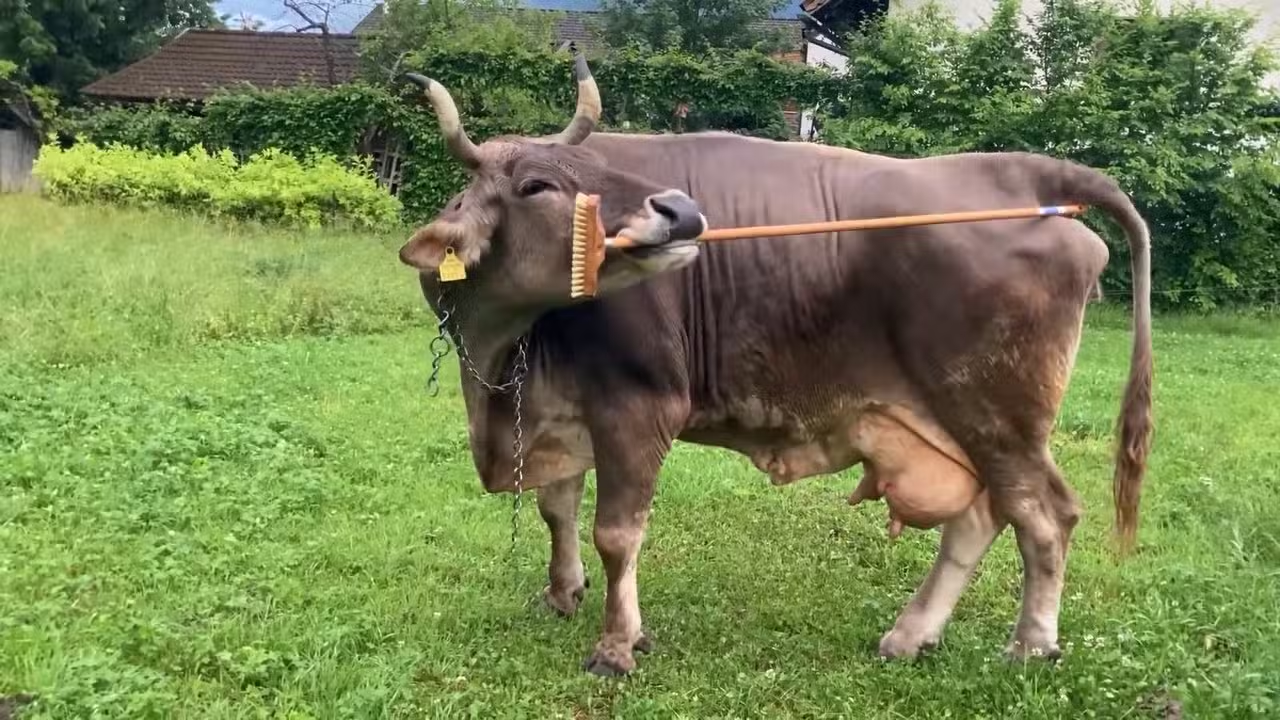
Veronika, a 13-year-old brown Swiss cow who lives as a pet in a mountain village in Áustria, has spent years developing the ability to use objects to scratch herself. Ela picks up sticks, rakes and garden brushes with his mouth and applies specific techniques to different parts of the body. The behavior was documented by scientists at Universidade of Medicina Veterinária of Viena and published in the magazine Current Biology on January 19.
The researchers highlight that this is the first scientific confirmation of the use of tools by a cow of the species Bos taurus. The observation began more than ten years ago when the owner noticed the cow picking up sticks to relieve itching. Over time, Veronika refined the method and began selecting objects based on texture and the area of the body that needed attention.
Flexible use of deck brush demonstrates intelligence
The tests carried out by the scientists involved presenting an asymmetrical deck brush to the cow. Veronika held the object by the handle or base with bristles and adjusted the orientation as necessary.
She used the side with stiff bristles to rub the back and areas with thicker skin with back and forth movements and pulling it forward. Para more delicate areas such as the belly, skin folds and the udder region, the cow preferred the smooth side of the handle, performing soft and precise touches.
This choice was not random. Análises statistics showed that Veronika used the bristle side about 2.5 times more for the upper body and the handle side predominantly for the lower parts. The interaction between the body region and the type of tool end proved to be significant in the statistical models applied.
The cows also felt picazón, like us, but Veronika decided to solve it alone… using his mouth. Científicos states that this is the first verified evidence of a cow using a tool to alleviate the sting. 🐄😮pic.twitter.com/kk2PDOQNVe
— Comunidad Biológica (@Bio_comunidad)January 20, 2026
Details of the technique reveal adaptation to the environment
The cow adjusted its grip occasionally, releasing and repositioning the brush before starting the movement. The researchers observed that the duration of itching events did not vary significantly between the ends of the tool, which indicates efficiency in execution.
Veronika also combined the use of her tongue with the tool at times. Essa combination allowed reaching difficult spots and cleaning residue at the same time. The rural environment with access to diverse natural and garden objects favored the spontaneous development of behavior over the years.
Initial Observations Led to Scientific Investigation
The cow’s owner, an organic farmer from Caríntia’s region, has followed the skill’s progress since Veronika was about three years old. Ele recorded several moments in which the cow selected sticks or garden tools for its own use.
These records caught the attention of experts in animal cognition. The team led by researchers Antonio Osuna-Mascaró and Alice Auersperg decided to carry out controlled tests to assess whether the behavior qualified as genuine tool use.



The results confirmed that Veronika not only used the object, but manipulated it in a flexible way and directed towards specific objectives. Essa flexibility has previously been recorded only in humans and chimpanzees in similar self-care contexts.
Controlled experiments confirm selectivity
During experimental sessions, brush orientation was semi-randomized to avoid bias. Mesmo thus, the cow demonstrated a clear preference for the bristle side when attacking itches on the back and for the smooth handle in sensitive areas.
The movements included lifting the tool, repositioning it and applying different pressure. Para the back, the movement of vigorous rubbing predominated. Nas lower regions, the touches were more delicate and targeted.
This differentiation by body region reinforces the idea that the cow processes information about the tool and its own body to choose the most appropriate strategy in each case.
Implications for understanding bovine cognition
The publication in Current Biology paves the way for new research on cognitive abilities in cattle. Até then, there were no documented records of tool use in this species despite ten thousand years of coexistence with humans.
Veronika lives in a pet context, without exploitation for milk or meat production, which allowed greater freedom to explore the environment and develop spontaneous behaviors. Scientists plan to continue observing the cow to better understand how these abilities emerge and improve over time.
The case highlights the importance of observing animals in environments that allow natural expression of behaviors. Estudos Futures could investigate whether other cattle in similar conditions also exhibit similar capabilities when stimulated.
- The cow has demonstrated use of multiple tools over the years, including sticks and rakes.
- Testing with the deck brush involved dozens of attempts with varying orientation.
- Statistical analyzes included chi-square tests and linear models to validate preferences.
- The behavior combines oral manipulation with precise movements and fine grip adjustments.
Veronika continues to amaze observers with her dexterity. The cow maintains the routine of selecting and using objects to relieve itching, always adapting the technique to the needs of the moment. Esse pioneering record contributes to expanding knowledge about the intelligence of production and companion animals.
Veja Tambem em News (EN)

Research reveals that parents are unaware of how their children use artificial intelligence

Samsung releases new system update with new features for Galaxy Watch 4 users

Digital retail reduces the value of the Galaxy S25 5G smartphone with bank bonuses and device exchange

Amazon’s wireless CarPlay adapter has a 50% discount and high approval ratings from drivers

Zach Cregger’s new Resident Evil ignores games and focuses on an unprecedented story with new characters

Rumor suggests that Nintendo is preparing a special edition of the Switch 2 with a remake of Ocarina of Time

Apple accelerates production of the iPhone 17e and develops new Air model with dual camera system

Epic Games platform releases twelve high-budget games at no permanent cost for PC users

PlayStation 5 Pro price drop accelerates digital retail sales and eliminates global stocks

New Galaxy Watch 9 firmware appears on server and confirms progress in software development

Apple’s commemorative project tests cell phone with 1.1 millimeter edge and curved screen for 2027
