
Solar radiation destroys crust of interstellar comet 3I/Atlas and releases rare organic compounds into space

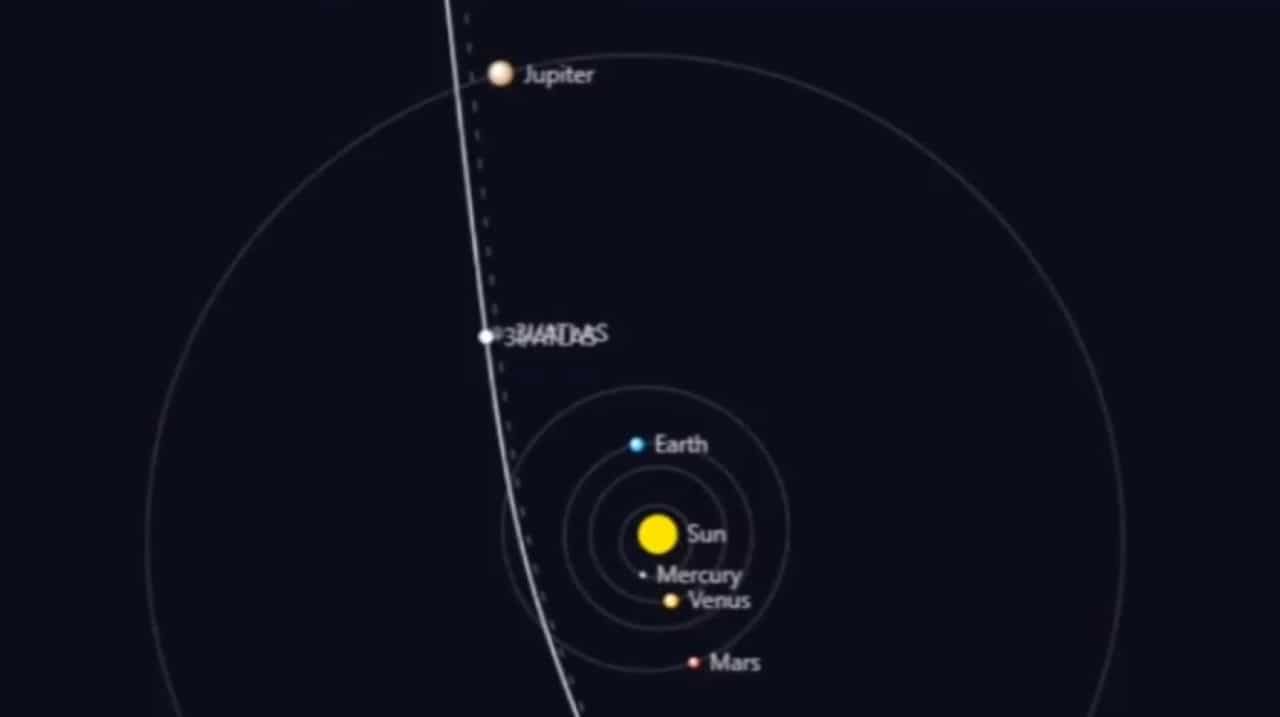
The celestial body’s passage through the inner solar system resulted in an astronomical event of great relevance to the international scientific community. Durante the closest approximation to Sol, the intense thermal exposure caused the rupture of the object’s old outer layer, triggering a series of physical and chemical reactions. Pesquisadores recorded the ejection of high-speed jets containing fundamental elements of organic chemistry, materials that had remained frozen in the deep vacuum of space for millions of years. The phenomenon offered an unprecedented opportunity for direct observation of primordial components that are rarely exposed to starlight.
Continuous monitoring of the trajectory revealed that the internal structure of the celestial body had kept substances intact since its formation. The absence of heat for most of its existence ensured that the materials did not undergo significant changes, functioning as a true chemical time capsule. The anomalous speed and inclination of the orbit confirmed the object’s external origin, differentiating it from bodies that inhabit the extremities of our own planetary system. The thermal approach acted as a catalyst, activating sublimation processes that exposed the dark, icy core to direct radiation.
🚨サークリ・ウザイリ・クイルクルユズル ☄️
Yıldızlararası kuyruklu yıldız 3I/ATLAS’ı araştıran bilim insanları onun “alkolle dolu” olduğunu söylüyor。
⚠️Atacama aktığını tespit et…pic.twitter.com/CcXfXA8URS
— 3I/ATLAS ギュンセレメレリ (@Defence12543)2026 年 3 月 13 日
Immediate spectroscopic analysis allowed the identification of complex molecules that form the basis of the formation of stellar systems. The data collected indicates that the debris cloud generated by surface fragmentation contains chemical signatures incompatible with local comets. The release of these gases and dust formed a temporary, highly luminous coma, allowing ground- and space-based observatories to capture precise details about the composition of the ejected material. The event reinforces theories about the distribution of essential elements through the interstellar medium.
The object crossed the region of rocky planets on a hyperbolic trajectory, meaning that its passage is a one-time event with no return. The interaction with the solar wind not only altered the physical morphology of the body, but also generated a tail of ions that stretched millions of kilometers into space. The observed mass loss dynamics provide crucial parameters for mathematical models that attempt to explain the durability and resistance of materials formed in extreme cold environments when subjected to sudden temperature variations.
Primordial origin and estimated age of the celestial body
Orbital calculations and light curve analysis indicate that the object’s formation occurred over a period estimated between 100 million and 120 million years ago. Esta time window suggests that the body originated in a dense molecular cloud, possibly the same one that gave rise to other stars and planetary systems in a distant region of the galaxy. The preservation of its initial structure is due to the fact that it was ejected from its original system shortly after its formation, wandering through interstellar space without the influence of significant heat sources.
The identified chemical composition acts as a direct record of the environmental conditions present during the early stages of star formation. Diferente of the asteroids and comets that have undergone multiple changes due to continuous solar radiation, this object has kept its volatile elements trapped under a rigid crust. The detection of specific isotopes helps astronomers map the differences between the chemistry of our system and that of other regions of Via Láctea, establishing a parallel about how matter is distributed and transformed in the universe.
Dynamics of fragmentation and loss of surface mass
Prolonged exposure to solar radiation during perihelion resulted in the loss of approximately 20 meters of the object’s hardened crust. The continuous sublimation process turned the ice directly into gas, creating internal pressure that fractured the rocky surface. Este phenomenon of space erosion occurred asymmetrically, depending on the angle of rotation and direct exposure to solar rays.
The rapid phase transition of the materials generated a thermal wall around the core. The ejected molecules, upon coming into contact with high-energy ultraviolet radiation, formed a dense plasma that temporarily enveloped the celestial body. Esta layer of ionized gas paradoxically acted as a partial shield, regulating the heating rate of the deeper layers and preventing total disintegration of the core.
The collapse of the external structure also changed the object’s angular momentum. The release of gas jets worked like small natural thrusters, subtly altering the rotation and original trajectory. Measuring these small orbital variations allows scientists to calculate the internal density and porosity of the material, revealing that the body has an internal structure that is much more fragile than its crust initially suggested.
Detection of chemical compounds and molecular signatures
Surface fragmentation revealed an anomalous concentration of methanol, recording levels up to four times higher than the average observed on local celestial bodies. Methanol is considered a fundamental building block for complex organic chemistry, and its presence in abundance suggests that significant chemical reactions can occur even in the freezing temperatures of dark molecular clouds.
In addition to methanol, the instruments detected the simultaneous presence of hydrogen cyanide, carbon monoxide and water in a gaseous state. The exact ratio between these elements provides clues about how far the object formed from its original star, indicating that it originated beyond the so-called snow line, where volatile compounds can condense into ice grains.
The release of these materials in a pure state allows us to test hypotheses about panspermia and the distribution of prebiotic ingredients throughout the cosmos. Embora do not represent life, the existence of such molecules in an interstellar object demonstrates that the chemical precursors necessary for the development of biological systems are common and can be transported across vast galactic distances.
Isotopic analysis of the ejected gas showed a ratio of deuterium to hydrogen that differs substantially from water found in Earth’s oceans. Este data is vital to understanding the diversity of water reservoirs in the universe and reinforces the idea that each stellar system has a unique chemical signature, shaped by the specific conditions of its primordial cloud.
Gravitational interaction and orbital acceleration
The orbital schedule indicates that on March 16, 2026, the object will pass through the vicinity of Júpiter, reaching a minimum distance of 0.358 astronomical units from the gas giant. Esta approach poses no risk of collision, but will have a profound effect on the body’s orbital mechanics, utilizing the planet’s immense gravity for a natural gravitational assistance maneuver.
Interaction with the gravitational field of Júpiter will provide the kinetic energy necessary to accelerate the object to a speed of 68 kilometers per second relative to Sol. Este thrust will ensure the ultimate escape velocity, directing the body out of the confines of the planetary system and beginning its return journey to deep interstellar space, where it will return to its state of absolute freezing.
Global astronomical monitoring effort
Observing this event required the coordination of a global network of astronomical and space infrastructure. The Telescópio Espacial James Webb was targeted to map the heat distribution and emission of dust in the infrared spectrum, revealing the texture of the coma and the size of the ejected grains. Simultaneamente, the ALMA observatory, located in the desert of Atacama, focused on detecting the cold gas molecules orbiting the nucleus, measuring the speed and density of carbon monoxide emissions. Para To complement the data, the JUICE space mission, which is en route through the solar system, had its ultraviolet spectroscopy instruments emergencyly recalibrated to capture the signature of specific ions during the object’s passage, ensuring complete spectral coverage of the phenomenon.
Return to deep vacuum
As the body moves away from the thermal influence of Sol, sublimation activity gradually ceases, and the coma of gas and dust dissipates into space. The nucleus, now with a new and slightly smaller surface configuration, resumes its state of thermal inertia, traveling towards the interstellar darkness, carrying with it the remnants of its primordial structure and the records of its brief and violent passage through our system.



