
Space telescope identifies unprecedented dust oscillation in the nucleus of interstellar comet 3I/ATLAS

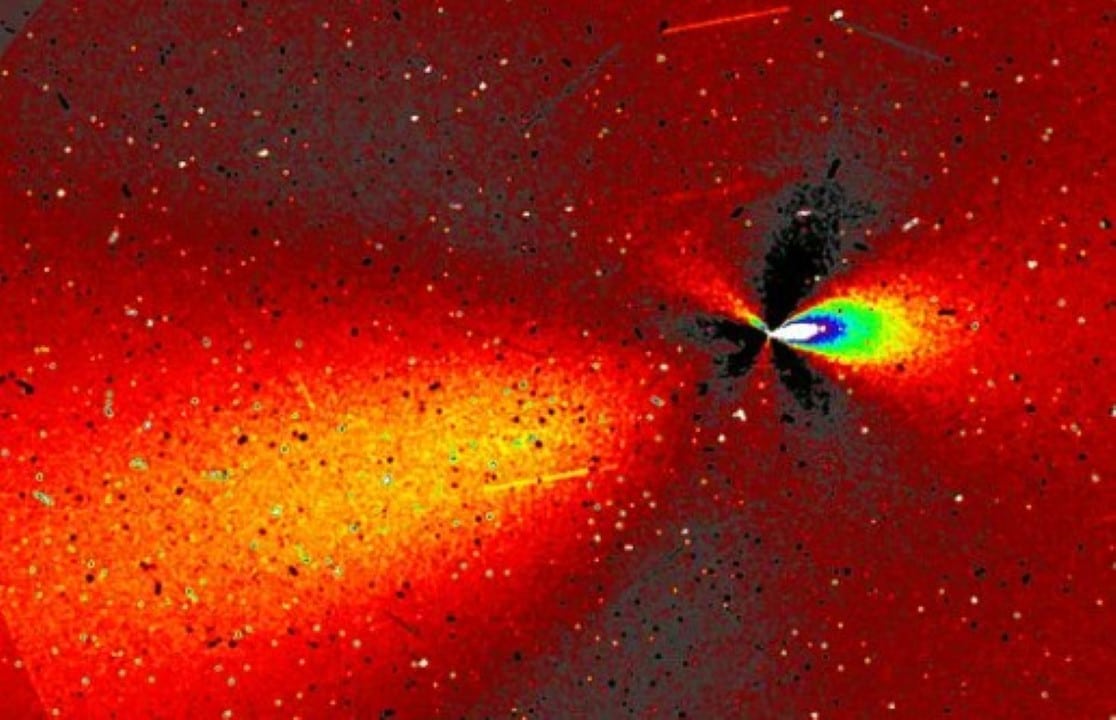
Continuous observation of celestial bodies from outside our planetary system has provided new data on the dynamics of hyperbolic objects. Imagens recent images captured by high-precision instruments in orbit have detailed the physical structure of the third interstellar visitor confirmed by astronomers.
The celestial body has a complex morphology, characterized by emissions of material that vary in intensity in a cyclical and predictable manner. Analysis of photographic captures shows that the object expels jets of dust and gas in opposite directions, with an alternation of brightness that intrigues the researchers responsible for monitoring.
🚨 ALERT: 3I/ATLAS IS SHEDDING UNUSUALLY LARGE PARTICLES 🚨
⚠️New analysis of interstellar object 3I/ATLAS (C/2025 N1) suggests something extraordinary is happening in its sunward jet — this visitor from another star system appears to be releasing particles far larger than the…pic.twitter.com/S6zVnAUKT2
— 3I/ATLAS updates (@Defence12543)December 26, 2025
The information collected helps to map the behavior of materials formed in other stellar systems when subjected to solar radiation. Constant monitoring makes it possible to calculate the rate of mass loss and the ejection speed of the particles that make up the diffuse atmosphere around the solid core.
Hyperbolic origin and trajectory of the celestial body
The initial identification of the object occurred through an asteroid impact warning system located at Chile. The extreme speed and open parabolic path immediately confirmed that the body was not gravitationally bound to Sol, attesting to its extrasolar nature.
The approach trajectory allowed ground- and space-based telescopes to prepare detailed observation campaigns before and after perihelion. The point of greatest proximity to the central star of our system occurred in October, when sublimation activity reached its maximum intensity peak.
Direct comparisons with the first two known interstellar visitors reveal that this new body exhibits much more pronounced and long-lasting cometary activity. The persistence of emissions facilitates the collection of spectroscopic and morphological data essential for understanding their origin and structural formation.
Alternation patterns in material emission
Advanced processing of images obtained by the space telescope’s wide-field camera revealed a double structure of narrow jets that dominate the comet’s coma. Photographic exposures lasting one hundred and seventy seconds, taken with specific filters, showed that one of the emissions gains luminous intensity while the other weakens simultaneously. Esse brightness anti-correlation phenomenon was recorded at different times, separated by an interval of fifteen days, ruling out the hypothesis of random dissipation or isolated explosions on the surface of the rocky, frozen core.
The regularity of this luminous variation suggests a shared and continuous physical mechanism, driven by the alternating exposure of active areas to solar radiation. Astronomers assess that the absence of chaotic changes in the structure of the jets indicates a remarkable stability in the dust emission. The maintenance of this structured pattern, even months after passing through the hottest point in the orbit, differentiates this celestial body from the majority of comets originating from Nuvem of Oort or Cinturão of
Velocity dynamics in particle ejection
Analysis of the movement of expelled material reveals significant differences depending on the size and density of the dust grains. The data indicates that the sublimation process acts as a natural engine that propels particles directly into outer space.
Instrumental measurements show that the smallest and lightest particles are ejected at a speed of approximately twenty-two meters per second. Essa rapid and constant acceleration creates the diffuse, outer part of the comet’s temporary atmosphere.
In contrast, larger, denser grains travel at a considerably slower speed, estimated to be in the range of two meters per second. Essa escape velocity difference generates a visually detectable stratification in the structure of the coma and extended tail.
The overall rate of mass loss calculated from these velocities is fully consistent with that of active comets in our own planetary system. The volume of ejected material confirms that the nucleus has a substantial reserve of volatile elements inside.
Nuclear rotation and structural oscillation
The alternating behavior of the luminous jets provides crucial clues about the rotation mechanics of the solid core, whose total diameter is estimated to be less than a kilometer. The oscillation seen in the emissions works analogously to a rotating beacon, illuminating the surrounding dust at regular, mathematically predictable intervals.
Experts point out that the consistent geometric alignment of the jets throughout all observations reinforces the theory of a stable and well-defined axis of rotation. The exact determination of the rotational period depends on the continued mapping of these brightness variations while the object remains within the visual range of the equipment.
Persistence of sun-directed extension
One of the most striking characteristics of the interstellar visitor is the maintenance of an anomalous structure that visually projects towards Sol. Essa asymmetric teardrop formation has been documented continuously since the first few months of astronomical tracking.
The persistence of this extension after perihelion indicates the presence of heavy particles that remain floating in the comet’s orbital plane. The visualization of this phenomenon strictly depends on the angle of observation of the Terra, but its prolonged duration provides important physical data on the maximum size of the ejected grains.
Chemical signatures and ultraviolet spectroscopy
The application of spectroscopy techniques in the ultraviolet range has allowed the identification of the specific gases that are sublimating from the surface of the nucleus as the object travels through space. Reading the wavelengths revealed a composition rich in primordial volatile elements, similar to those found in frozen celestial bodies in our own cosmic neighborhood. Além of the clear signature of water and carbon monoxide molecules, the analysis of the light reflected by the coma showed a very distinct reddish color. Essa specific hue is a strong indicator of the presence of complex organic compounds mixed with the continuously ejected dust. The detection of these carbon-based molecules in an object formed around another star reinforces the hypothesis that the essential chemical building blocks are widely distributed throughout the galaxy. The diffuse halo maintained by the constant ejection of material serves as a natural astrophysics laboratory, allowing instruments to measure the exact proportion of each element before they completely disperse into the vast interstellar vacuum.
Departure route and next orbital landmarks
The celestial body follows its outgoing hyperbolic trajectory, progressively moving away from the center of the planetary system towards deep space. The astronomical monitoring schedule predicts that the object will make an approach to the orbit of the planet Júpiter in March 2026, an event that closes the main detailed observation window with the current generation of telescopes.



