The global gaming community has dedicated more than 334 million hours to exploring the feudal Japão since the launch of Ubisoft’s latest stealth-action title. Official data released by the developer reveals the level of user engagement with the historical recreation of the period Sengoku. During this period of activity, the protagonists Naoe and Yasuke were responsible for eliminating more than 4 billion virtual opponents in different regions of the map. The volume of interactions reinforces the game’s stability in the digital entertainment market and the maintenance of public interest.
Exploration statistics and interactions on the Japanese map
In addition to direct combat and infiltration missions, the company’s reports indicate a high rate of engagement with peaceful elements in the scenario. Users showed particular interest in the local fauna and religious structures spread across the Asian provinces.
Server logs detail specific user behavior metrics outside of armed conflict zones, highlighting the use of open world mechanics:
- Interaction with felines: 26 million approaches and interactions recorded.
- Visits to sacred sites: 159 million shrines honored by users.
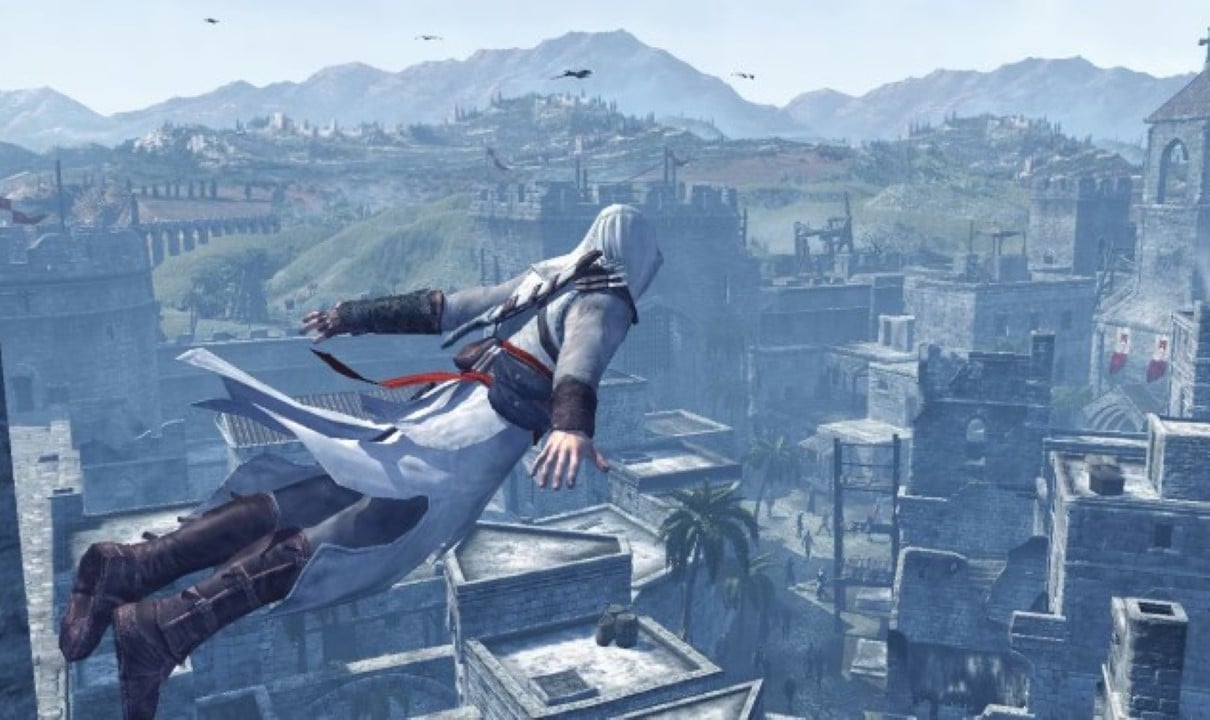
- Acrobatic maneuvers: 58 million leaps of faith performed on various structures.
This secondary animal interaction mechanic was implemented by the development team to add layers of immersion to the daily life of the recreated towns and cities. The technical objective was to make environments more reactive to the presence of avatars controlled by players.
In the cultural and vertical exploration aspect, movement through the scenarios requires constant use of topography and local architecture. The franchise’s classic maneuver continues to be widely used for quick descents from high observation points, facilitating movement.
Technological advances implemented by the development team
The project’s art director, Thierry Dansereau, detailed the technical processes necessary to build the open world. The coordination of hundreds of professionals across multiple disciplines was essential to deliver the geographic scale required by the Asian setting.
Updates to the graphics engine allowed the complete restructuring of urban and natural navigation systems. Parkour and stealth mechanics received new collision detection and command response algorithms, ensuring greater precision in the characters’ movements.
The combat system has also undergone fundamental revisions to accommodate the different styles of the two protagonists. The technology developed to manage dynamic lighting and severe weather variations established a new internal standard for the production company’s studios.
Sharing resources for future brand productions
The innovations created specifically for the setting in the period Sengoku will not be restricted to this release. The technical board of Ubisoft confirmed that the code base responsible for improvements in artificial intelligence, environment rendering and particle physics will serve as the foundation for the company’s next studios. Sharing technology between different global teams aims to optimize production time, reduce programming bottlenecks and maintain consistency in graphic quality in the brand’s subsequent releases.
This corporate strategy of unifying development tools allows smaller studios or teams focused on side projects to use dynamic weather systems, realistic cloth physics, and non-playable character behavior routines already tested on a large scale. Technological standardization significantly reduces operational costs and minimizes the occurrence of critical technical failures in the early stages of programming new entertainment software aimed at the latest hardware.
Progress of side projects and expansion of the universe
In parallel with the maintenance of current servers, the producer maintains the development of Assassin’s Creed Hexe. The new title, under the responsibility of veterans from Ubisoft Montreal, proposes a change in art direction, adopting a darker atmosphere and a structure focused strictly on narrative progression.
Another work front involves the modernization of Assassin’s Creed Black Flag. The project to recreate the game with a naval theme is in the structuring phase, with the aim of adapting the navigation and maritime combat mechanics to current technological standards in the industry.
Audiovisual adaptation in series format
The expansion of intellectual property extends to the streaming market with a live-action series financed by Netflix. Filming is currently taking place in locations that simulate the city of Roma in the year 64 AD, integrating historical facts from classical antiquity with the mythology established by electronic games.
Gameplay dynamics between stealth and frontal action
The duality of protagonists offered players different approaches to resolving conflicts in the feudal Japão. The character Naoe focuses her skills on silent infiltration and eliminations without prior detection, using the design of environments for tactical concealment.
In contrast, the samurai Yasuke features mechanics focused on direct combat and crowd control with heavy weapons. Switching between these two tactical profiles allowed the community to adapt the gameplay experience as required by each specific mission.
Maintaining long-term engagement
Player retention beyond the initial launch period represents one of the key indicators of financial and technical stability for open-world games in today’s digital entertainment market. The developer’s ongoing strategy of providing periodic updates, structural performance fixes and seasonal events has directly contributed to the accumulation of more than 334 million hours logged on global servers. The non-stop exploration of Japanese provinces is strongly encouraged by the density of secondary activities, ranging from collecting natural resources to improve military equipment to solving complex environmental puzzles in remote and mountainous areas of the map. The high volume of interactions with non-hostile elements, exemplified by the millions of sanctuaries visited and animals petted, empirically demonstrates that the user base consumes content in a comprehensive and cadenced way. Esses combined factors justify the company’s high investments in creating detailed virtual ecosystems, historically based and capable of sustaining public interest for multiple operational years.