Developer of classic The Simpsons Hit and Run details obstacles to recreating the 2003 game
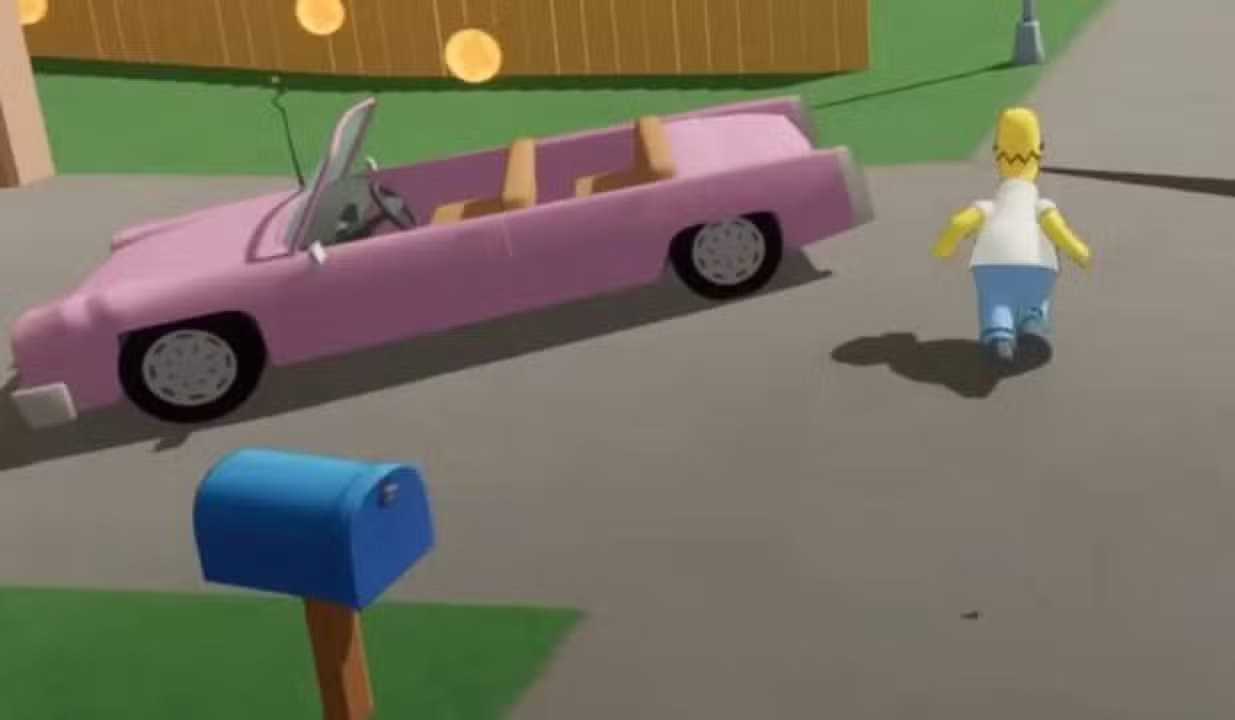
The debate over the return of the acclaimed electronic game based on the famous television animation has once again gained prominence in the digital entertainment industry. Profissionais involved in the original creation publicly addressed the challenges and possibilities of reviving the title originally launched in 2003. The discussion exposes the complex behind-the-scenes of licensing intellectual properties in the current technology market.
The work, which parodied open world mechanics popular at the time, maintains an active fan base even more than two decades after its release. The public’s continued interest contrasts with the silence of the large corporations that currently hold the rights to the brand. Fóruns online and social networks often record campaigns calling for a modernized version of entertainment software.
However, the feasibility of a relaunch comes up against a web of corporate contracts signed over the years. The transition of publishing rights between different studios and media conglomerates has created an intricate legal landscape. Especialistas point out that resolving this impasse requires an unprecedented agreement between giants in the technology and entertainment sector.
Commercial success and the scenario at the time of launch
During the early 2000s, the electronic games market was experiencing an explosion of open-world titles, driven by urban action franchises. Foi in this context that the developer Radical Entertainment, under the publication of Vivendi Universal Games, took on the task of adapting the virtual city for sixth generation consoles. The project distanced itself from the franchise’s traditional platform games to adopt a format of free exploration and motorized missions. The design decision proved to be an immediate commercial success, reaching millions of units sold globally within a few months. The title was made available simultaneously for the main hardware of the time, ensuring massive penetration in the consumer market.
The cultural impact of the software transcended the bubble of technology enthusiasts, reaching the general public that followed the animated series on television. One of the main factors for this acceptance was the direct collaboration with the program’s original writers, who guaranteed the fidelity of the humor and visual references. Além Furthermore, hiring official voice actors to record thousands of previously unreleased lines of dialogue gave the final product unprecedented authenticity. Players could explore iconic locations reproduced with three-dimensional precision, interacting with dozens of secondary characters that inhabited the virtual map. Expert critics at the time praised the way the game balanced vehicle driving mechanics with on-foot platform elements, creating a varied experience. Diferente than other licensed adaptations that often suffered from tight deadlines and poor quality, this project received adequate development and polishing time. The result was a work that not only respected the source material, but also functioned as a competent action product in its own right. Até Today, the title is frequently listed in industry publications as one of the best adaptations of a television property for interactive media.
Market analysts identify specific elements that cemented this launch’s lasting reputation in the industry. The combination of technical and creative factors set a high standard for subsequent licensed products. The main pillars of this success include:
– Fidelidade absolute to the satirical tone and visual identity of the original animation.
– Mecânicas of accessible gameplay that appealed to both casual and experienced players.
– Participação full voice cast and television writing team.
Copyright hinders development
The main barrier to any remastering project lies in the current distribution of intellectual property rights. The acquisition of major film studios by media conglomerates has drastically altered control over animation’s flagship brand. The market consolidation process transferred franchise ownership to new shareholders with strict licensing guidelines.
At the same time, the exclusive license to produce electronic games based on the franchise was acquired by a different publisher several years ago. Essa fragmentation means that any new development would require approval and negotiation of profits between multiple competing conglomerates. The lack of a clear commercial alignment prevents the start of any pre-production phase.
Recent statements from the original team
Members of the original production team and executive producers of the animated series recently expressed their desire to see the game adapted for modern platforms. Durante technology industry interviews and panels, they recognized the incessant consumer demand for an updated version of the code. The statements confirm that creative interest exists, regardless of legal barriers.
Professionals highlighted that the original source code and audio resources still exist in secure files, which would theoretically facilitate a remastering process. Preserving this fundamental data eliminates the need to recreate basic programming logic from scratch. However, they were categorical in stating that the decision to use this material is completely outside the responsibility of content creators.



Corporate bureaucracy was singled out as the ultimate obstacle, discouraging independent initiatives within development studios. The original programmers expressed frustration with how legal issues keep the product inaccessible to new generations of hardware. The consensus among developers is that only a change in the executive leadership of the companies holding the rights could change this scenario.
Movement of the gaming community
The absence of official ways to access the software has driven a strong organic mobilization on the internet over the last decade. Petições online directed to companies that hold the rights accumulate hundreds of thousands of signatures from users from different countries. The volume of engagement demonstrates a consumer market ready to purchase the product if it becomes legally available.
In addition to formal requests, independent programmers began recreating segments of the game using state-of-the-art graphics engines. Esses demo projects recreate the virtual city with high-resolution textures, realistic lighting, and enhanced physics. The volunteer work of these developers serves as a visual prototype of what a professional studio could achieve with the right budget.
Videos documenting the unofficial recreation process often go viral on sharing platforms, racking up millions of views in short periods. Engagement in these posts acts as a clear barometer of the financial potential of an official relaunch. The repercussion attracts the attention of specialized media, keeping the issue in the spotlight on technology news portals.
Corporations, however, often monitor these activities closely, often issuing legal orders to protect their intellectual properties. Essa dynamics create a continuous cycle of expectation and frustration among interactive media enthusiasts. Independent projects are often terminated before they are completed, reinforcing the need for an official commercial solution.
The role of mergers in the technology market
The legal complexity is not just limited to television brand rights, but also encompasses ownership of the original software code. The title’s original publisher went through a series of mergers and acquisitions, culminating in its absorption by an even larger conglomerate. Essa corporate trajectory obscures the chain of custody of digital assets created at the beginning of the century. Advogados specialists in software copyright point out that tracking down original distribution contracts is an extremely costly process. Documentos at the time often did not provide for digital distribution or backward compatibility on future hardware.
This phenomenon reflects a systemic problem in the technology and entertainment industry, where digital preservation is often overlooked during large financial transactions. Obras acclaimed brands end up stuck in legal limbo, unable to be legally sold in modern online stores. The retro games market suffers from the unavailability of classic titles, forcing consumers to turn to the second-hand market. The absence of specific regulations for software abandonment worsens the situation for digital archivists. Consequentemente, the preservation of the history of interactive media depends on private contractual resolutions.
Financial viability of a restoration project
From a corporate point of view, approval of a remake or remaster depends on a rigorous cost and benefit analysis. Executivos of large publishers evaluate whether the investment required to untangle legal rights will yield a greater financial return than developing an entirely new intellectual property. Atualmente, the dominant business model focuses on games as a service, which generate recurring revenue through microtransactions over years. A title focused on a single-player experience, without ongoing monetization options, represents a different financial risk from the perspective of shareholders. Além Furthermore, the costs of renegotiating contracts with unions for the use of original voices in a new commercial product can significantly inflate the initial budget. The server infrastructure and ongoing support required by modern standards also enter into this complex equation. Studios need to ensure that the network architecture supports eventual online integrations, even in traditional campaign games. Apesar Despite the evident nostalgic appeal, corporate financial spreadsheets require massive sales projections to justify the allocation of high-level development teams. Portanto, the viability of the project remains strictly conditioned to a change in the portfolio strategy of the companies involved.
Official position of the companies involved
To date, none of the corporations that hold portions of the copyright have issued official statements regarding the development of a new version of the work. Public relations departments maintain a strict policy of not commenting on rumors or unannounced projects, leaving the market to speculate about possible internal negotiations.
Consumer market expectations
The resounding success of recreations of other classic franchises from the same era demonstrates that there is a highly profitable business model for software restoration. Today’s adult consumer public has purchasing power and willingness to invest in products that recall their past entertainment experiences. Industry sales data confirms that brand familiarity reduces marketing costs.
The brand’s continued strength in global pop culture suggests that a well-executed relaunch would appeal not only to veteran gamers but also to a new audience. Resta for the market to wait and see whether corporate barriers will yield to consumer pressure and the latent commercial opportunity in the technology sector.
Veja Tambem em News (EN)

Research reveals that parents are unaware of how their children use artificial intelligence

Samsung releases new system update with new features for Galaxy Watch 4 users

Digital retail reduces the value of the Galaxy S25 5G smartphone with bank bonuses and device exchange

Amazon’s wireless CarPlay adapter has a 50% discount and high approval ratings from drivers
Zach Cregger’s new Resident Evil ignores games and focuses on an unprecedented story with new characters
Rumor suggests that Nintendo is preparing a special edition of the Switch 2 with a remake of Ocarina of Time

Apple accelerates production of the iPhone 17e and develops new Air model with dual camera system

Epic Games platform releases twelve high-budget games at no permanent cost for PC users

PlayStation 5 Pro price drop accelerates digital retail sales and eliminates global stocks

New Galaxy Watch 9 firmware appears on server and confirms progress in software development

Apple’s commemorative project tests cell phone with 1.1 millimeter edge and curved screen for 2027