
Direct images of birth planets show what the early Solar System was like according to ESO

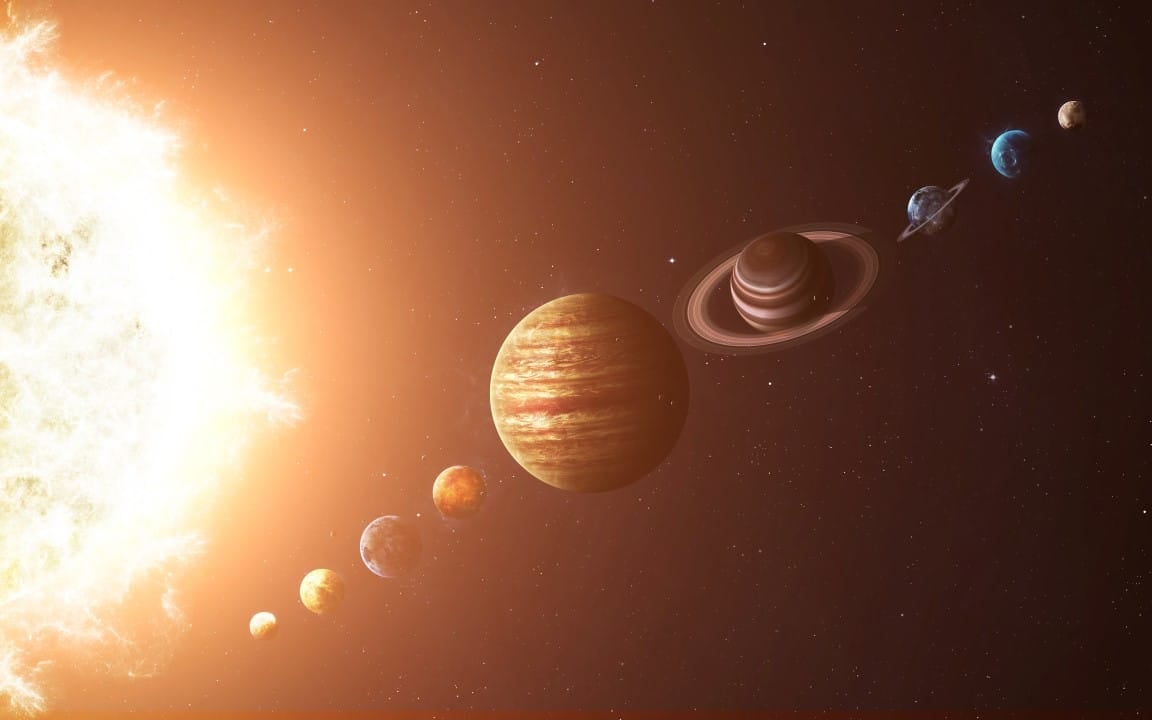
An international team of astronomers directly observed two planets forming at the same time around the young star WISPIT 2. The system features an extensive disk of gas and dust with clear rings and gaps, which matches theoretical models of the early stage of Sistema Solar. The detection occurred with instruments from Observatório Europeu to Sul to Chile and was announced in a recent scientific publication.
The researchers highlight that the observed structure provides the closest available view into the past of Sistema Solar itself. The star WISPIT 2, located in the constellation Águia, still maintains an active protoplanetary disk where material clumps together to give rise to new worlds.
- WISPIT 2b was previously detected and has a mass about five times that of Júpiter.
- It orbits the star at a distance equivalent to approximately 60 times the orbit of Terra around Sol.
- WISPIT 2c, now confirmed, has an even greater mass and is closer to the central star.
- Both are classified as gas giants, similar to Júpiter and Saturno in composition.
Details of the detection of new planets
Astronomers confirmed the existence of WISPIT 2c using two advanced instruments attached to Very Large Telescope. The SPHERE instrument captured direct images of the object, while GRAVITY+ provided data that validated its planetary nature through precise motion measurements. Sem the recent GRAVITY+ update, detection of a planet so close to the star would not have been possible with equivalent clarity.
The international team involved researchers from Universidade of Galway, in Irlanda, and from Instituto Max Planck of Física Extraterrestre, in Alemanha. Chloe Lawlor, doctoral student and lead author, led the work that made it possible to distinguish the signals of the planets amidst the turbulent disk of material.
The disk around WISPIT 2 stands out for its larger size and more defined organization compared to other previously observed systems. Anéis of dust and empty spaces indicate regions where the gravity of the protoplanets has already removed or clumped together much of the surrounding gas and dust.
Structure of the protoplanetary disk in formation
The process of planetary formation begins with dust and gas particles colliding and gradually coming together through gravitational attraction. Quando these clusters reach enough mass, they form protoplanets that continue to grow by clearing the material around them. In the case of WISPIT 2, the two planets have already created visible gaps in the disk, leaving well-defined rings of remaining material.
This configuration with multiple gaps suggests that the system is still in an active construction phase. Researchers have identified at least one additional gap further away from the star, where space is narrower and shallower. The suspicion is that a third planet, possibly with a mass similar to that of Saturno, is in the process of forming in this region.
Images captured by the VISTA telescope complement the VLT observations by showing the star field around WISPIT 2. The dataset allows the star’s position and disk structures to be accurately mapped at different wavelengths.
Comparison with the past of Sistema Solar
The WISPIT 2 system reproduces the conditions described by models of the formation of Sistema Solar around 4.5 billion years ago. Naquela time, the young Sol was surrounded by a similar disk of gas and dust that gradually transformed into the planets known today. The current observation offers a rare opportunity to study this process in real time in another star system.
Only one previous case has recorded two planets forming simultaneously, the PDS 70 system. However, WISPIT 2’s disk has superior dimensions and organization, which makes the new finding particularly valuable for understanding the complete evolution of planetary systems. The detected gas giants share characteristics with the outer planets of Sistema Solar in its early phase.
The researchers plan to continue observations with the future Extremely Large Telescope, still under construction in the Atacama desert. Esse instrument should allow for sharper direct images of the possible third planet and additional details about the movement of material in the disk.
Next steps in system investigation
Confirming more planets in formation depends on new observation sessions with high-resolution equipment. Current data already indicates that the disk continues to evolve, with the remaining material organizing itself into structures that could give rise to additional worlds. The team intends to refine the mass and orbit estimates of the objects already identified.
This discovery reinforces the role of large ground-based telescopes in studying early-stage exoplanets. The direct images obtained represent a significant advance in the ability to visualize processes that, in Sistema Solar, occurred billions of years ago without direct recording.
The results contribute to the general understanding of how planetary systems are organized based on protoplanetary disks. The simultaneous presence of two gas giants at different distances from the central star provides a natural laboratory for testing theories about planetary migration and gravitational interaction during formation.



