
James Webb Telescope discovers extreme levels of deuterium in interstellar object 3I/ATLAS

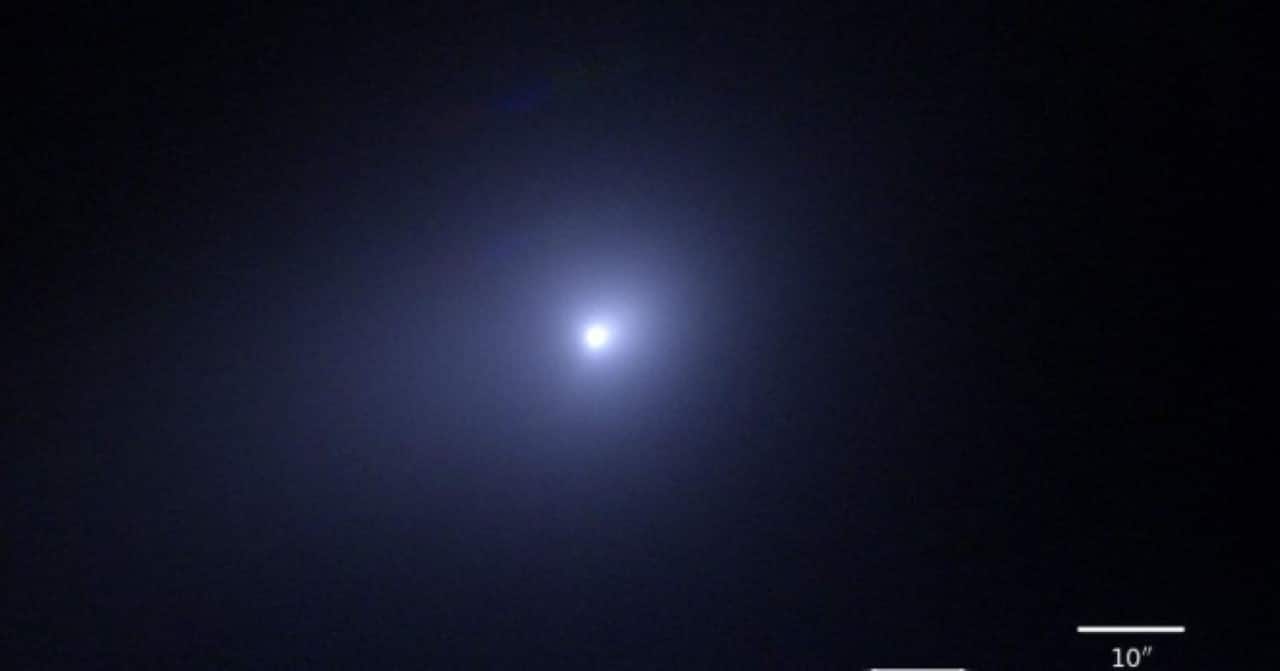
Recent data captured by Telescópio Espacial James Webb revealed an unusually high concentration of deuterium in the emissions from molecules from the interstellar object 3I/ATLAS. The discovery, conducted by two international teams of astronomers, points to proportions of deuterium in relation to hydrogen that far exceed values recorded in Sistema Solar comets. The celestial body quickly passed through the inner region of our system, allowing detailed spectroscopic observations of its chemical composition before continuing its trajectory into deep space.
The analyzes focused mainly on the methane and water emissions released by the interstellar visitor during its closest approach to Sol. Deuterium, a stable isotope of hydrogen that has an additional neutron in its nucleus, serves as a fundamental chemical tracer for understanding temperature and density conditions at planet formation sites. The abundant presence of this element suggests that the celestial body originated in an extremely cold and ancient environment, very different from the conditions that gave rise to our cosmic neighborhood.

Researchers identified unique chemical characteristics during the celestial body’s passage, including:
– Detecção of deuterated organic molecules through near-infrared spectroscopic data.
– Medições of water with isotopic enrichment orders of magnitude greater than known comets.
– Assinaturas which indicate formation in a metal-poor region at the beginning of Via Láctea.
Isotopic ratios reveal distinct formation environment
The high-precision instruments measured a deuterium-to-hydrogen ratio of approximately 0.95% in the water released by the object, a value that represents more than ten times the amount found in comets previously mapped by scientists. A second independent analysis detected an even more surprising proportion of about 3.31% in methane, a level considered extremely rare for interstellar objects. Essas chemical signatures work like a cosmic fossil, indicating that the formation of the material occurred at temperatures below 30 Kelvin, in a region of the galaxy with a low presence of heavy elements.
Models of galactic chemical evolution applied to the data suggest that the accretion of this material happened between 10 and 12 billion years ago, long before the formation of Sol itself. The international team responsible for processing this information included the participation of scientists from Goddard Space Flight Center and Jet Propulsion Laboratory, both linked to the North American space agency. The studies, which document these unprecedented ratios of carbon-12 to carbon-13 compared to nearby interstellar clouds and protoplanetary disks, were submitted to high-impact scientific journals such as Nature Astronomy and Nature.
Hypotheses about the origin of the celestial body gain new elements
The abundance of deuterium found in the ejecta results from a formation process in an ancient, icy protoplanetary disk. The research authors conclude that 3I/ATLAS formed under extreme conditions in the galaxy’s distant past, trapping heavy isotopes much more efficiently than local celestial bodies. Essa natural interpretation explains the data collected without the need to resort to artificial or anomalous processes.
Astronomer Avi Loeb, recognized in academia for exploring technological possibilities in interstellar visitors, raised questions about the recent findings. Ele highlighted that deuterium, when combined with tritium, actively participates in nuclear fusion reactions, being the basis for clean energy research at Terra. Essa peculiar characteristic motivated debates about the possibility of the element representing a technological signature.
Despite questions about the use of the isotope as a potential fusion fuel, most researchers prioritize explanations based on natural astrophysical processes. The retention of deuterated molecules in very low temperature environments is a phenomenon documented in interstellar chemistry simulations, which corroborates the thesis of a purely natural origin for the visitor.
Details of spectroscopic measurements during approach
The observations captured gas emissions around the object just as it crossed the hottest region of its orbit. The detection of deuterated molecules in methane represents an extremely rare case in the study of interstellar visitors, requiring extremely sensitive equipment. The analyzes combined data from multiple instruments aboard the space telescope to refine isotopic ratios with unprecedented precision.
The co-authors of the two scientific articles present a large overlap in their conclusions, which reinforces the consistency of the preliminary results published. Water measurements show enrichment that defies formation models of our own planetary system. Methane presents even more discrepant values in relation to the gas giant planets and icy moons already studied.
Processing the spectroscopic data required the collaboration of teams from different research institutions around the world. Separating the chemical signals in the infrared spectrum allowed us to isolate the deuterium signature from regular hydrogen emissions. Esse level of detail was only possible thanks to the privileged position of the space observatory.
The results highlight striking differences between 3I/ATLAS and the celestial bodies orbiting Sol. The extreme isotopic signatures unequivocally point to low metallicity environments and temperatures close to absolute zero. The preservation of these volatile molecules indicates that the object traveled through interstellar space without experiencing significant heating until its recent approach.
Astronomical context expands debate on external visitors
3I/ATLAS represents the third confirmed interstellar object to visit the inner solar system, following in the footsteps of its famous predecessors. Sua hyperbolic trajectory and chemical composition offer unique opportunities to study intact materials from other stellar systems. The new measurements add crucial layers of information about the chemical diversity present in ancient regions of the galaxy.
The rapid passage of the celestial body required a coordinated response from observatories to ensure data capture before it definitively moved away. The ability to analyze the composition of a fragment of another star system directly from our neighborhood transforms the way scientists understand the distribution of elements in the universe. Continuous monitoring of anomalous trajectories has proven essential to identify these rare visitors.
Abundance of isotopes and implications for planetary formation
Scientists emphasize that the formation in cold protoplanetary disks perfectly explains the retention of deuterium in molecules such as water and methane. Esse process of isotopic enrichment occurs over billions of years under very specific radiation and density conditions. The current interpretation aligns observational data with the most accepted theoretical models of galactic evolution.
The observations contribute significantly to the understanding of how primordial materials accumulate in distant star systems. The object released gases that acted as a window into the past, allowing detailed analyzes of its original chemical composition. Pesquisadores continue to process the vast volume of information collected during the passage to extract additional data.
Advances in understanding chemistry in molecular clouds
The detection of high levels of deuterium in 3I/ATLAS provides direct observational evidence about the chemical processes occurring in giant molecular clouds, the nurseries of stars. Durante the initial phases of collapse of these clouds, low temperatures favor isotopic exchange reactions where deuterium replaces normal hydrogen in molecules formed on the surface of cosmic dust grains. Quando a planetary system begins to take shape, these grains covered in deuterium-rich ice clump together to form planetesimals and comets. The fact that 3I/ATLAS presents concentrations so much higher than those of our system suggests that it formed in a molecular cloud with substantially different thermal and chemical characteristics than the primordial solar nebula. Essa chemical disparity not only confirms the object’s extrasolar origin, but also serves as a natural laboratory to test astrophysical theories about the variation of the deuterium-to-hydrogen ratio throughout the history of Via Láctea, providing a tangible link between the chemistry observed in distant regions of star formation and the physical bodies traveling through interstellar space.
Studies reinforce the need for continuous monitoring
Research teams plan additional refinements to data interpretation models to consolidate preliminary findings. The detection of deuterated organic molecules paves the way for future investigations into the complexity of interstellar chemistry. The case of 3I/ATLAS clearly illustrates the importance of keeping advanced space telescopes operational for the rapid exploration and analysis of distant objects that cross our cosmic neighborhood.




