
Japanese XRISM mission solves mystery of 50-year-old X-ray emissions from gamma star Cas

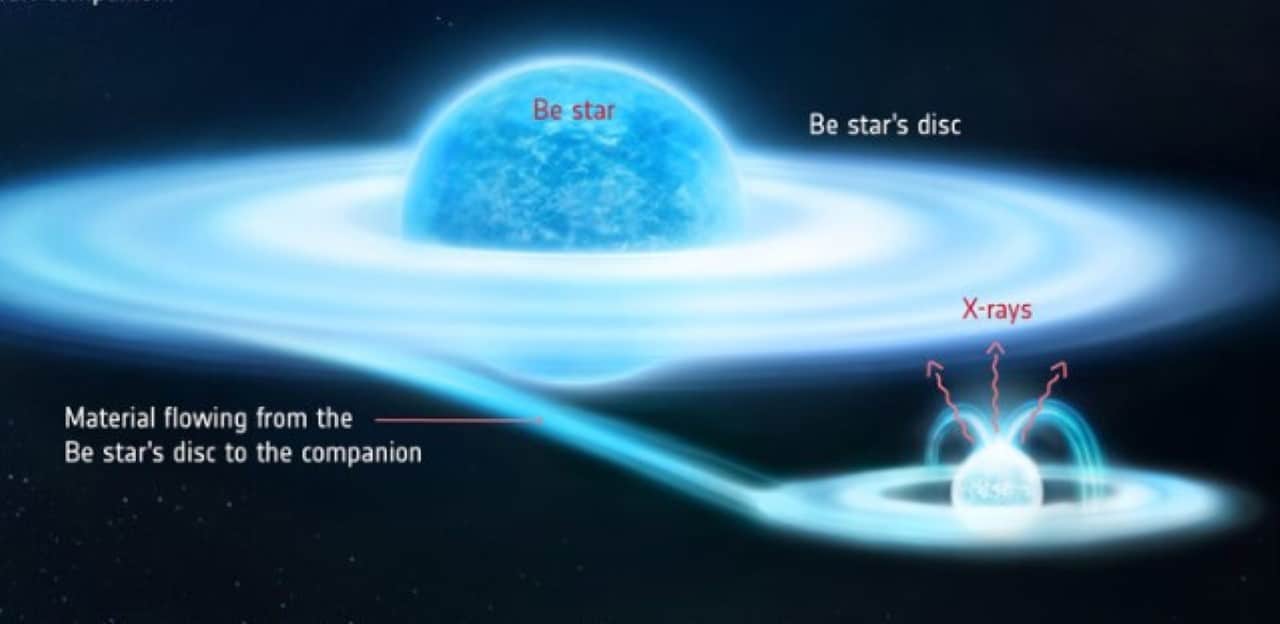
Astronomers at Universidade of Liège, at Bélgica, have identified the origin of X-ray emissions from the star γ The extreme radiation comes from a magnetic white dwarf orbiting the massive star, rather than from γ Cas itself, as some previous hypotheses have indicated.
The conclusion came from observations carried out by the Japanese space telescope XRISM, using the instrument Resolve. Essa discovery ends an astronomical enigma that has persisted since 1976 and confirms the existence of a class of binary systems that was previously only theoretical.
- The star γ Cas belongs to the type Be and is visible to the naked eye in the constellation Cassiopeia.
- It quickly ejects matter, forming a disk around it.
- Since the late 1970s, measurements have shown X-rays with an intensity about 40 times greater than expected for similar stars.
- The plasma reached temperatures above 100 million degrees with rapid variations.
High-precision xrism observations clarify enigma
The team conducted three observation campaigns between December 2024 and June 2025. Esses data covered the entire orbital period of the binary system, estimated at approximately 203 days.
The obtained spectra revealed that the signatures of the hot plasma changed speed over time. Essa variation followed the orbital motion of the compact companion, rather than that of the main Be star.
The change was recorded with high statistical reliability. Trata provides the first direct evidence that the ultrahot plasma responsible for X-rays is associated with the companion star.
Analysis of the width of the spectral lines, with velocities around 200 km/s, made it possible to rule out the scenario of a white dwarf without a significant magnetic field.
XRISM solves the 50-year mystery of a famous star 🌟
— ESA Science (@esascience)March 24, 2026
An invisible companion consuming material from the star gamma-Cas has been revealed as the culprit for curious X-rays coming from the stellar system 👉https://t.co/B3HEm2w1SY pic.twitter.com/qk1Ngzk1vv
Proposed model explains x-ray production mechanism
The star Be ejects material that forms a disk around it. Parte of this material is captured by the white dwarf, creating a second accretion disk.
The white dwarf’s magnetic field directs the flux toward the poles of the compact object. Nesse process, energy is released in the form of intense X-rays.
Part of the material flows towards the companion’s poles, where the main emission occurs. Alguns X-rays are reflected by the surface of the white dwarf.
This setup establishes a clear mechanism consistent with high-resolution observations.
Discovery confirms new class of binary stellar systems
The results validate the existence of systems composed of Be-type stars and accreting white dwarfs. The Essa population represents about 10% of the observed Be stars.
The systems are mainly associated with the most massive Be stars. Essa distribution contrasts with previous theoretical predictions that indicated a more numerous population with lower mass stars.
The discrepancy suggests the need to review binary evolution models. In particular, studies point to adjustments in the efficiency of mass transfer between components.
This review aligns with findings from several recent independent surveys on similar systems.
Spectral analysis reveals companion’s orbital motion
Data from the Resolve instrument made it possible to measure spectral variations with unprecedented precision. The three observations spread over six months were decisive for the result.
The hot plasma signature followed the white dwarf’s motion throughout the entire orbital period. Essa orbital correlation eliminated hypotheses that attributed the emission directly to the star Be or its disk.
The team ruled out alternative scenarios, such as local magnetic reconnection on the star’s surface or the presence of a neutron star. The magnetic white dwarf model proved to be the most compatible with all the evidence collected.
This approach confirms that the compact object is small, dense and equipped with a magnetic field capable of channeling the accreting material.
Implications for the study of massive binary systems
The star γ Cas forms the central tip of the constellation Cassiopeia, with a characteristic “W” shape. Ela is located about 550 light years from Terra and rotates rapidly, which contributes to the formation of the disk of matter.
Observers in the Northern Hemisphere can see it with the naked eye on clear nights. Pequenos telescopes reveal variations in their brightness caused by the ejection of material.
Understanding these binary systems helps to study phenomena such as the emission of gravitational waves at the end of the lives of massive stars. The discovery opens avenues to investigate other analogues of γ Cas identified over the decades.
Around 20 similar objects have already been catalogued, and now astronomers have a tested model to analyze them with greater precision.
Technical details of the Resol instrument contribute to advancement
The high-precision microcalorimeter on board XRISM analyzed X-ray spectra in unprecedented detail. Essa capability allowed it to distinguish subtle orbital movements that had eluded previous observations.
Observation campaigns were designed to capture different phases of the 203-day cycle. The combined results provided consistent evidence across the entire period.
The research was published in the magazine Astronomy & Astrophysics this Tuesday. Ela represents a milestone in high-energy astrophysics and demonstrates the potential of XRISM to solve long-standing puzzles.
The star γ Cas continues to be a popular target for amateur and professional astronomers due to its visibility and the dynamic behavior of the system.



