
NASA monitors asteroid 2026 FM3 that crosses close to Earth in a few hours
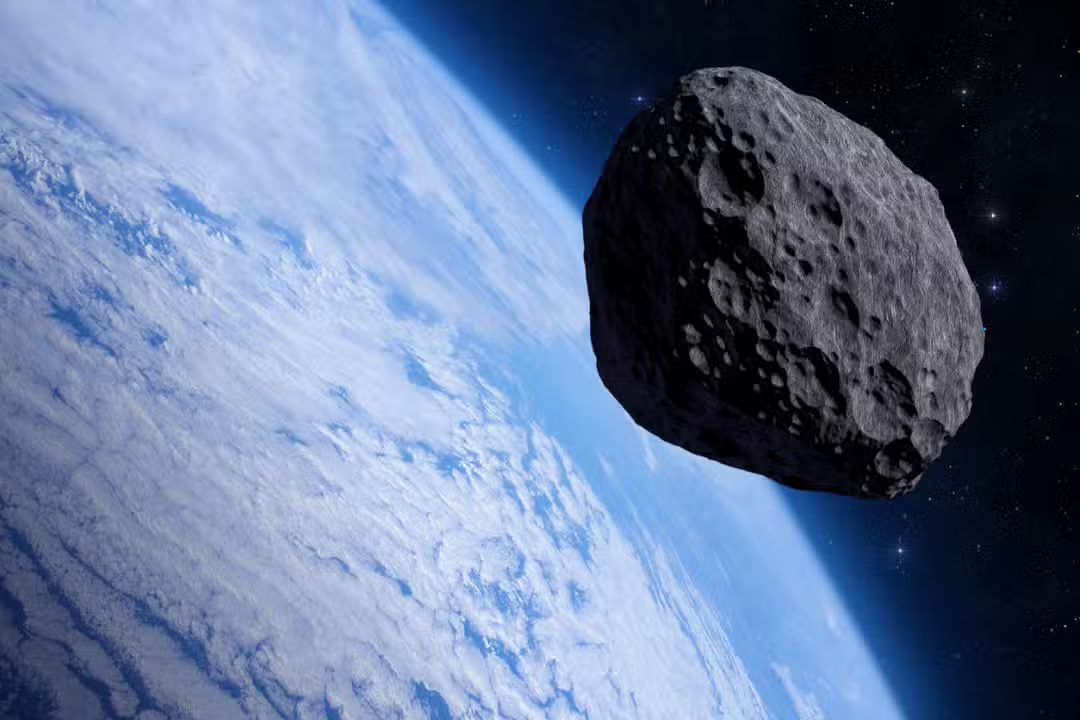
An asteroid with an estimated diameter of between four and eight meters, equivalent to the size of a small car, makes a safe approach to Terra this evening. The space object designated 2026 FM3 was detected just three days earlier by the Zwicky Transient Facility, installed on the Observatório Palomar, on the Califórnia. The passage takes place at a distance of approximately 237,918 kilometers from the planet’s southern hemisphere, which represents around 61.9% of the average distance between Terra and Lua.
NASA experts confirm that the asteroid does not pose any risk of impact. The closest meeting is scheduled to take place at around 11:07 pm, Brasília time, on March 24th. The celestial body travels at a relative speed of 18,444 kilometers per hour during the trajectory that takes it to cross Earth’s orbit.
- Discovered on March 21st by Zwicky Transient Facility
- Estimated size between 4 and 8 meters in diameter
- Speed of 18,444 km/h on approach
- Minimum distance of 237,918 km from the southern hemisphere
Details of the trajectory of asteroid 2026 FM3
The asteroid travels in an almost circular orbit around Sol with a period of approximately 354 days. Essa configuration causes it to cross the orbit of Terra on two occasions throughout each cycle. The closest approach recorded to date occurred in September 1965, when the object passed just 49,181 kilometers from the planet.
More recent observations indicate that 2026 FM3 will not repeat such a close approach within the next hundred years. The small size also excludes it from the list of potentially dangerous asteroids maintained by NASA’s Centro to Estudos to Objetos Próximos to Terra. Pouco more than three hours after passing through Terra, the asteroid flies by Lua at a distance of 595,492 kilometers.
Orbital monitoring and characteristics
Astronomers continue to refine data about 2026 FM3’s orbit with new observations. The rapid discovery demonstrates the efficiency of automated sky scanning systems, which identify nearby objects even just a few days in advance. The asteroid does not raise concerns for planetary security due to its limited dimensions.
The Earth’s atmosphere acts as a natural barrier against small fragments like this. Quando these smaller bodies enter the gaseous layer, they usually disintegrate and produce brief luminous trails known as meteors. Eventos more intense ones, like fireballs, occasionally occur with larger fragments, but 2026 FM3 follows a trajectory that keeps it well away from any collision.
Context of asteroids close to Terra
More than 41 thousand asteroids close to Terra have already been cataloged by space agencies. Esse number tends to grow significantly with the operation of new large telescopes, such as the Observatório Vera Rubin, which has already identified thousands of unknown objects in its first analyses. The case of 2026 FM3 exemplifies the continuous monitoring routine carried out by international networks.
Detection systems allow small objects to be located shortly before passing. In the current case, the identification occurred just three days in advance, which still allowed the precise calculation of the trajectory. Especialistas reinforce that approaches like this happen frequently, but most go unnoticed without causing any effect on the planet.



Passage through Lua and absence of threat
After the closest point to Terra, the asteroid heads towards Lua. The lunar distance recorded during the flyby confirms that there is no risk to the natural satellite. Todo the event takes place without any possibility of impact with the Earth or lunar surface.
Monitoring continues with updated data sent by observatories around the world. NASA’s combination of ground-based telescopes and orbital information ensures that any changes in trajectory are detected early enough. Até at the moment, all measurements point to a routine and inconsequential passage.
Importance of tracking spatial objects
Programs dedicated to the study of nearby asteroids contribute to the general understanding of the solar system. Cada new discovery adds information about the distribution and behavior of these celestial bodies. 2026 FM3, despite its modest size, is part of the dataset that helps scientists model future risks more accurately.
Early detection, even of small objects, demonstrates the technological advances of recent years. Redes like Zwicky Transient Facility operate continuously and process large volumes of images every night. Esse collective effort allows the scientific community to keep the catalog of objects that cross the vicinity of Terra updated.
Updates on today’s event
Teams of astronomers monitor the approach data in real time. The calculated speed and distance remain consistent with initial projections. Não there are signs of any deviation that could alter the scenario of safe passage.
The interested public can follow official information through scientific dissemination channels. The event serves as a reminder of the constant activity in space near Terra, where small asteroids regularly perform flybys without posing any danger. Observations continue until the object moves far enough away that monitoring is reduced.
Veja Tambem em News (EN)

Research reveals that parents are unaware of how their children use artificial intelligence

Samsung releases new system update with new features for Galaxy Watch 4 users

Digital retail reduces the value of the Galaxy S25 5G smartphone with bank bonuses and device exchange

Amazon’s wireless CarPlay adapter has a 50% discount and high approval ratings from drivers

Zach Cregger’s new Resident Evil ignores games and focuses on an unprecedented story with new characters

Rumor suggests that Nintendo is preparing a special edition of the Switch 2 with a remake of Ocarina of Time

Apple accelerates production of the iPhone 17e and develops new Air model with dual camera system

Epic Games platform releases twelve high-budget games at no permanent cost for PC users

PlayStation 5 Pro price drop accelerates digital retail sales and eliminates global stocks

New Galaxy Watch 9 firmware appears on server and confirms progress in software development

Apple’s commemorative project tests cell phone with 1.1 millimeter edge and curved screen for 2027
