
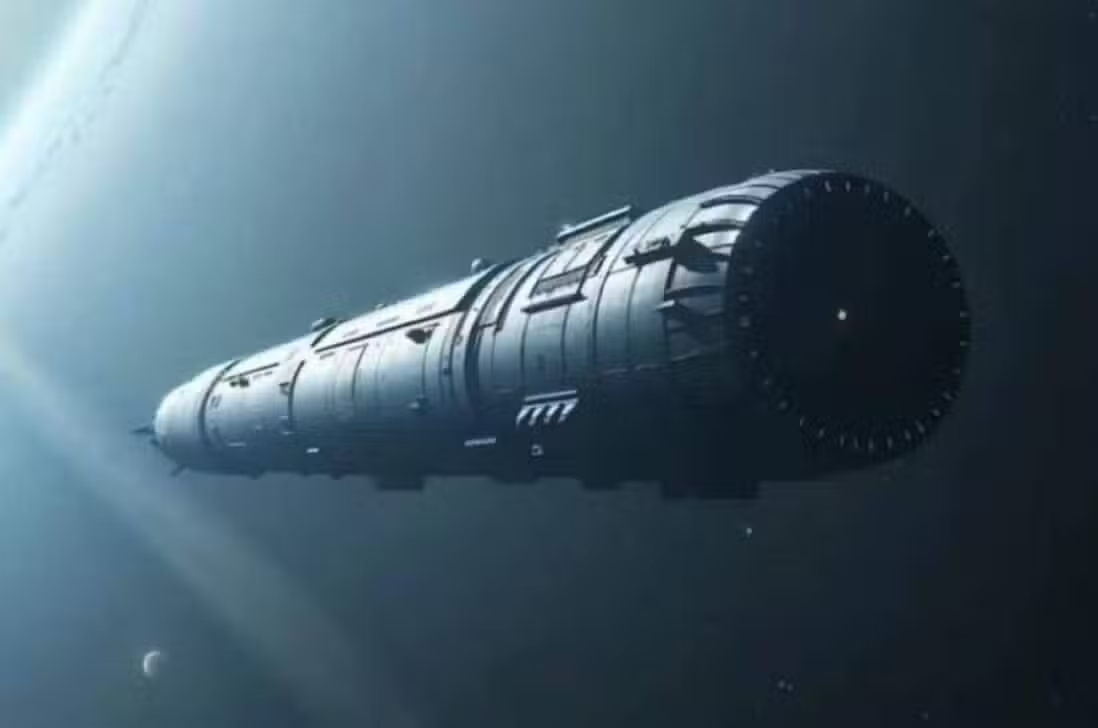
The Chrysalis spacecraft represents one of the most detailed concepts ever developed for crewed interstellar travel. The project, winner of the Project Hyperion competition organized by Initiative for
The final destination is the exoplanet Proxima Centauri b, considered one of the closest and most promising candidates for possible human colonization outside of Sistema Solar. The mission is unidirectional and involves multiple generations who would be born, live and die aboard the ship before arrival.
- The ship uses propulsion based on nuclear fusion with deuterium and helium-3.
- Rotating concentric modules generate artificial gravity equivalent to 0.1 g.
- Layered design protects against radiation and micrometeoroids.
- In-situ manufacturing systems allow for repairs and expansion on the fly.
The concept draws from current or near-development technologies, such as direct fusion engines and self-sustaining habitats inspired by space colony projects.
Modular structure of the ship Chrysalis
The Chrysalis adopts a cigar shape with several concentric cylinders that function like Russian shells. Cada layer fulfills specific functions, from external protection to internal habitats. Essa configuration reduces structural stresses during acceleration and deceleration and facilitates maintenance over centuries.
Rotating modules create artificial gravity by centrifugation. The initial acceleration takes about a year to reach cruising speed. Depois After this, the ship continues on a constant trajectory until it begins a braking maneuver close to the destination.
The estimated total mass reaches 2.4 billion metric tons. Construction would involve assembly in Earth or lunar orbit with materials processed in space.
https://twitter.com/defrevista/status/1955932411247911241?ref_src=twsrc%5EtfwLife on board through generations
Internally, the ship operates as a self-sufficient city with residential, agricultural, industrial and community sectors. Áreas greens simulate terrestrial biomes, including tropical forests, parks and lakes, ensuring continuous production of food and oxygen for multiple generations.
Schools, libraries, galleries and collective spaces promote education and psychological well-being. Governance includes artificial intelligence systems that assist in decision-making and preserving knowledge accumulated throughout the trip.
The initial population of up to 2,400 people is managed to maintain demographic balance. Estruturas horizontal and shared families replace traditional models, encouraging cooperation in an environment of limited resources.
Why Proxima Centauri b as destination
Proxima Centauri b orbits in the habitable zone of the star Proxima Centauri, about 4.24 light-years from Terra. The rocky planet has a mass similar to that of Terra and conditions that could allow liquid water to exist on the surface.
The relative proximity makes travel more feasible compared to more distant star systems. Especialistas point to the exoplanet as one of the priority targets for future exploration due to its location in the Alpha Centauri system.
Observations indicate that the planet completes an orbit in just 11 Earth days. Apesar challenges such as intense stellar flares, the site offers unique opportunities for study and possible human settlement.
Technological challenges of the interstellar mission
Sustainable energy generation for centuries requires reliable fusion reactors and robust storage systems. The durability of materials against cosmic radiation and impacts represents another critical point in the project.
Manufacturing in space allows you to manufacture replacement parts while traveling, reducing dependence on initial supplies. Preparação of the crew in isolated environments, such as stations on Antártida, tests social and psychological aspects of prolonged coexistence.
The ship incorporates robots and artificial intelligence agents that share tasks with humans. Essa integration seeks to maintain operational stability and transfer knowledge between generations without significant loss of information.
Social aspects and crew preparation
The design considers not only physical engineering but also human dynamics in a confined environment for centuries. Treinamentos previews simulate conditions of extreme isolation to prepare participants and their families.
Governance and decision-making systems involve AI contributions to resolve conflicts and optimize resources. Cultural and scientific preservation receives special attention so that descendants maintain a connection with their terrestrial origin.
The Chrysalis is not just a transport vehicle, but a complete ecosystem where human life develops independently. The concept integrates architecture, engineering, biology and social sciences to enable the mission.
Proposed advances in propulsion and protection
Nuclear fusion propulsion with deuterium and helium-3 allows gradual acceleration to interstellar speeds. The system combines energy efficiency with the potential for continuous operation for decades.
The ship’s outer layers act as shields against radiation and particles. Materiais Advanced and modular designs minimize cumulative damage over the 400-year journey.
The final slowdown, also lasting about a year, positions the ship to transfer colonists to the exoplanet. Veículos assistants disembark on the surface of Proxima Centauri b.
Competition Details Project Hyperion
The competition brought together international teams of architects, engineers, astrophysicists and specialists in human sciences. The Chrysalis project, developed by an Italian team, stood out for its systemic coherence and depth of technical and social details.
Other finalist proposals explored different configurations, but Chrysalis stood out for its integration of modular habitats and focus on long-term sustainability. The results were announced in 2025, reinforcing discussions about the feasibility of manned interstellar travel.
The concept serves as a reference for future studies on ship generation, even though actual implementation still requires significant advances in several technological areas.
Perspectives for exploration beyond Sistema Solar
Chrysalis demonstrates how concepts based on proximal technologies can address multigenerational travel challenges. The project stimulates debates about sustainability, governance and human survival in extreme environments.
Experts continue to analyze data about Proxima Centauri b to refine habitability models. Missões preliminary robotics may precede any manned effort toward the neighboring system.
The development of resistant materials and self-sufficient life support systems advances in parallel with research into nuclear fusion. Esses elements form the basis for future interstellar exploration initiatives.
The 58 km spacecraft Chrysalis will take 2400 people to Proxima Centauri b on a 400-year journey. The winning design combines modular engineering with social planning to sustain human life for centuries in deep space.